








The Things We Inherit Without Ever Being Given Them
Culture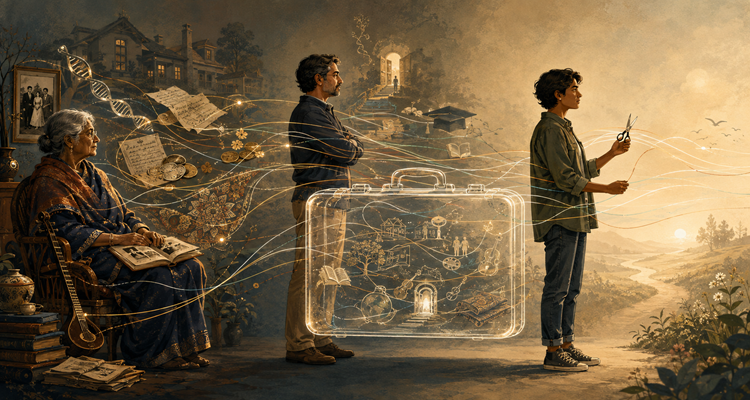
Some of the most influential things in a person’s life never arrive as gifts.
They are already there.
A language learned before we can remember learning it. A family’s relationship with money. Expectations about education, work, marriage or success. A neighborhood, a social position, a set of opportunities. Even certain biological characteristics can arrive through inheritance without anyone consciously deciding to pass them on.
Inheritance, in other words, is much larger than property.
Science gives us one form of inheritance through genes. Society gives us another through culture, education and social position. Families transmit habits, knowledge and expectations through ordinary daily life. And research continues to examine whether some biological effects of environmental exposure can persist across generations, although the evidence in humans remains limited and debated.
The important point is that these different forms of inheritance do not operate independently. They overlap, reinforce one another and help shape the starting conditions from which people make their own choices.
Key Takeaways
- We inherit far more than genes or property; culture, knowledge, expectations and social circumstances can also cross generations.
- Family background can influence education and economic outcomes even when no physical asset changes hands.
- Language and cultural habits are learned socially, making them inherited in practice rather than biologically encoded.
- Genetic inheritance influences traits, but heritability does not mean a trait is predetermined by genes.
- Claims about trauma or environmental experiences being biologically inherited require more caution than popular explanations often suggest.
- Understanding inherited advantages and disadvantages can make individual choices easier to interpret without reducing people to their background.
Inheritance Is Bigger Than Biology
In everyday language, inheritance usually means something concrete: money, land, a house, jewelry or another possession transferred after someone dies.
Biology uses the word differently. Genes are passed from parents to children, and genetic variants can influence physical characteristics and susceptibility to particular conditions. But genetics does not mean that every family resemblance is genetically programmed.
MedlinePlus makes an important distinction between heritability and being familial. A trait can appear frequently within a family because relatives share genes, but it can also be shared because they live in similar environments and develop similar habits. Heritability itself is a population-level statistical measure, not a percentage of an individual person’s identity that is “caused by genes.”
That distinction matters because it changes how we understand the word inherit.
A child may inherit a genetic variant. But the child may also inherit a household vocabulary, a way of handling conflict, familiarity with books, expectations about education, knowledge about navigating institutions and assumptions about what kind of life is possible.
None of those things needs to be formally handed over.
They are absorbed.
We Learn the World Before We Learn to Question It
Culture is one of humanity’s most powerful inheritance systems.
Researchers describe cultural transmission as the movement of information between people through mechanisms such as imitation, teaching and language. Unlike genetic inheritance, it does not require biological parenthood. Information can move vertically between generations, horizontally among peers or through other social relationships.
This is why children do not simply inherit the language spoken by their parents in a metaphorical sense. They actually acquire it through social learning.
The same basic process applies to thousands of less obvious things: how food is prepared, what counts as polite behavior, which careers seem respectable, how elders are treated, what stories are repeated at family gatherings and which historical events are remembered.
Culture can therefore behave like an inheritance without behaving like DNA.
One generation receives a collection of practices and assumptions, modifies some of them and passes others forward. Research into cultural evolution describes this as a cumulative process in which people can build on information developed by earlier generations rather than rediscovering everything independently.
That is an enormous advantage.
It is also a source of blind spots.
A tradition can contain accumulated knowledge, but the fact that something survived from the past does not automatically mean it remains useful in the present.
Education Can Be Inherited Without a Certificate
One of the less visible forms of inheritance is educational advantage.
A parent does not need to hand a child a university degree for education to influence the child’s future. The transmission can happen through expectations, familiarity with institutions, access to information, encouragement, networks and the probability that higher education is seen as a normal destination rather than an unfamiliar one.
Recent OECD data show substantial intergenerational persistence in educational attainment. Across OECD countries covered by its latest analysis, young adults with at least one tertiary-educated parent are significantly more likely to attain tertiary education themselves. The OECD’s 2025 education data put the average likelihood at around 70%.
That does not mean parents determine their children’s education.
It means starting positions differ.
The distinction is important. A person’s achievement can be entirely real while still being influenced by circumstances that existed before that person had any control over them.
The same principle appears in employment and earnings. The OECD’s 2026 analysis of intergenerational social mobility found persistent relationships between parental education and children’s educational and economic outcomes across the countries studied, although the strength of those relationships varies considerably.
Education is therefore not merely something an individual earns.
It can also be part of the environment an individual inherits.
Money Is the Most Visible Version of an Invisible Advantage
Financial inheritance is easier to see because it can be measured.
A house can be transferred. A bank account can be transferred. Shares can be transferred. A down payment can be provided to a young adult before they begin building wealth themselves.
But money can also create advantages before formal inheritance occurs.
A financially secure family may be able to provide better housing, educational opportunities, financial assistance or the ability to take risks that would be impossible for someone without that safety net.
OECD research has found that wealth transfers are unevenly distributed, with wealthier households generally more likely to receive inheritances or substantial gifts and to receive larger transfers. Its research also notes that inheritances and gifts can contribute to the persistence of wealth across generations.
This makes inheritance more complicated than the moment when an estate is divided.
The real transfer may begin decades earlier.
It can look like tuition support, help buying a first home, unpaid assistance in a family business or simply the ability to survive a financial setback without losing everything.
The recipient may experience these as ordinary family support.
Economically, they can also function as inherited advantages.
Some Families Pass Down Expectations More Than Assets
Perhaps the hardest inheritance to notice is an expectation.
A child may grow up hearing that education matters, that starting a business is possible, that certain professions are respectable or that financial security should always come before personal interest.
Another child may grow up with very different assumptions.
Neither family needs to announce these rules.
Children learn them through observation.
This is where cultural inheritance and socioeconomic inheritance intersect. Research on cultural transmission shows that humans acquire information through observing others, imitating them and learning from socially important models.
A parent’s behavior can therefore become part of a child’s mental map of what is normal.
That does not make the map permanent.
People revise inherited assumptions throughout their lives. Education, friendships, migration, technology, work and exposure to different communities can introduce competing models.
But the first map still matters because it determines what feels familiar before anything is consciously questioned.
What About Trauma and Epigenetics?
This is where the conversation needs restraint.
It is tempting to explain difficult family patterns by saying that experiences such as trauma are biologically “passed down.” There is legitimate scientific research into intergenerational effects, including studies of parental adverse childhood experiences and later child outcomes.
A recent systematic review and meta-analysis found associations between parental adverse childhood experiences and some child outcomes, while also emphasizing that the effects are not universal and that more research is needed to understand the mechanisms involved.
Epigenetics adds another layer of scientific interest. Researchers have identified mechanisms through which chemical and regulatory changes can influence gene expression without changing the underlying DNA sequence. Evidence for transgenerational epigenetic inheritance is strong in some organisms, but its importance in humans remains much less certain.
A 2018 review noted that evidence for epigenetic inheritance in human populations was sparse, while a 2022 Nature Reviews Genetics review described substantial progress alongside important differences between organisms and limitations in mammals.
That distinction prevents a seductive but unsupported conclusion:
A parent’s experience does not automatically become a child’s biological destiny.
Intergenerational patterns can arise through many pathways, including parenting, environment, socioeconomic circumstances, behavior and culture. Separating these mechanisms is scientifically important because they imply very different possibilities for change.
Inheritance Does Not Mean Destiny
Perhaps the most useful way to think about inherited circumstances is not as a sentence, but as a starting position.
Genes influence possibilities without dictating every outcome. Family wealth can create opportunities without guaranteeing success. Cultural traditions can provide knowledge without requiring permanent loyalty. Parental expectations can shape choices without making those choices inevitable.
Even social mobility research demonstrates movement as well as persistence.
The OECD’s recent work finds that parental background continues to matter across many dimensions, but it also shows that education and skills can weaken some of the relationship between parental circumstances and children’s outcomes.
That is a crucial distinction.
If everything inherited were destiny, effort and institutions would matter very little.
They clearly do.
The more accurate picture is that people begin from unequal and different positions, then interact with opportunities, constraints, institutions, relationships and their own decisions.
The Things We Choose to Pass Forward
Every generation is both recipient and transmitter.
We receive language and decide which words to keep. We inherit traditions and decide which ones still make sense. We grow up around attitudes toward money, work and education and eventually decide whether to reproduce them.
Some inherited things are valuable precisely because they survived: knowledge, skills, stories, practical wisdom and cultural memory.
Others may persist simply because nobody stopped to question them.
That is why inheritance should not be understood only as something we receive.
It is also something we edit.
The most consequential inheritance may be the one that never arrives in a box, bank account or legal document. It is the collection of assumptions, abilities, opportunities, constraints and memories that quietly shape what seems possible before we have learned to ask why.
Recognizing those invisible inheritances does not diminish individual responsibility. It makes responsibility more precise.
We cannot choose every condition we begin with.
But we can become more conscious of what we received, decide what deserves to continue, and make different things easier for the people who come after us.
The views and opinions expressed in this article are those of the author and are intended for informational and educational purposes only. While every effort is made to ensure accuracy, Wiobs does not guarantee the completeness, reliability, or timeliness of the information presented. Readers are encouraged to verify facts independently and use their own judgment before making decisions based on this content.
Stay Connected with Wiobs
Explore more insights on technology, artificial intelligence, science, business, and innovation. Follow Wiobs and never miss an update.