









Kargil War 1999: The Intelligence Failure, High-Altitude Battle and Diplomatic Turning Point That Shaped Modern India
History & Legacy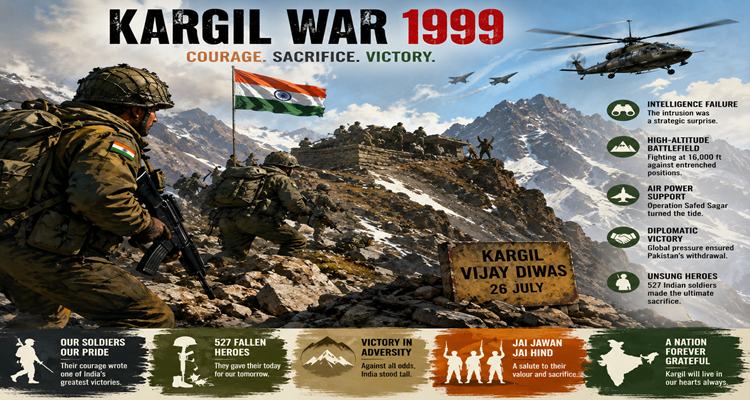
The Kargil War is often remembered through images of soldiers scaling near-vertical mountains, the capture of Tiger Hill, and the sacrifice of officers such as Vikram Batra. But reducing the conflict to battlefield heroism leaves out one of its most consequential lessons.
Kargil was also a war of surprise, intelligence, logistics, air power, diplomacy and nuclear-era restraint.
The first confirmed reports of an intrusion reached Indian authorities on May 3, 1999. Within weeks, India was fighting an enemy that had occupied tactically important heights along the Line of Control (LoC), forcing troops to attack uphill against fortified positions. The conflict eventually ended with the withdrawal of Pakistani forces and the formal declaration of the end of operations on July 26. India lost hundreds of soldiers, while the conflict exposed serious weaknesses in intelligence collection and coordination.
Twenty-seven years later, the most useful way to understand Kargil is not simply to revisit who captured which peak. It is to ask a harder question: How did a major military intrusion become possible in the first place, and what did India change afterward?
Key Takeaways
- The Kargil intrusion was a major intelligence and surveillance surprise for India, according to the Kargil Review Committee.
- India’s battlefield advantage was initially offset by the attackers’ control of high ground and the extreme Himalayan environment.
- The Indian Air Force’s Operation Safed Sagar added critical air power while India deliberately kept operations on its side of the LoC.
- The conflict demonstrated how a conventional war could become an international crisis between two newly nuclear-armed states.
- Kargil’s lasting legacy lies as much in reforms to India’s security system as in the military victory itself.
Kargil Was a War India Did Not Expect
The most revealing document for understanding Kargil is not a battlefield memoir. It is the Kargil Review Committee report.
The committee was established after the conflict to examine how the intrusion occurred and recommend measures to prevent a recurrence. Its findings were unusually candid: the large-scale Pakistani intrusion came as a complete surprise to the Indian government, Army and intelligence agencies. The committee found that while smaller infiltrations were considered possible, the scale of the military operation across the Kargil heights had not been anticipated.
That distinction matters.
Kargil was not simply a case of soldiers failing to notice an enemy approaching. It was a broader intelligence-assessment problem.
Information existed in different places, but the ability to collect, interpret and coordinate that information was inadequate. The review found weaknesses in intelligence collection and coordination among agencies and identified a longstanding assumption that large-scale military action across the Kargil heights was unlikely.
The intrusion was eventually detected on May 3 by shepherds in the area. Patrols subsequently confirmed the presence of intruders. Indian forces then began moving additional troops into the sector, with the Indian Air Force entering the operation later that month.
The important lesson is therefore broader than the famous story of a shepherd discovering suspicious activity: local observation exposed a strategic blind spot.
Why the Mountains Changed the Rules of War
Kargil was fought at extreme altitude, with some operations taking place around 16,000 feet.
At those elevations, geography becomes a combatant of its own.
Troops attacking fortified positions on mountains face a fundamental disadvantage. The defender can observe approaches from above, establish firing positions and exploit terrain that restricts movement. Meanwhile, attackers must carry weapons, ammunition, food and medical supplies uphill while operating in thin air and severe weather.
The Kargil Review Committee noted the extraordinary conditions under which the conflict developed, including heavy snowfall and the difficulty of maintaining winter positions and patrols.
This explains why the conflict cannot be understood simply by comparing the size of the two armies.
A numerically larger force does not automatically possess an advantage when the battlefield consists of exposed mountain slopes, narrow approaches and fortified heights.
For Indian troops, the central operational problem was therefore not merely finding the enemy. It was removing an entrenched enemy from terrain that strongly favoured the defender.
That is why battles around positions such as Tololing, Point 5140 and Tiger Hill became so costly.
The Air Force Changed the Battlefield Without Crossing the LoC
Another defining feature of Kargil was India’s decision to use air power while maintaining a significant geographic constraint.
The Indian Air Force launched Operation Safed Sagar on May 26, supporting the Army’s effort to dislodge the intruders.
The political and military constraint was crucial: Indian forces were not authorised to cross the LoC during the conflict.
That limitation made the operation considerably more demanding. Aircraft had to attack targets located in difficult mountainous terrain while operating within carefully defined boundaries.
The result was an unusual combination of conventional military force and strategic restraint.
India sought to regain the occupied positions without turning the conflict into a wider war across the international boundary.
This restraint would become increasingly important as the diplomatic dimension of Kargil intensified.
Kargil Was Also a Nuclear-Era Crisis
The conflict occurred only a year after India and Pakistan conducted their nuclear tests in 1998.
That changed the strategic meaning of the fighting.
Kargil was therefore not simply another India-Pakistan confrontation. It was a conventional conflict involving two nuclear-armed states, creating international concern about escalation. The William J. Clinton Presidential Library describes the conflict as a confrontation between two nuclear states that ultimately remained below the threshold of a broader war.
The diplomatic turning point came on July 4, 1999, when U.S. President Bill Clinton met Pakistani Prime Minister Nawaz Sharif.
The resulting joint statement said concrete steps would be taken to restore the Line of Control and stressed that the LoC should be respected under the 1972 Simla framework. U.S. officials subsequently indicated that Pakistan would withdraw forces from the Indian-controlled side.
The episode is important because it demonstrates something that battlefield narratives often understate:
India’s military position and its diplomatic position reinforced each other.
India had publicly maintained that the LoC should be restored rather than accepting an internationalised settlement imposed through the fighting. Pakistan’s withdrawal eventually became the central diplomatic objective.
The United States did not formally mediate the Kashmir dispute. Clinton’s administration instead pressed for restoration of the LoC and de-escalation.
The Biggest Cost Was Human, Not Territorial
India ultimately recovered the positions it had lost.
But military victory came at a substantial human cost.
The Government of India’s Press Information Bureau has long cited 527 Indian soldiers killed and 1,363 wounded during the war.
More recent official commemorative material has used a broader figure of 545 personnel and civilians, counting 537 Army personnel, five Air Force personnel, one Border Security Force member and two civilians.
The difference illustrates why casualty figures should always be accompanied by their definition rather than presented as isolated numbers.
Behind either figure were families who lost sons, husbands and fathers, and soldiers who returned with permanent injuries.
The battle for each height was therefore not an abstract military exercise. The strategic objective was measured in ground gained, but its cost was measured in human lives.
What Happened to the Pakistani Soldiers?
One of the more frequently repeated claims about Kargil concerns the identities of those killed.
During the conflict, Pakistan initially disputed India’s characterization of the intruders as regular Pakistani troops and presented many of them as militants. The Kargil Review Committee noted that Pakistan had sought to obscure the service identities of personnel involved and that the assessment of the intruders’ composition was complicated by this policy.
This is important because the question of who was fighting was itself part of the conflict’s information war.
The issue was not merely military. Acknowledging regular soldiers would have meant acknowledging direct Pakistani military involvement across the LoC.
The historical record subsequently made the role of Pakistan’s military formations much clearer, including the involvement of the Northern Light Infantry.
That episode remains one of Kargil’s clearest examples of how information, attribution and diplomacy can become part of battlefield strategy.
The Most Important Kargil Lesson Came After the War
The war ended on July 26, 1999, but India’s examination of Kargil did not end with the withdrawal.
The Kargil Review Committee was created just days after the conflict. Its report was eventually tabled in Parliament in February 2000.
Its significance lies in the fact that it did not simply celebrate the eventual victory. It examined what had gone wrong.
Among the issues highlighted were:
- weaknesses in intelligence collection;
- inadequate coordination between intelligence organisations;
- limitations in surveillance;
- assumptions about the likelihood of a large-scale intrusion;
- shortcomings in the wider national-security system.
That makes Kargil unusual in India’s military history.
A battlefield victory was followed by an institutional effort to understand why the country had been strategically surprised.
The report’s findings subsequently fed into broader discussions and reforms concerning India’s national-security architecture.
This is arguably Kargil’s most enduring legacy.
What the Popular Kargil Story Often Misses
The familiar version of Kargil tends to reduce the war to a sequence of heroic battles.
Those stories deserve remembrance, but they can obscure the larger strategic picture.
Kargil was simultaneously:
A military challenge:
Indian forces had to recapture tactically dominant heights under extreme conditions.
An intelligence failure:
The scale of the intrusion was not adequately assessed before the operation began.
An air-power challenge:
The Air Force had to provide battlefield support while operating under restrictions designed to prevent geographical escalation.
A diplomatic contest:
India sought withdrawal and restoration of the LoC rather than allowing the conflict to redefine the territorial status quo.
A nuclear-era warning:
Two nuclear powers fought a conventional conflict whose escalation carried consequences far beyond the mountains of Ladakh.
Seen this way, Kargil becomes more than a story of courage.
It becomes a case study in how modern wars are won through the interaction of intelligence, logistics, terrain, technology, political decisions and diplomacy.
Why Kargil Still Matters in 2026
The 27th anniversary of India’s victory was commemorated in July 2026, with official events continuing to honour those who died during the conflict.
But anniversaries should do more than preserve memory.
For a modern military power, the deeper question is whether the lessons of an old conflict remain relevant.
They do.
Kargil demonstrated that sophisticated military systems can still be vulnerable to assumptions about what an adversary will or will not attempt. It showed the importance of persistent surveillance in difficult terrain. It demonstrated how rapidly a local military incident can become a diplomatic crisis when nuclear weapons are part of the strategic background.
And it showed that victory does not erase the need for institutional self-examination.
The most valuable legacy of Kargil, therefore, is not simply the list of peaks recaptured. It is the recognition that national security begins long before the first shot is fired.
Conclusion
The Kargil War remains one of the defining conflicts of modern Indian military history because it combined battlefield adversity with strategic surprise and extraordinary political restraint.
Indian soldiers eventually reclaimed the occupied positions, but the war exposed vulnerabilities that could not be solved by courage alone. The Kargil Review Committee’s findings made clear that intelligence, surveillance and coordination required serious improvement.
The conflict also demonstrated the unusual character of warfare between nuclear-armed neighbours: military objectives had to be pursued while carefully managing escalation and international diplomacy.
That is why Kargil deserves to be remembered in two ways.
First, as a tribute to the soldiers who fought and died in extraordinarily difficult conditions.
Second, as a warning that the strongest defence is not created only on the battlefield. It is built through information, preparedness, technology, institutions and the ability to recognise a threat before it becomes a war.
The views and opinions expressed in this article are those of the author and are intended for informational and educational purposes only. While every effort is made to ensure accuracy, Wiobs does not guarantee the completeness, reliability, or timeliness of the information presented. Readers are encouraged to verify facts independently and use their own judgment before making decisions based on this content.
Stay Connected with Wiobs
Explore more insights on technology, artificial intelligence, science, business, and innovation. Follow Wiobs and never miss an update.