










Are AI Assistants Changing How We Think? The Hidden Cognitive Trade-Off
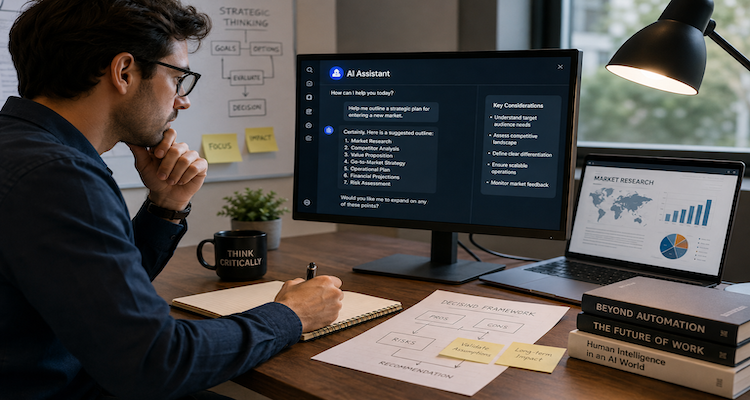
A growing number of people no longer begin their workday by opening a search engine. Instead, they open an AI assistant.
Students use AI to summarize reading assignments. Professionals use it to draft emails, brainstorm ideas, and organize projects. Developers rely on it to generate code. Even everyday decisions, from planning vacations to choosing products, are increasingly routed through artificial intelligence.
The shift appears harmless, even beneficial. After all, every major technological advance has helped humans do more with less effort. Calculators reduced the need for mental arithmetic. GPS reduced the need to memorize routes. Search engines reduced the need to remember facts. AI assistants seem like the next logical step.
Yet a deeper question is beginning to emerge beneath the enthusiasm: if AI increasingly performs parts of our thinking, what happens to the skills we no longer practice?
The answer may define one of the most important cultural and technological debates of the coming decade.
The Rise of Cognitive Convenience
Human beings naturally gravitate toward efficiency.
When a task can be completed faster, cheaper, or with less mental effort, most people adopt the shortcut. AI assistants are exceptionally good at providing cognitive convenience. They can condense hours of research into minutes, generate first drafts instantly, explain complex topics, and offer recommendations on demand.
For many users, the benefits are undeniable.
A marketing professional can create campaign ideas faster. A small business owner can write product descriptions without hiring a copywriter. A student can receive personalized explanations of difficult concepts. AI removes friction from countless activities.
The challenge is that thinking itself often depends on friction.
Critical reasoning, creativity, problem-solving, and deep understanding are rarely produced instantly. They develop through effort, uncertainty, experimentation, and occasional failure. When technology removes too much of that process, people may gain efficiency while losing something less visible.
The risk is not that AI makes people unintelligent. The risk is that it changes which mental skills they regularly exercise.
From Information Retrieval to Thought Generation
Previous digital technologies mainly helped people access information.
Search engines pointed users toward answers. Users still had to evaluate sources, compare viewpoints, and synthesize information themselves.
AI assistants operate differently.
Instead of simply retrieving information, they increasingly generate responses, interpretations, summaries, and recommendations. The technology does not merely help people find knowledge; it participates in the thinking process itself.
This distinction matters.
When someone asks a search engine a question, they often encounter multiple perspectives. When they ask an AI assistant, they frequently receive a single coherent answer.
That convenience can save time. It can also reduce opportunities for intellectual exploration.
The result may be a subtle shift from active investigation to passive acceptance.
Most users do not notice this transition because the experience feels productive. The answer arrives quickly, the task is completed, and the immediate objective is achieved.
But speed and understanding are not always the same thing.
The Hidden Skill That May Be Declining
One of the least discussed consequences of AI adoption involves a skill that employers, educators, and leaders increasingly value: independent judgment.
Throughout history, expertise was built through repeated exposure to problems. People learned to recognize patterns, evaluate trade-offs, and make decisions under uncertainty.
AI can accelerate access to knowledge, but it cannot automatically transfer judgment.
A manager who relies entirely on AI-generated recommendations may become less practiced at weighing competing priorities. A student who depends on AI-generated explanations may understand conclusions without fully understanding the reasoning behind them.
This creates an interesting paradox.
The more capable AI becomes, the more important human judgment may become.
As information generation becomes abundant, the ability to evaluate, question, and challenge information could become a defining competitive advantage.
In other words, the future may not reward those who can generate the most content. It may reward those who can identify when generated content is incomplete, misleading, or insufficient.
The Workplace Is Already Revealing the Pattern
Organizations are adopting AI at remarkable speed.
Teams use AI to draft reports, summarize meetings, analyze documents, and automate communication. Productivity gains are often immediate and measurable.
However, some business leaders are beginning to encounter a new challenge.
Employees can produce more output than ever before, but output alone does not guarantee understanding.
A report generated in minutes may look polished while containing subtle errors. A strategic recommendation may sound convincing without accounting for critical context. An AI-generated proposal may appear complete while overlooking real-world constraints.
This has led some organizations to rethink what expertise means in an AI-driven environment.
The most valuable employees are increasingly those who know how to collaborate with AI rather than simply depend on it. They use AI to accelerate routine tasks while retaining responsibility for analysis, verification, and decision-making.
The distinction may seem small, but it is significant.
One approach delegates thinking. The other augments thinking.
A Cultural Shift Beyond Productivity
The implications extend far beyond workplaces and classrooms.
AI assistants are becoming part of everyday life. People ask them for relationship advice, financial guidance, travel recommendations, health information, and personal decisions.
Historically, individuals formed opinions through conversations, books, experiences, and diverse sources of information. AI introduces a new intermediary into that process.
This raises questions that are less technological and more cultural.
How do people develop independent perspectives when intelligent systems constantly provide ready-made answers?
How does creativity evolve when idea generation becomes automated?
What happens to curiosity when obtaining an answer becomes easier than exploring a question?
These questions do not suggest that AI is harmful. Rather, they highlight how transformative the technology may become.
The most profound impact of AI may not be what it does for us. It may be how it changes the habits of mind we develop over time.
Why This Moment Feels Different
Every major technology has altered human behavior.
Writing reduced dependence on memory. Printing transformed access to knowledge. Calculators changed mathematics education. Smartphones reshaped attention and communication.
AI differs because it operates closer to cognition itself.
It does not merely store information or transmit it. It participates in activities traditionally associated with human thinking, writing, analyzing, planning, summarizing, and problem-solving.
That proximity to cognitive work makes the current transition unique.
For the first time, many people have a tool that can perform significant portions of intellectual labor on demand.
The long-term consequences remain uncertain. Some skills may diminish. Others may become more important. New forms of expertise will likely emerge.
What seems increasingly clear is that the future will not be defined by choosing between human intelligence and artificial intelligence.
It will be defined by how effectively the two work together.
The Real Question Isn’t Whether We Use AI
The debate is often framed as a choice between embracing AI or resisting it.
That is no longer the relevant question.
AI assistants are already becoming embedded in education, business, creative work, and everyday decision-making. Their influence will continue to grow.
The more important question is how people choose to use them.
Used thoughtfully, AI can expand human capabilities, reduce routine work, and unlock new forms of creativity. Used carelessly, it can encourage intellectual passivity and overreliance.
The hidden cognitive cost of AI may not be the loss of intelligence. It may be the gradual erosion of habits that intelligence depends upon: questioning assumptions, wrestling with uncertainty, and thinking through problems independently.
As AI becomes more capable, those habits may become more valuable, not less.
The future belongs not to those who outsource their thinking entirely, but to those who learn when to delegate and when to think for themselves.
The information presented in this article is based on publicly available sources, reports, and factual material available at the time of publication. While efforts are made to ensure accuracy, details may change as new information emerges. The content is provided for general informational purposes only, and readers are advised to verify facts independently where necessary.