









Why Smart Homes Are Becoming Harder to Live With
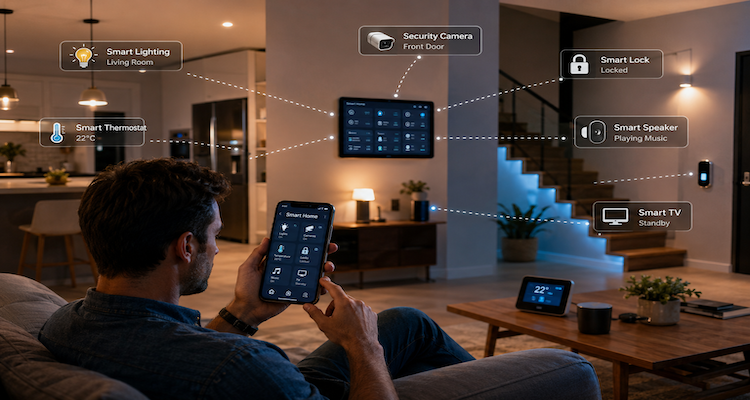
A smart speaker adjusts the thermostat before you wake up. Motion sensors turn on lights automatically. A video doorbell alerts you when a package arrives. On paper, the smart home promises a simpler, more convenient life.
Yet for many households, the reality feels surprisingly different. Instead of reducing complexity, smart devices are often introducing new layers of management, troubleshooting, and decision-making. Homeowners are finding themselves updating apps, reconnecting devices, resetting networks, and navigating a growing collection of digital ecosystems that do not always work together as smoothly as advertised.
The irony is difficult to ignore: technology designed to make homes smarter is, in some cases, making everyday living more complicated.
The Convenience Promise That Keeps Expanding
The appeal of smart home technology is easy to understand. Connected lighting, security cameras, thermostats, appliances, and voice assistants offer automation that once seemed futuristic.
The challenge is that convenience often arrives one device at a time.
A homeowner might begin with a smart speaker, then add connected bulbs, a video doorbell, security cameras, smart locks, and automated blinds. Each addition promises a small improvement. Collectively, however, they create a network of systems that require coordination.
Many products operate within separate ecosystems. A device designed for one platform may offer limited functionality with another. As a result, users often spend time configuring integrations, managing permissions, and learning multiple apps simply to maintain the experience they were promised.
What starts as a convenience upgrade can gradually become a technology management project.
More Features Mean More Decisions
One of the less discussed consequences of smart homes is decision fatigue.
Traditional household devices tend to have straightforward functions. A light switch turns lights on or off. A thermostat adjusts temperature. A lock secures a door.
Smart alternatives introduce customization options, automation schedules, voice commands, notifications, geofencing settings, and user permissions. While flexibility can be valuable, it also requires users to make ongoing choices about how their homes should behave.
Many households discover that configuring automation is only the beginning. Over time, routines need adjustments as schedules change, family members adopt different habits, or software updates alter functionality.
The result is a subtle shift: instead of technology adapting entirely to people, people often find themselves adapting to technology.
The Hidden Cost of Digital Maintenance
Every connected device effectively becomes a miniature computer inside the home.
Like computers, these devices require updates, security patches, account management, and occasional troubleshooting. When a smart lock disconnects from Wi-Fi or a camera stops syncing with its app, the convenience advantage can quickly disappear.
Unlike traditional household infrastructure, smart technology depends on multiple layers functioning simultaneously. Internet service, wireless networks, cloud services, mobile apps, and hardware all need to work together.
A problem in any one layer can disrupt the entire experience.
This growing maintenance burden reveals an important shift in modern living. Homes are no longer just physical spaces; they are increasingly digital environments that require ongoing management.
The Ecosystem Problem
One reason smart homes often feel more complicated than expected is fragmentation.
Major technology companies have developed their own connected ecosystems. Devices may work best within a particular platform, encouraging consumers to remain within a specific brand environment.
For users, this creates a challenge. A household may contain products from multiple manufacturers acquired over several years. Bringing them together into a seamless experience is often more difficult than product marketing suggests.
Industry initiatives aimed at improving interoperability have gained attention, reflecting recognition that consumers want connected devices to work together more easily. However, the smart home market remains a work in progress.
Until compatibility becomes more universal, complexity is likely to remain a common feature of connected living.
When Automation Creates New Expectations
Perhaps the most interesting shift is psychological rather than technical.
Automation changes expectations.
Once a household becomes accustomed to lights turning on automatically or doors locking themselves, any disruption feels more significant than a failure in traditional systems. People begin relying on automated processes they previously handled manually.
This creates a paradox. The more technology reduces effort, the less tolerant users become of interruptions.
A light switch that occasionally fails would be unacceptable. Yet many consumers accept periodic glitches from smart devices because they perceive the overall benefits as worthwhile.
As automation spreads, reliability becomes just as important as innovation.
Smart Homes Are Revealing a Larger Digital Trend
The challenges emerging in connected homes reflect a broader pattern across modern technology.
Many digital tools promise simplicity while concealing increasing complexity beneath the surface. Streaming services simplify entertainment but fragment content across platforms. Productivity apps streamline work but multiply notifications and workflows. Smart homes follow a similar trajectory.
The real innovation is often not the technology itself but the management of complexity.
Companies that succeed in the next phase of connected living may not be those offering the most features. Instead, they may be the ones that make technology fade into the background.
This represents a subtle but important shift in consumer expectations. People increasingly value systems that require less attention rather than more capabilities.
Why Interest in This Issue Is Growing
As smart devices become mainstream, more households are moving beyond early adoption and entering long-term ownership.
The conversation is no longer focused solely on what smart devices can do. It is increasingly about what it takes to live with them over time.
Consumers are evaluating practical questions:
- How many connected devices are too many?
- Which automations genuinely save time?
- What happens when support ends for older products?
- How much personal data is being collected?
- Is the convenience worth the ongoing maintenance?
These questions reflect a more mature phase of technology adoption, where usability and sustainability matter as much as innovation.
The Future May Be Less Visible Technology
The next evolution of smart homes may not involve adding more devices. Instead, it could involve making technology less noticeable.
Consumers appear increasingly interested in systems that work quietly in the background without requiring constant configuration. The most successful connected products may be those that disappear into daily life rather than demand attention.
In that sense, the future of the smart home may be defined by restraint rather than expansion.
The ultimate goal of home technology has never been to create more settings, apps, and notifications. It has always been to make daily life easier.
As smart devices continue to evolve, the companies that understand this distinction may be best positioned to shape the next generation of connected living.
The information presented in this article is based on publicly available sources, reports, and factual material available at the time of publication. While efforts are made to ensure accuracy, details may change as new information emerges. The content is provided for general informational purposes only, and readers are advised to verify facts independently where necessary.