










How Technology Is Quietly Reshaping the Way Families Share Responsibilities
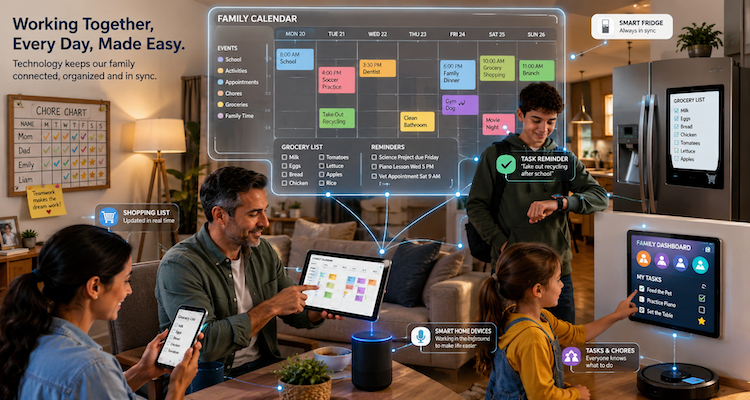
A household chore chart hanging on a refrigerator once represented the center of family coordination. Today, that role is increasingly being played by shared calendars, grocery apps, smart speakers, family messaging platforms, and even artificial intelligence-powered assistants. What appears to be a simple shift in convenience is gradually changing how families organize their daily lives and how responsibilities are distributed among household members.
The transformation is subtle enough that many people barely notice it. Yet technology is influencing who remembers appointments, who manages shopping lists, who keeps track of school activities, and even who reminds everyone else about what needs to be done. In many homes, the mental work of managing family life is becoming as important as the physical tasks themselves.
This evolution reveals something larger than digital convenience. It highlights how technology is changing family dynamics, expectations, and the invisible systems that keep households functioning.
The Rise of the Digital Household Manager
For generations, family responsibilities were often divided through routines and direct communication. Parents remembered appointments, children followed schedules, and household tasks were coordinated through conversations or handwritten notes.
Today, digital tools are taking on part of that organizational burden.
Shared calendars allow multiple family members to see upcoming commitments. Grocery applications enable everyone to add items in real time. Smart home devices can manage reminders, alarms, shopping lists, and recurring household tasks. Messaging apps create constant communication channels that help coordinate schedules throughout the day.
These tools are reducing friction in everyday life. Instead of relying on one person to remember every detail, information can be stored, updated, and shared instantly.
As a result, household management is becoming more collaborative in many families.
The Invisible Work Technology Is Making Visible
One of the most significant shifts is happening in an area that often receives little attention: mental load.
Mental load refers to the ongoing responsibility of remembering, planning, organizing, and anticipating household needs. It includes remembering school deadlines, scheduling appointments, planning meals, tracking supplies, and coordinating activities.
Historically, much of this work remained invisible because it happened inside someone’s mind.
Technology is changing that.
When tasks appear on shared calendars, digital checklists, or family management platforms, the planning process becomes visible to everyone. Family members can see what needs to be done and contribute more easily.
This does not automatically create equal responsibility, but it can make household management more transparent. Visibility often becomes the first step toward a more balanced distribution of responsibilities.
Children Are Participating Earlier
Technology is also altering how children engage with household responsibilities.
In the past, children often learned responsibilities through direct instruction and routine. Today, digital reminders, task-management applications, and family dashboards can help younger family members participate more independently.
A child may receive reminders to complete homework, feed a pet, prepare for extracurricular activities, or finish assigned chores. Teenagers can manage portions of their schedules through shared family systems rather than depending entirely on parents.
This doesn’t eliminate parental involvement, but it can encourage greater accountability and self-management.
As digital literacy becomes a normal part of childhood, many young people are learning organizational skills through technology alongside traditional household responsibilities.
Smart Homes Are Changing Expectations
The growing presence of smart home technology is creating another shift.
Devices connected to lighting, security systems, appliances, and climate controls can automate tasks that once required regular attention. Voice assistants can manage reminders, create shopping lists, and coordinate schedules.
While automation reduces workload in some areas, it also changes expectations.
Families may spend less time performing routine tasks and more time managing systems, settings, subscriptions, and digital services. The nature of responsibility is shifting from manual execution toward oversight and coordination.
This creates a new kind of household role: the family technology manager. Whether intentionally or not, someone often becomes responsible for maintaining devices, troubleshooting problems, managing accounts, and ensuring systems work properly.
In some households, technology reduces work. In others, it simply redistributes it.
Family Communication Is Becoming Continuous
Perhaps one of the most overlooked changes is how technology affects communication.
Family coordination no longer depends solely on conversations at breakfast or dinner. Through messaging platforms and shared apps, communication can continue throughout the day.
Parents can send reminders, coordinate pickups, confirm schedules, and share updates instantly. Family members can respond regardless of location.
This constant connectivity can improve organization, especially for busy households balancing work, school, caregiving, and extracurricular commitments.
However, it also introduces new challenges. Some families may feel pressure to remain constantly available. Others may find that digital communication replaces face-to-face discussions that once strengthened family relationships.
The technology itself is neutral. Its impact depends largely on how families choose to use it.
AI Could Become the Next Household Coordinator
Artificial intelligence may represent the next phase of this evolution.
AI-powered assistants are becoming increasingly capable of organizing schedules, summarizing information, generating shopping lists, suggesting meal plans, and managing reminders.
Rather than simply storing information, future systems may actively help families coordinate responsibilities.
Imagine a digital assistant that notices overlapping schedules, recommends task assignments, suggests efficient shopping routes, or reminds family members about responsibilities before conflicts arise.
While these capabilities could improve efficiency, they also raise important questions about privacy, dependence, and decision-making. Families may eventually need to decide how much responsibility they want technology to manage on their behalf.
The balance between assistance and autonomy will likely become an important discussion in the years ahead.
A Cultural Shift Beyond Convenience
The deeper story is not about apps, devices, or automation. It is about how families adapt to changing social and technological realities.
Modern households often face complex schedules, dual-income careers, remote work arrangements, caregiving responsibilities, and educational demands. Technology has emerged as a tool for managing this complexity.
What makes the current moment different is that technology is moving beyond supporting household tasks. It is becoming part of the structure through which responsibilities are organized and shared.
This shift reflects a broader cultural change. Family management is becoming more data-driven, collaborative, and digitally coordinated. The skills needed to run a household increasingly include digital organization, information management, and technology literacy.
The Future of Shared Responsibility
Technology will not solve every challenge related to household responsibilities. Family dynamics, communication habits, personal preferences, and social expectations will continue to shape how work is divided.
Yet technology is creating new opportunities for transparency, participation, and coordination.
The most important insight may be that the future of household management is not simply about doing less work. It is about making responsibilities more visible and easier to share.
As digital tools become woven into everyday life, successful families may be those that use technology not merely to automate tasks, but to strengthen collaboration. The households that benefit most will likely be the ones that treat technology as a facilitator of shared responsibility rather than a replacement for human involvement.
The refrigerator chore chart may not disappear entirely. But increasingly, it is being joined by a growing digital ecosystem that is quietly redefining what it means to manage a home together.
The information presented in this article is based on publicly available sources, reports, and factual material available at the time of publication. While efforts are made to ensure accuracy, details may change as new information emerges. The content is provided for general informational purposes only, and readers are advised to verify facts independently where necessary.