








Why Neighborhoods Are Becoming Social Again in Unexpected Ways
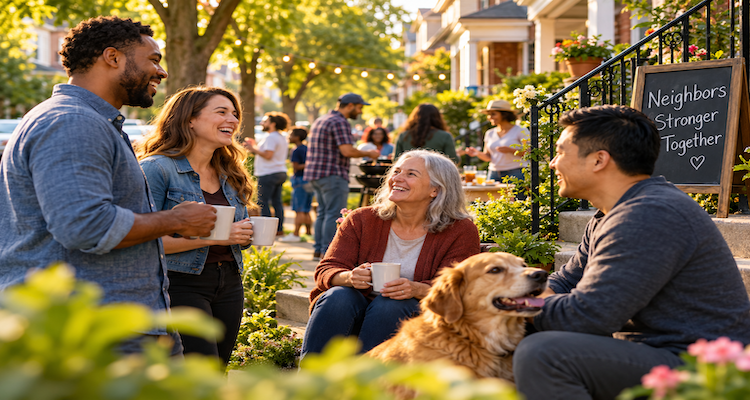
A neighborhood can become social without suddenly becoming friendly. The change may begin with something much smaller: a familiar face at the café, a message in a local group, children playing outside, a shared walk, a community garden, a library event, or a neighbor asking whether anyone has a spare tool.
That matters because social connection is increasingly being understood not only as a matter of individual relationships, but also as something shaped by the places where everyday life happens. Research on “third places” settings outside home and work such as parks, cafés, libraries, community facilities and local businesses has repeatedly linked accessible neighborhood spaces with opportunities for interaction and belonging.
There is also evidence that the neighborhood itself may be becoming a more important social layer. A September 2026 survey commissioned by Nextdoor and conducted with The Harris Poll reported that 32% of Americans said trust in their neighborhood had strengthened over the previous five years, while 67% said they could call on a neighbor for help. Because this is company-commissioned research, it should be treated as an indicator rather than proof of a universal social revival.
The more interesting story is therefore not that everyone is suddenly becoming friends with their neighbors. It is that small, repeated forms of local interaction are finding new routes back into ordinary life sometimes through technology, sometimes through physical spaces, and often through a combination of both.
Key Takeaways
- Neighborhood connection is increasingly being built through repeated everyday encounters rather than formal community organizations alone.
- Digital neighborhood platforms can turn local information into opportunities for offline interaction, but they do not automatically create trust.
- Parks, libraries, cafés, gyms, sidewalks and community facilities can function as important “third places” for weak social ties.
- Research suggests walkability and accessible public spaces can support belonging and social interaction, although the causal evidence remains limited.
- Neighborhood revival is uneven: affordability, accessibility, age, mobility and cultural differences determine who benefits.
- The emerging model is less about returning to an old-fashioned neighborhood and more about rebuilding local connection in new ways.
The New Social Life Is Often Built From Weak Ties
Strong relationships usually receive the most attention when people talk about community. Yet neighborhoods often work through weaker connections.
Knowing the person who runs the corner shop, recognizing another parent from the playground, greeting someone who walks the same route every morning or seeing familiar people at a local gym may not constitute friendship. But these repeated encounters can create familiarity.
Research on third places helps explain why this matters. A 2026 study of older adults in Orlando found that frequent engagement with third places was associated with greater social capital and moderate leisure-time physical activity, while neighborhood walkability was also positively associated with those outcomes.
Another recent qualitative study involving older adults in Australia found that third places could generate connections ranging from encounters with strangers to stronger relationships. The researchers also found that transport, walkability and the design of spaces affected whether people could actually remain and interact.
This suggests that a socially active neighborhood does not necessarily need everyone to know everyone.
It needs places and routines that make repeated contact possible.
Technology Is Bringing the Neighborhood Back Into the Phone
There is an apparent contradiction in the neighborhood revival: some of it is happening online.
Local WhatsApp groups, neighborhood platforms, community Facebook groups and services such as Nextdoor allow residents to exchange information about lost pets, local services, safety concerns, recommendations, events and requests for help.
The important development is not simply that neighbors are talking digitally. It is that digital communication can sometimes reduce the friction involved in beginning an offline relationship.
A question such as “Does anyone know a good plumber nearby?” is very different from approaching a stranger and introducing yourself. Once people have interacted through a practical problem, another layer of familiarity can emerge.
Nextdoor’s own recent product direction illustrates this hybrid model. In 2025, the company redesigned its platform around local “Alerts,” “News” and “Ask” functions, describing the service as a way to connect people with what is happening around them. The company said at the time that it had more than 100 million verified neighbors across 11 countries. Those figures are company-reported, but the product shift itself is notable: neighborhood technology is increasingly organized around practical local utility rather than simply social networking.
That distinction is important.
People may not join a neighborhood network because they want another social-media feed. They may join because they need information. Connection can emerge as a by-product of usefulness.
The Unexpected Return of the “Third Place”
The traditional idea of a neighborhood gathering place is changing.
The third place might be a coffee shop, but it could also be a library, gym, religious center, barber shop, playground, community center, public square or park.
Recent research suggests that the function of these places may matter more than their label.
A 2024 study of 892 Australian residents found that places where people participate in specific activities with defined groups such as gyms or places of worship could generate stronger place attachment than purely consumption-oriented locations such as large shops and cafés.
That offers an important clue about why some neighborhoods feel more connected than others.
A place where people do something together can create more opportunities for interaction than a place where everyone simply passes through.
A community garden requires cooperation.
A children’s sports club creates repeated encounters.
A library workshop gives strangers a reason to talk.
A walking group creates a routine.
A religious gathering creates continuity.
A local market creates recognition.
The social effect can be indirect.
People arrive for the activity and gradually acquire a network.
Walkability Can Turn Ordinary Movement Into Social Contact
One of the less obvious ways neighborhoods become social is through walking.
A walkable street does more than make it easier to get somewhere. It can increase the amount of time residents spend in shared public space.
Research involving 45 residents of a Canadian city found that physical changes in neighborhood environments could influence walking behavior and social interactions, with participants describing connections between visible neighborhood modifications, walking experiences and feelings of belonging.
But the evidence needs to be interpreted carefully.
A 2025 natural-experiment study across Montréal, Saskatoon and Vancouver found only limited evidence that public open-space exposure changed social connectedness during the pandemic period. Higher exposure to public open space was associated with a modest protective effect on community belonging, but not broadly across every measure of connectedness.
That is a useful warning against oversimplifying urban design.
A park does not automatically create a community.
Its location, accessibility, safety, design, maintenance and the activities taking place there can determine whether people merely pass through or actually interact.
The Pandemic Changed What People Notice About Local Life
The pandemic disrupted many of the routines through which people normally encounter others.
Cafés closed. Offices emptied. Recreation centers restricted access. Religious gatherings changed. Informal meetings disappeared.
Research involving older Americans found that these disruptions changed how people engaged with community and third places, while also demonstrating the importance of such spaces for different forms of social connection.
More recent qualitative research has highlighted something particularly difficult to replace digitally: incidental connection.
A 2025 study of Australians during COVID-19 restrictions described public spaces as providing forms of collective and incidental relational experience that were difficult to reproduce after everyday life moved into private homes.
That may explain part of today’s renewed interest in local life.
People discovered that many interactions they previously considered insignificant were actually part of the social fabric of everyday life.
But “More Social” Does Not Mean More Inclusive
There is another side to the story.
A neighborhood can become socially active while still excluding some residents.
A recent study of older Turkish migrants in the Nuremberg metropolitan region examined parks, cafés, religious sites and neighborhood centers as third places. Participants often found culturally familiar locations supportive, but access and participation were shaped by factors including age, gender, health, economic constraints and changing neighborhood conditions. The researchers also found that third places do not automatically generate interaction across generations or cultures.
Research on third-place availability in the United States has similarly found substantial geographic disparities. A study covering 2010–2021 found widespread reductions in several categories of third places during 2019–2021, with particularly pronounced declines in some socially vulnerable and rural communities.
This creates an important qualification to the neighborhood revival narrative.
A neighborhood with cafés, parks and community events may feel highly connected to some residents while remaining difficult to access for people without cars, people with disabilities, lower-income households, newcomers or residents who do not feel culturally represented by existing activities.
Social infrastructure only works as social infrastructure when people can actually use it.
The Most Interesting Change May Be the Combination
The emerging pattern is not a simple return to the neighborhood communities of the past.
It is more hybrid.
A local event may be discovered through a phone.
A neighborhood problem may be discussed online and solved offline.
A walking group may use messaging to coordinate.
A community garden may recruit volunteers digitally.
A library may become both a physical meeting point and an information hub.
A local business may become a recurring place where residents recognize one another.
Technology and physical space are therefore not necessarily competing for people’s attention.
Sometimes technology is the coordination layer, while the neighborhood remains the social layer.
That distinction could become increasingly important as work patterns, mobility and household structures continue to change.
Research using American Time Use Survey data has found that home is the largest source of daily social connection, followed by workplaces and third places. The same research found that people living alone had substantially fewer daily social connections and were less able or willing to compensate through work or third places.
This suggests that the neighborhood can become especially important when traditional sources of social contact such as family households or workplaces are weaker.
What a More Social Neighborhood Actually Needs
The evidence points toward a relatively simple principle: communities do not necessarily need grand social programs to become more connected.
They need repeated opportunities for low-pressure interaction.
That can mean:
- accessible parks and public spaces;
- libraries and community facilities;
- walkable streets;
- affordable local businesses;
- recurring sports or cultural activities;
- neighborhood groups that solve practical problems;
- spaces where different age groups can participate;
- activities that encourage people to return regularly.
The U.S. Surgeon General’s advisory on social connection similarly emphasizes the importance of creating opportunities and spaces for inclusive social connection and building partnerships among community institutions.
The strongest lesson is therefore not that neighborhoods are magically becoming friendlier.
It is that the conditions for connection can be deliberately created and sometimes rediscovered in places people previously overlooked.
Conclusion
The neighborhood is becoming social again in ways that are easy to miss because they rarely look like traditional community building.
It can be a digital message that leads to a real-world favor. It can be a familiar stranger encountered every morning. It can be a library class, a local walking route, a children’s activity, a shared garden or a café where people gradually begin recognizing one another.
The evidence does not support declaring a universal neighborhood revival. Access remains unequal, some third places have disappeared, and physical proximity alone does not guarantee social connection.
But there is a meaningful shift in how researchers, communities and technology platforms are thinking about local life.
The future of neighborhood connection may not be about recreating the past.
It may be about making ordinary local life slightly more connected one repeated encounter at a time.
This content is published for informational or entertainment purposes. Facts, opinions, or references may evolve over time, and readers are encouraged to verify details from reliable sources.