










Why Abandoned Theme Parks Feel More Disturbing Than Haunted Houses
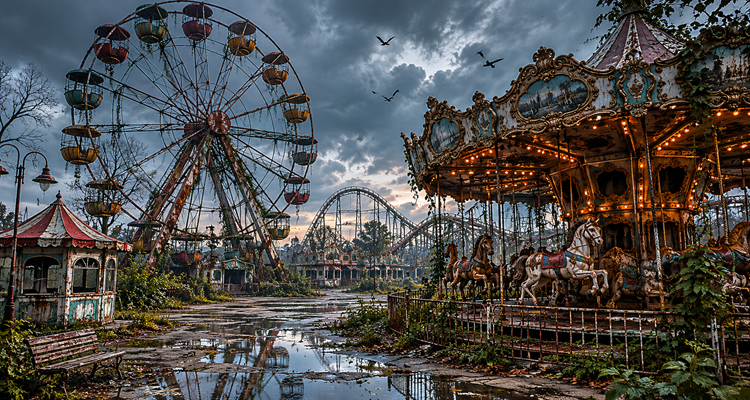
There’s something uniquely unsettling about a rusting roller coaster standing silent against the sky. A carousel frozen in place. A faded mascot smiling from a cracked sign long after the crowds have disappeared.
Unlike haunted houses, which are intentionally designed to scare us, abandoned theme parks were built for the exact opposite purpose. They were created to generate joy, excitement, and shared memories. When those spaces fall into decay, the contrast can feel far more disturbing than any staged horror attraction.
That strange emotional tension is one reason abandoned theme parks continue to fascinate people online, inspire films and games, and capture attention across social media. They tap into something deeper than fear: the discomfort of seeing happiness left behind.
Places Built for Joy
A haunted house announces its intentions from the start. Dim lighting, eerie sounds, and frightening imagery prepare visitors for an experience centered on fear.
Theme parks operate differently. Every design choice is meant to create delight. Bright colors, cheerful music, playful characters, and thrilling rides work together to create a temporary escape from everyday life.
When a theme park closes and years of neglect begin to show, those familiar symbols remain—but their purpose disappears.
The colorful entrance fades. The music stops. The rides no longer move.
What was once lively becomes strangely lifeless.
This reversal creates a powerful emotional reaction because the environment conflicts with our expectations. Our brains associate amusement parks with noise, movement, and people. When those elements vanish, the silence feels unnatural.
The Psychology of Abandoned Happiness
Human beings often find contrasts more emotionally powerful than absolutes.
A dark cave is expected to be dark. A cemetery is expected to feel solemn. But a place designed for celebration that becomes empty creates a psychological contradiction.
Researchers and psychologists have long noted that people respond strongly to environments that feel familiar yet slightly wrong. Abandoned theme parks sit squarely in that category.
The rides are recognizable.
The pathways still exist.
The mascots remain.
Yet everything appears disconnected from its original purpose.
The result is a feeling that many people struggle to describe. It is not simply fear. It is closer to unease, melancholy, nostalgia, and curiosity combined.
Visitors often report feeling as though they are walking through a memory rather than a physical place.
Silence Becomes Part of the Story
One of the most powerful elements of an abandoned theme park is silence.
Active amusement parks are environments of constant sensory stimulation. There are conversations, mechanical sounds, music, announcements, and laughter.
When all of that disappears, the absence becomes noticeable.
Silence in an abandoned factory may seem ordinary because industrial spaces are associated with machinery rather than human emotion. Silence in a former amusement park feels different because it highlights what is missing.
The empty pathways suggest where families once walked.
The motionless rides remind visitors of movement that no longer exists.
The environment almost tells a story without speaking.
That narrative quality is part of what makes abandoned parks so captivating in photographs and videos.
Nostalgia Can Make Fear Stronger
Many people associate amusement parks with childhood.
They remember birthday celebrations, summer vacations, school trips, or family outings. These memories are often connected to positive emotions and a sense of innocence.
When viewers see an abandoned amusement park, they are not just seeing a neglected property. They are witnessing the deterioration of something culturally linked to happiness and youth.
This creates a unique emotional effect.
The fear does not come from immediate danger. Instead, it comes from confronting change, aging, and the passage of time.
A decaying Ferris wheel can become a symbol of lost moments rather than simply a broken ride.
That emotional layer makes abandoned parks resonate with audiences in ways that traditional horror settings often do not.
Why Decaying Mascots Feel So Uncomfortable
Perhaps no image captures the eeriness of abandoned theme parks better than forgotten mascots.
Characters designed to appear friendly and welcoming can become surprisingly unsettling when left to weather and decay.
Part of this reaction comes from the fact that mascots are intended to appear alive and expressive. When they become damaged or abandoned, they occupy a strange middle ground between human and object.
A smiling character with peeling paint or missing features creates a sense of unease because it no longer fulfills its original role.
The mascot remains recognizable, but something feels wrong.
This discomfort appears frequently in popular culture, where abandoned attractions and forgotten characters often become symbols of psychological horror.
The Internet’s Fascination With Forgotten Places
The popularity of urban exploration videos, abandoned-location photography, and eerie travel content has introduced millions of people to forgotten amusement parks.
Images of overgrown roller coasters and nature reclaiming former attractions spread quickly because they combine multiple emotional triggers at once.
They offer visual mystery.
They provoke nostalgia.
They encourage storytelling.
Most importantly, they invite viewers to imagine what happened.
Unlike a haunted house, where the story is usually scripted, abandoned parks leave room for speculation. Every rusted ride and empty building feels like part of a larger unanswered question.
People naturally want to fill those gaps.
A Reflection of Broader Cultural Anxiety
One reason abandoned theme parks remain compelling is that they reflect concerns beyond the parks themselves.
Modern societies often celebrate growth, entertainment, and constant activity. An abandoned amusement park represents the opposite: decline, stillness, and impermanence.
The sight of a once-popular destination standing empty can serve as a reminder that even successful places can disappear.
That realization connects to broader fears about change, economic shifts, cultural transformation, and the temporary nature of human creations.
A Key Insight
What makes abandoned theme parks especially disturbing is not that they represent death, it is that they represent interrupted happiness.
Most frightening places are expected to be frightening. Abandoned theme parks challenge a deeper assumption: that places associated with joy will remain joyful.
When that expectation collapses, the emotional impact becomes stronger than conventional horror because it forces people to confront the fragility of positive memories and familiar experiences.
The fear comes not from what is there, but from what is missing.
Why They Continue to Haunt Our Imagination
Haunted houses are designed to create temporary fear. Once visitors leave, the illusion ends.
Abandoned theme parks operate differently. Their eeriness comes from reality rather than performance.
They are reminders of crowds that vanished, attractions that stopped, and moments that cannot be recreated.
Perhaps that is why images of forgotten amusement parks continue to capture attention across generations. They combine nostalgia, mystery, silence, and loss into a single powerful experience.
In the end, the most unsettling thing about an abandoned theme park is not the decay itself. It is the lingering evidence that a place once filled with laughter became completely quiet.
And for many people, that silence feels far more disturbing than any haunted house ever could.
This content is published for informational or entertainment purposes. Facts, opinions, or references may evolve over time, and readers are encouraged to verify details from reliable sources.