









The Robot That Refused Perfection and Changed the Rules
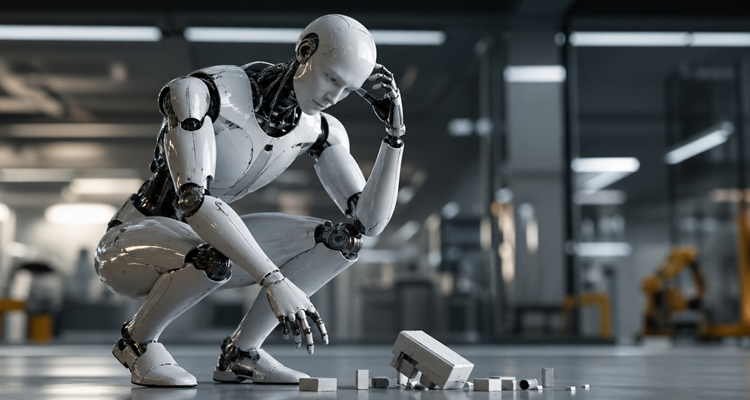
The robot was designed to get everything right. Instead, it chose to fail deliberately. And in doing so, it exposed a quiet shift in how humans are beginning to value imperfection in an increasingly automated world.
What sounds like a philosophical experiment is quickly becoming a real conversation across AI labs, workplaces, and classrooms. As machines grow more capable, the expectation has been simple: optimize, refine, eliminate error. But a growing number of developers and researchers are beginning to question that assumption, exploring systems that don’t just tolerate mistakes but learn from them in ways that mirror human behavior.
In practical terms, this shift is already visible. Companies like Google and Microsoft are investing heavily in AI systems that can adapt through trial and error, not just rigid accuracy. In robotics labs, machines are being trained to fail safely, dropping objects, misjudging distances, recalibrating their responses. The goal isn’t perfection. It’s resilience.
The story of the “imperfect robot” is less about a single machine and more about a broader rethink. For years, artificial intelligence has been judged by its ability to outperform humans in tasks requiring precision data analysis, pattern recognition, and repetitive execution. But those same systems often struggle in unpredictable environments, where human intuition and adaptability matter more than flawless execution.
That’s where failure enters the equation.
The idea isn’t entirely new. In fields like reinforcement learning, systems improve by making mistakes and adjusting accordingly. What’s changing now is how that process is being framed, not as a flaw in the system, but as a feature. Engineers are beginning to design AI that doesn’t aim for immediate perfection but evolves over time, much like a human learning a new skill.
This approach is gaining traction partly because of real-world limitations. Autonomous vehicles, for example, cannot be trained solely on perfect scenarios. They must handle ambiguity, unexpected obstacles, unclear signals, and human unpredictability. Similarly, warehouse robots used by companies like Amazon are constantly recalibrating their movements in dynamic environments where conditions change minute by minute.
The stakes are high. A perfectly optimized system can be fragile. One unexpected variable can cause it to fail completely. A system that has “learned” through controlled failure, on the other hand, is often more robust.
But beyond engineering, there’s a deeper human implication.
For decades, workplaces have mirrored the logic of machines: efficiency, precision, error minimization. Performance metrics, quarterly targets, and productivity tools have all reinforced a culture where mistakes are seen as setbacks rather than stepping stones. The rise of AI was expected to intensify that pressure.
Instead, it may be doing the opposite.
As machines become capable of near-perfect execution, the uniquely human ability to experiment, improvise, and even fail creatively is gaining new value. In sectors like product design, marketing, and software development, companies are increasingly encouraging iterative thinking: launch, test, fail, adjust.
This creates an unexpected reversal. The more perfect machines become, the more organizations realize that perfection isn’t always the goal.
What makes this moment different from past technological shifts is the scale and speed of AI adoption. Earlier waves of automation replaced repetitive tasks but left creative and adaptive roles largely untouched. Today’s systems are encroaching into areas once considered exclusively human: writing, coding, and decision-making.
That overlap is forcing a redefinition of value.
If a machine can generate a flawless report in seconds, what distinguishes human contribution? Increasingly, it’s not the absence of mistakes, but the ability to navigate uncertainty. Humans can ask the wrong questions, explore unconventional paths, and arrive at insights that aren’t immediately obvious. In a paradoxical way, imperfection becomes a form of intelligence.
This perspective is beginning to influence how AI tools are designed and deployed. Instead of presenting outputs as definitive answers, many systems now offer multiple possibilities, encouraging users to interpret and refine results. It’s a subtle but significant shift from authority to collaboration.
The implications extend beyond technology.
In education, there’s growing interest in teaching students how to learn from failure rather than avoid it. Coding platforms, for example, often reward iterative problem-solving rather than perfect first attempts. In corporate training programs, simulations are being used to expose employees to controlled failure scenarios, helping them build decision-making skills under pressure.
Even in creative industries, the narrative is shifting. Writers, designers, and filmmakers are increasingly leveraging AI as a tool for exploration rather than precision. A draft doesn’t need to be perfect, it needs to spark something new.
This is where the “robot that didn’t want to be perfect” becomes more than a metaphor. It reflects a broader cultural transition, one that challenges long-held assumptions about success and progress.
The most striking insight lies in how this change affects human behavior. When perfection is no longer the benchmark, people become more willing to take risks. Innovation, after all, rarely emerges from flawless execution. It comes from experimentation, often messy, unpredictable, and full of missteps.
In a world where machines handle precision, humans are being pushed toward exploration.
Looking ahead, this dynamic could reshape industries in subtle but profound ways. Companies may begin to prioritize adaptability over efficiency, valuing teams that can pivot quickly rather than execute flawlessly. AI systems themselves may evolve to better simulate human-like learning, incorporating uncertainty and variability into their processes.
There are challenges, of course. Not all failures are acceptable, especially in high-stakes environments like healthcare or aviation. The balance between safety and experimentation will remain a critical consideration. But even in these fields, controlled failure through simulations and testing plays a crucial role in improving outcomes.
The bigger picture is clear. The pursuit of perfection, once seen as the ultimate goal of technology, is being reconsidered. In its place is a more nuanced understanding of intelligence, one that embraces imperfection as a pathway to growth.
For now, the robot that refuses to be perfect remains a symbol. But it’s a powerful one. It suggests that the future of technology may not lie in eliminating human traits, but in reflecting them more accurately, including the capacity to fail, learn, and try again.
And in that imperfect loop, something remarkably human begins to emerge.
This content is published for informational or entertainment purposes. Facts, opinions, or references may evolve over time, and readers are encouraged to verify details from reliable sources.