










When Bedtime Stories Become Personal: Kids as Heroes
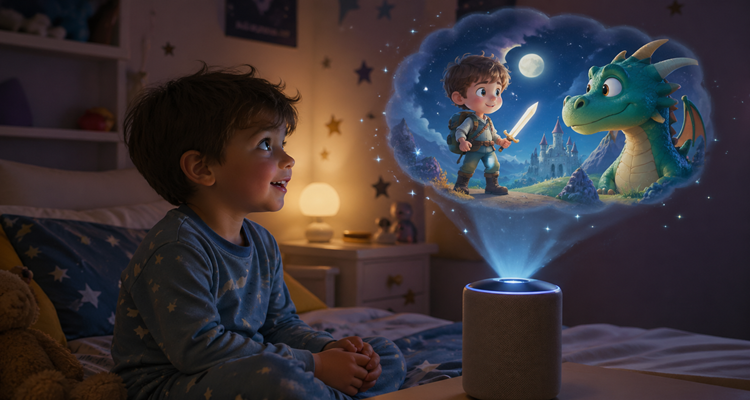
A quiet shift is happening in children’s bedrooms, not in the toys they play with, but in the stories they hear before sleep. Increasingly, the hero isn’t a distant prince or a talking animal. It’s the child themselves.
Across apps and platforms, personalized AI bedtime stories are turning young listeners into the central characters of their own adventures. What once required a parent’s imagination is now being powered by algorithms trained to craft custom narratives in seconds.
Parents are beginning to notice the difference. Instead of repeating the same worn-out fairy tales, children are asking for stories where they explore space, solve mysteries, or save kingdoms, using their own names, personality traits, and even daily experiences as the foundation of the plot.
This shift is being driven by a new wave of consumer-facing AI tools. Platforms like OpenAI-powered storytelling apps, Google’s generative AI features, and startups such as Storytailor or Wonderbly are making it easy for families to generate personalized narratives on demand. With just a few inputs, name, age, and favorite activities, the system builds a story arc tailored to the child.
The timing isn’t accidental. The rapid adoption of generative AI in everyday life has pushed the technology beyond productivity tools into more intimate spaces. As voice assistants, smart speakers, and AI chatbots become household staples, it was only a matter of time before storytelling, a deeply human ritual, was reimagined through code.
For parents juggling work and family responsibilities, the appeal is immediate. Personalized stories can hold a child’s attention longer, reinforce positive behaviors, and even incorporate educational themes. A story about a child who learns patience or bravery can feel more impactful when the protagonist shares their identity.
There’s also a subtle emotional shift. Children don’t just listen, they recognize themselves. That recognition can build confidence, encourage imagination, and create a sense of agency. In a way, these stories blur the line between entertainment and identity-building.
But what makes this moment different from earlier attempts at personalized content is the speed and scale. In the past, custom storybooks existed, but they were static, printed once, with limited variation. Today’s AI-generated stories are dynamic. Each night can bring a new adventure, shaped by evolving prompts or even a child’s mood.
That fluidity is reshaping expectations. Kids are growing up in an environment where content adapts to them, rather than the other way around. The implications extend beyond bedtime.
For the publishing industry, this raises complex questions. Traditional children’s books are built around shared cultural narratives, stories that generations grow up with. Personalized AI stories, by contrast, are deeply individual. They don’t create the same collective experience, but they offer something else: relevance.
Media companies and tech giants are paying attention. Microsoft and Google have both invested heavily in generative AI ecosystems, and storytelling is a natural extension of that capability. Meanwhile, startups are exploring subscription models for personalized content, blending entertainment with education.
There’s also a growing intersection with voice technology. AI-generated stories can now be narrated in lifelike voices, sometimes even mimicking a parent’s tone. This adds another layer of immersion, especially for families who rely on digital assistants during bedtime routines.
Yet, beneath the excitement lies a more nuanced conversation about creativity and dependency. If children grow accustomed to stories that always center them, what happens to their engagement with traditional narratives? Will the value of shared storytelling diminish, or will it evolve into something more hybrid?
One emerging insight is behavioral. Personalized storytelling may subtly shift how children perceive the world, not just as observers, but as protagonists. That can be empowering, but it also raises questions about empathy. Classic stories often teach children to see through someone else’s eyes. AI-driven narratives, by design, bring the focus inward.
This tension highlights a broader societal trend. As digital experiences become increasingly tailored, from social media feeds to streaming recommendations, storytelling is following the same path. The child’s bedtime story is becoming another data-driven experience.
At the same time, there’s an opportunity in balance. Some educators and child development experts see potential in combining personalized AI stories with traditional books. A child might hear a custom story one night and a classic tale the next, gaining both self-centered and outward perspectives.
Looking ahead, the technology is likely to become more sophisticated. Future iterations could incorporate real-time feedback, emotional cues, or even visual elements through augmented reality. Imagine a bedtime story that adapts based on a child’s reactions or integrates illustrations generated on the fly.
For now, the rise of personalized AI bedtime stories reflects a deeper transformation. It’s not just about convenience or novelty; it’s about how technology is reshaping one of the oldest human traditions.
The bedtime story has always been a space for imagination, comfort, and connection. What’s changing is who gets to be at the center of that story, and how that center is created.
As AI continues to move into personal spaces, the question isn’t whether storytelling will evolve. It already has. The real question is how families, creators, and educators will shape that evolution, and what kind of stories children will grow up believing about themselves.
This content is published for informational or entertainment purposes. Facts, opinions, or references may evolve over time, and readers are encouraged to verify details from reliable sources.