









The Invisible Monster That Teaches Kids to Beat Fear
The scariest monsters aren’t the ones children can see; they’re the ones they imagine. And for generations, the space under the bed has been a stage for those unseen fears. Now, a quiet shift is taking place in how parents, educators, and storytellers are helping children face them, not by dismissing fear, but by turning it into something they can understand.
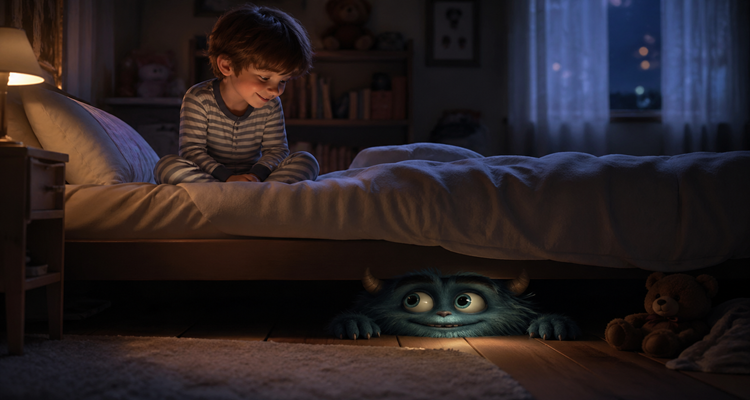
At the center of this shift is a growing wave of storytelling that reframes fear itself. “The Invisible Monster Under the Bed” is less about what lurks in the dark and more about how children interpret uncertainty. Instead of treating fear as something to eliminate, modern children’s narratives are beginning to treat it as something to explore.
In classrooms and bedtime routines alike, stories like these are becoming tools for emotional development. Rather than saying, “There’s nothing there,” the narrative invites children to imagine that the monster might be shy, misunderstood, or even friendly. The fear remains, but its meaning changes.
This approach reflects a broader movement in child psychology. For years, experts have emphasized the importance of validating children’s emotions rather than dismissing them. Platforms like YouTube Kids and apps such as Headspace for Kids have already embraced this philosophy, using guided stories and animations to help children process anxiety and fear in relatable ways.
The idea is simple: fear loses its grip when it is named, understood, and reshaped.
That shift didn’t emerge overnight. For decades, parenting advice often leaned toward reassurance, telling children that monsters weren’t real, that the dark was safe. While well-intentioned, this method sometimes left children feeling unheard. The fear didn’t disappear; it just went unspoken.
Today, the narrative is evolving alongside a deeper understanding of emotional intelligence. Books and digital content are increasingly designed not just to entertain, but to equip children with tools for navigating their inner world. In this new storytelling landscape, the “monster under the bed” becomes a metaphor, a stand-in for anxiety, uncertainty, or even loneliness.
What makes this moment different is how seamlessly storytelling is blending with real-world tools. Educational platforms are integrating interactive elements, allowing children to “talk” to their fears through guided prompts or visual exercises. Even major tech companies like Google have experimented with child-focused features that promote mindfulness and emotional learning through voice assistants and smart devices.
The result is a more engaged, participatory experience. Instead of passively listening, children actively reshape the story, deciding what the monster is, what it wants, and how it changes.
That shift carries real consequences. When children learn to reinterpret fear early, they build resilience that extends far beyond bedtime. It affects how they approach new environments, social situations, and even academic challenges.
There’s a subtle but powerful insight here: fear doesn’t need to be eliminated to be overcome. It needs to be understood. And when children are given th e language and imagination to do that, they begin to feel a sense of control over something that once felt overwhelming.
This marks a departure from older storytelling traditions, where fear was often externalized as something to defeat a villain, to conquer, or to escape. In contrast, today’s narratives are more introspective. The “monster” is no longer just an external threat; it becomes part of the child’s emotional landscape.
That evolution mirrors broader societal changes. As conversations around mental health become more open, even among adults, the importance of early emotional education is gaining recognition. Schools are introducing social-emotional learning programs, and parents are seeking resources that go beyond academics.
In that context, a simple bedtime story takes on new significance. It becomes a rehearsal space for real-life challenges, a place where children can safely explore what it means to feel afraid and what it means to move through that fear.
Looking ahead, this trend is likely to deepen. With the rise of AI-driven storytelling tools, personalized narratives could soon adapt to a child’s specific fears or emotional state. Imagine a bedtime story that changes based on how a child responds, gently guiding them toward confidence in a way that feels uniquely their own.
At the same time, the core idea will remain unchanged. The power of these stories doesn’t come from technology alone; it comes from their ability to meet children where they are, in the quiet moments when imagination is at its strongest.
The invisible monster under the bed may never fully disappear. And perhaps that’s the point.
Because when children learn that even the scariest things can be understood, reshaped, and even befriended, they carry that lesson with them long after the lights go out.
This content is published for informational or entertainment purposes. Facts, opinions, or references may evolve over time, and readers are encouraged to verify details from reliable sources.