






Shiva Beyond Mythology: What Ancient Symbolism Still Teaches Us Today
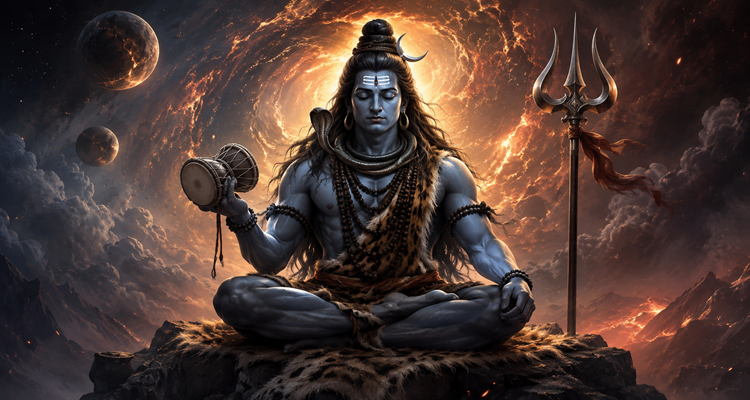
Across generations, the figure of Shiva has occupied a unique place in Indian spiritual thought. More than a deity confined to mythology, Shiva represents ideas that continue to resonate in modern life: creation and destruction, stillness and transformation, discipline and compassion, silence and cosmic energy. For many people, these symbols are not just religious concepts. They are philosophical tools for understanding existence itself.
What makes Shiva especially fascinating is the depth hidden within every image associated with him. The damaru, the trident, the serpent, the ash-covered body, the third eye, the meditative posture, and the fierce Tandava dance are all layered with meaning. These are not random artistic details. They are visual philosophies encoded into storytelling.
Even in an age dominated by technology, science, and fast-moving digital culture, ancient symbolism surrounding Shiva continues to attract curiosity from scholars, spiritual seekers, artists, psychologists, and everyday readers alike. Part of that appeal comes from how timeless the themes are. Human beings still struggle with fear, ego, anger, attachment, purpose, and change, exactly the subjects Shiva’s symbolism explores.
Rather than treating these stories as distant mythology, many people today are revisiting them as reflections on consciousness, self-control, balance, and the cycles of life itself.
Understanding Shiva as a Symbol, Not Just a Deity
In traditional Hindu philosophy, Shiva is often described as the force beyond beginnings and endings. Unlike many mythological figures associated with specific roles, Shiva embodies paradox. He is both ascetic and householder, destroyer and protector, terrifying and compassionate.
This duality is central to understanding why Shiva remains culturally relevant.
The Sanskrit root associated with “Shiva” is often interpreted as “that which is auspicious” or “pure consciousness.” But beyond literal translation, Shiva symbolizes the unchanging reality beneath constant change.
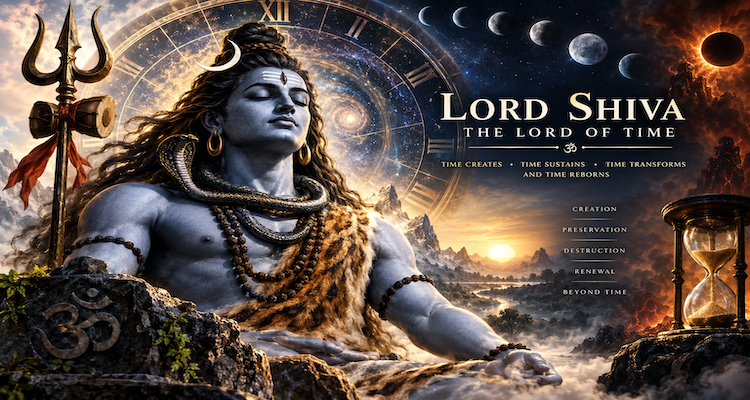
Ancient Indian philosophy frequently viewed existence as cyclical rather than linear. Creation, preservation, destruction, and rebirth were seen as recurring processes woven into nature itself. Shiva represents the transformative phase of that cycle, not destruction for chaos, but destruction that clears the path for renewal.
That distinction matters.
In modern thinking, destruction is usually treated as negative. Yet nature itself operates through cycles of collapse and regeneration. Forest fires create fertile ground for new ecosystems. Old habits must end before healthier ones emerge. Societies evolve by challenging outdated systems. Shiva’s symbolism reflects this uncomfortable but necessary truth: transformation often requires dissolution first.
The Deeper Meaning Behind Shiva’s Damaru
One of Shiva’s most recognizable symbols is the damaru, the small hourglass-shaped drum often shown in his hand.
At first glance, it may appear decorative. Philosophically, however, it represents rhythm, vibration, and the continuity of existence.
The shape itself resembles expansion and contraction, two opposing forces connected through a center point. Many interpretations associate this with the cyclical movement of the universe: creation emerging from stillness, dissolving, and then beginning again.
The sound of the damaru is also linked to vibration as the origin of existence. Ancient Indian spiritual traditions frequently emphasized sound as a foundational force. The sacred syllable “Om” is considered by many traditions to symbolize cosmic vibration and universal consciousness.
In a broader sense, the damaru can also be viewed as a metaphor for human life. Everything operates through rhythm: heartbeat, breath, seasons, tides, sleep cycles, growth, and decay. Life itself is movement between opposites.
The symbolism suggests that endings are rarely absolute. What disappears in one form often returns in another.
Why Shiva’s Third Eye Represents Awareness
The third eye is among the most powerful and misunderstood symbols associated with Shiva.
Popular storytelling often presents it as a destructive force capable of reducing anything to ashes. Symbolically, however, the third eye represents insight beyond ordinary perception.
In spiritual philosophy, the two physical eyes observe the external world, while the third eye symbolizes inward awareness, the ability to perceive truth beyond illusion, ego, or distraction.
This idea remains surprisingly relevant today.
Modern life constantly competes for human attention. Social media algorithms, advertising, and digital noise create endless stimulation, often encouraging reactive thinking rather than reflective awareness. The symbolic “third eye” can be understood as the capacity to pause, observe clearly, and see beyond surface appearances.
In many traditions, awakening awareness is not about escaping the world. It is about seeing reality more honestly.
That includes recognizing personal flaws, emotional patterns, unhealthy attachments, and illusions created by fear or ego.
The Serpent Around Shiva’s Neck and the Idea of Self-Control
The serpent around Shiva’s neck is another deeply symbolic element.
Serpents have historically represented both danger and wisdom across cultures. In Shiva’s imagery, the serpent is often interpreted as controlled power rather than uncontrolled fear.
One philosophical interpretation links the serpent to human energy and instinct. Another sees it as a representation of time, mortality, and transformation. Rather than rejecting these forces, Shiva wears them calmly.
This matters because self-mastery is a recurring theme in spiritual traditions worldwide.
Modern psychology often discusses emotional regulation, impulse control, and mindfulness in scientific language. Ancient symbolism approached similar ideas metaphorically. The message remains familiar: strength is not the absence of emotion or power; it is the ability to control it.
The serpent does not dominate Shiva. Shiva remains composed in its presence.
That distinction reflects emotional discipline rather than suppression.
Tandava: The Dance of Creation and Destruction
Few images capture Shiva’s complexity more vividly than the cosmic dance known as Tandava.
In artistic depictions, Shiva dances within a ring of fire while one foot crushes ignorance beneath him. One hand holds fire, another the damaru, while another offers protection.
The symbolism is layered and profound.
The fire represents destruction and transformation. The drum symbolizes creation and rhythm. The raised foot is often interpreted as liberation or spiritual freedom. The crushed figure beneath Shiva represents ignorance, ego, or unconsciousness.
Together, these elements create a philosophical statement about existence itself: life is motion.
Nothing remains fixed forever.
Civilizations change. Relationships evolve. Identities shift. Economies rise and fall. Personal growth often requires discomfort. The dance symbolizes the universe as an ongoing process rather than a static condition.
In contemporary terms, the image can also be interpreted psychologically. Human beings constantly balance creation and destruction within themselves, building habits while breaking others, letting go of outdated identities, rebuilding after failure, and adapting to change.
Shiva’s dance acknowledges that chaos and order are not opposites. They are interconnected.
Why Ashes Matter in Shiva’s Symbolism
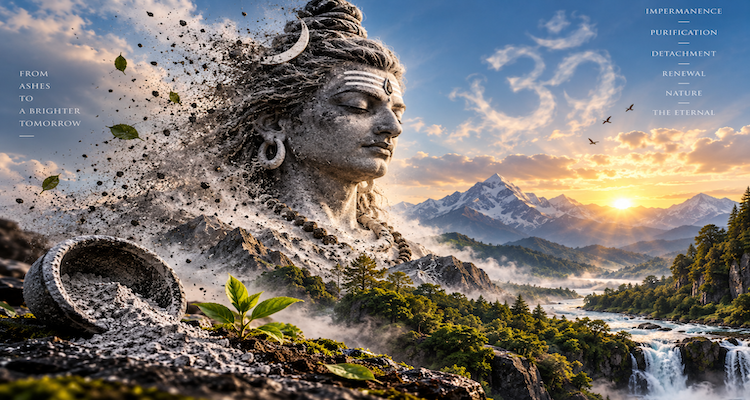
Shiva is frequently depicted covered in ash, a detail that carries profound philosophical meaning.
Ash represents the final state of all material things. No matter how powerful, beautiful, wealthy, or influential something becomes, physical existence eventually returns to dust.
Rather than promoting pessimism, this symbolism encourages perspective.
Modern culture often revolves around status, consumption, appearance, and achievement. Yet many philosophical traditions emphasize impermanence as a pathway to wisdom. Recognizing mortality can sharpen gratitude, humility, and clarity about what truly matters.
Ash also symbolizes purification.
Fire destroys form, but ash remains as a reminder of what survives beyond external identity. In spiritual terms, this points toward consciousness rather than material attachment.
It is a radical contrast to modern cultures that often avoid discussing impermanence altogether.
The Philosophy of Detachment and Inner Freedom
Shiva’s meditative posture in the Himalayas reflects another major philosophical theme: detachment.
Detachment is often misunderstood as emotional coldness or withdrawal from life. In spiritual traditions, however, it usually refers to freedom from compulsive attachment.
There is an important difference.
Attachment becomes harmful when identity depends entirely on possessions, approval, control, or outcomes. Detachment does not require abandoning relationships or responsibilities. Instead, it encourages balance, engaging fully with life without becoming psychologically consumed by temporary conditions.
This concept feels increasingly relevant in a world driven by constant comparison and performance.
Burnout, anxiety, overstimulation, and emotional exhaustion are common modern experiences. The image of Shiva in stillness serves as a counterbalance to perpetual urgency.
Silence, reflection, and mental clarity are not weaknesses. They are forms of strength.
Shiva and the Idea of Equality
One overlooked aspect of Shiva symbolism is inclusiveness.
Traditional depictions often surround Shiva with wildly different beings, animals, ascetics, gods, spirits, and ordinary devotees alike. Serpents coexist with peacocks. Fierce imagery coexists with compassion.
This reflects a broader philosophical idea: existence is interconnected.
Many spiritual interpretations of Shiva reject rigid social hierarchy in favor of essential unity. Beneath labels, status, and divisions, all life emerges from the same source.
In contemporary society, where identity conflicts and polarization dominate public discourse, this message continues to resonate.
Equality in this context is not sameness. It is recognition of shared existence despite differences.
Why Shiva’s Symbolism Endures in Modern Culture
The enduring relevance of Shiva comes from the fact that these symbols operate on multiple levels simultaneously.
For some people, Shiva is a deeply personal deity. For others, Shiva represents philosophical truth, psychological insight, artistic inspiration, or cosmic symbolism.
The imagery adapts across generations because the underlying questions remain timeless:
- How do humans deal with change?
- What happens when ego dominates?
- How can destruction lead to renewal?
- What is true freedom?
- How should power be controlled?
- What survives beyond temporary identity?
These are not ancient questions alone. They are modern human questions.
In many ways, Shiva’s symbolism feels increasingly relevant in an era marked by uncertainty, technological acceleration, emotional overload, and social fragmentation.
The ancient imagery offers something surprisingly contemporary: balance.
Strength balanced with compassion. Action balanced with stillness. Power balanced with awareness. Ambition balanced with detachment.
The Real Lesson Hidden in Shiva’s Stories
At its core, Shiva’s symbolism is less about fear or worship and more about transformation.
The stories encourage people to confront uncomfortable truths rather than escape them. Change is inevitable. The ego can become destructive. Attachment creates suffering. Ignorance limits growth. Yet awareness, discipline, compassion, and self-understanding can lead to inner freedom.
Perhaps that is why Shiva continues to captivate people across generations.
The symbolism does not promise a life without chaos. Instead, it suggests that wisdom comes from learning how to move through chaos without losing awareness of what matters most.
In a constantly shifting world, that message remains as powerful today as it was centuries ago.
This content is published for informational or entertainment purposes. Facts, opinions, or references may evolve over time, and readers are encouraged to verify details from reliable sources.