










The Invisible Internet: APIs Are Replacing Websites
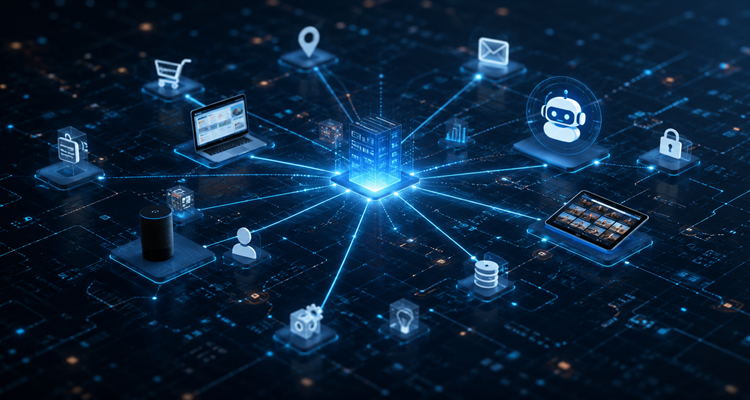
You’re using the internet every day, but you’re seeing less of it than ever before.
A decade ago, most online activity started with a browser. You typed in a website address, clicked through pages, and interacted directly with what companies published online. Today, much of the internet works differently. The visible web, the pages people browse, is increasingly just a thin layer sitting on top of something deeper and far more powerful: APIs.
Most users never notice the shift. But it’s reshaping how apps work, how businesses compete, and even how artificial intelligence understands the web itself.
The Internet You Don’t See
An API, or Application Programming Interface, allows software systems to communicate with each other directly. Instead of a human visiting a webpage, one app requests data from another app automatically.
When you book a flight through a travel app, check the weather on your phone, stream music through a smart speaker, or ask an AI assistant for restaurant recommendations, APIs are usually doing the heavy lifting behind the scenes.
The visible website often becomes optional.
That’s the core idea behind what many technologists quietly call the “invisible internet.” More digital interactions are happening machine-to-machine rather than human-to-website.
For users, the experience feels smoother. For companies, it changes everything.
Why Websites Are Losing Their Central Role
Websites were originally designed for people to read and navigate. APIs are designed for software to consume instantly.
That difference matters.
Modern users expect speed, personalization, and convenience. They don’t want to open five websites just to compare prices, manage subscriptions, or find information. They want one app to handle everything in the background.
That’s exactly what APIs enable.
Food delivery platforms connect restaurants, maps, payment processors, and logistics systems through APIs. Streaming platforms use APIs to sync recommendations across TVs, phones, and cars. Financial apps pull banking data from multiple institutions without users visiting a single bank website.
Even social media increasingly operates this way. Content appears inside feeds, recommendation engines, or embedded previews long before users ever visit the original source.
The website still exists—but often as infrastructure rather than a destination.
AI Is Accelerating the Shift
Artificial intelligence may push this transformation even further.
Large AI systems don’t browse the internet the same way humans do. Increasingly, they rely on structured data, integrations, plugins, and APIs to retrieve information and perform tasks.
That changes the value of being “online.”
In the past, visibility meant ranking high on search engines and attracting visitors to a website. In the API-driven era, visibility may depend on whether systems can access and interpret your data programmatically.
For businesses, that creates a new priority: becoming machine-readable.
A restaurant with accurate API-connected booking data may be more discoverable to AI assistants than one with a beautiful but isolated website. Retailers with strong integrations may outperform competitors with larger web traffic but weaker backend connectivity.
The internet is becoming less about pages and more about access points.
The Rise of “Headless” Digital Businesses
One of the clearest signs of this change is the growth of “headless” systems.
In a traditional setup, a company’s website, design, and backend systems are tightly connected. In a headless model, the frontend experience is separated from the underlying infrastructure. APIs deliver content and services wherever they’re needed: mobile apps, smart devices, kiosks, wearables, AI assistants, or future platforms that don’t even exist yet.
Consumers may never interact with the original website at all.
This approach is now common across e-commerce, media, banking, and entertainment. A streaming platform, for example, might deliver the same content through televisions, gaming consoles, mobile apps, and voice assistants simultaneously through APIs.
The screen changes. The infrastructure stays the same.
That flexibility has become one of the internet economy’s biggest competitive advantages.
The Surprising Impact on Consumer Behavior
One of the most important shifts isn’t technical; it’s behavioral.
People increasingly expect the internet to come to them rather than actively searching for it.
Music is recommended automatically. Shopping suggestions appear before users search. News arrives through feeds, summaries, and alerts. Navigation apps predict destinations. AI assistants answer questions directly instead of sending users through pages of links.
This reduces friction, but it also narrows visibility.
Users experience a more curated internet while seeing less of the broader web itself. The open, exploratory feeling that once defined online browsing is gradually being replaced by invisible systems making decisions in the background.
That creates convenience, but it also concentrates power among platforms controlling those connections.
The businesses that own the interfaces—apps, assistants, operating systems, marketplaces- gain enormous influence over what users actually encounter.
Why Businesses Are Rebuilding Around APIs
For companies, APIs are no longer just developer tools. They are a business strategy.
Retailers use APIs to distribute products across marketplaces and social platforms. Banks open APIs to fintech partners. Media companies syndicate content across apps and devices. Logistics systems connect warehouses, shipping providers, and customer tracking tools in real time.
The value increasingly lies in interoperability.
A company that integrates smoothly into larger ecosystems becomes easier to adopt, automate, and scale. One that remains isolated risks becoming invisible.
This is especially important as consumers spend more time inside ecosystems rather than standalone websites. Super apps, smart assistants, connected cars, wearable devices, and AI-powered workflows all rely on APIs to function seamlessly.
The companies that thrive are often the ones users never directly notice.
The Hidden Risk of the Invisible Internet
The API-driven internet is efficient, but it also introduces new vulnerabilities.
When more services depend on interconnected systems, outages spread faster. A failure in one infrastructure provider can disrupt dozens of apps simultaneously. Security risks also become more complex because information flows constantly between platforms.
There’s also a growing transparency problem.
Users often don’t know how many companies are involved in a single digital interaction. A food delivery order, for example, may involve mapping APIs, payment gateways, recommendation systems, cloud infrastructure, customer analytics tools, and logistics platforms operating invisibly in parallel.
The internet feels simpler on the surface while becoming vastly more layered underneath.
That complexity matters because it shapes privacy, competition, and digital control in ways most users never directly see.
What the Future Internet May Look Like
The next phase of the internet may feel less like browsing and more like orchestration.
Instead of opening websites, users may increasingly rely on AI agents, voice assistants, connected devices, and automated systems that retrieve information and complete actions on their behalf.
In that world, APIs become the internet’s real operating layer.
Websites won’t disappear entirely. Brands still need identity, trust, storytelling, and direct customer relationships. But the website may no longer be the center of digital life.
It could become just one interface among many.
The invisible internet is already here. Most people simply experience it as convenience.
Every time an app updates instantly, a smart assistant answers naturally, or a platform predicts what users want before they search, APIs are quietly replacing the web pages that once defined the online experience.
The internet hasn’t vanished.
It has simply moved behind the curtain.
The information presented in this article is based on publicly available sources, reports, and factual material available at the time of publication. While efforts are made to ensure accuracy, details may change as new information emerges. The content is provided for general informational purposes only, and readers are advised to verify facts independently where necessary.