










The End of Apps? How AI Agents Could Replace Your Phone
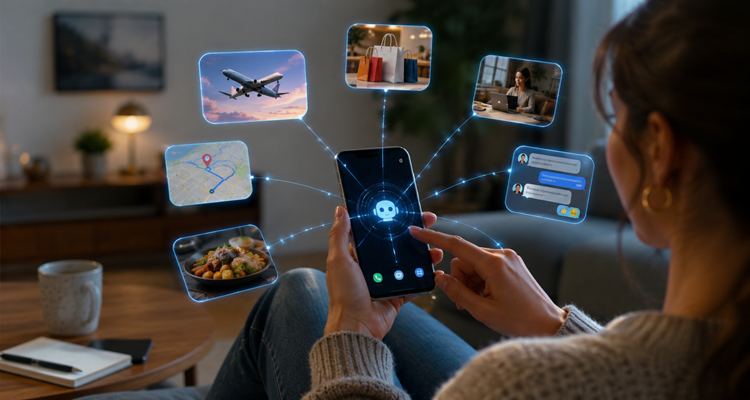
A decade ago, the smartphone changed how people interacted with the internet. Apps became the gateway to everything: food delivery, banking, shopping, travel, entertainment, work, and communication. Every digital service wanted a permanent spot on the home screen.
Now, that model may be heading toward its biggest disruption yet.
A growing wave of AI agents is challenging the idea that users should manually open apps, search through menus, compare options, and complete tasks themselves. Instead of tapping through five different platforms to plan a trip or order dinner, future AI systems may simply handle the entire process through conversation.
The shift sounds subtle at first. In practice, it could completely reshape the mobile industry.
The Smartphone Isn’t Disappearing, but Apps Might Matter Less
The next phase of consumer technology may not be about replacing phones. It may be about replacing the way people use them.
Today’s smartphone experience is built around isolated ecosystems. A food delivery app knows what you eat. A travel app knows your bookings. A calendar app tracks meetings. A banking app handles payments. None of them truly work together unless users manually connect the dots.
AI agents promise something different: a single interface that understands intent rather than commands.
Instead of opening a ride-sharing app, comparing prices, switching to maps, checking your calendar, and texting someone about your arrival time, a user could simply say:
“Get me to the airport by 6 PM and keep the cost reasonable.”
An advanced AI agent could theoretically manage the entire workflow in the background, booking the ride, monitoring traffic, notifying contacts, and adjusting plans if delays appear.
The user never opens an app at all.
That possibility is why major technology companies are racing to build AI assistants that go beyond answering questions and start taking actions.
Why This Moment Feels Different
Digital assistants are not new. Siri, Google Assistant, and Alexa have existed for years. But they largely functioned as voice-controlled shortcuts layered on top of the app economy.
The current generation of AI is different because it understands context, intent, and multi-step reasoning far better than previous systems.
Large language models can already summarize emails, organize schedules, generate content, search across information, and interact conversationally. The next leap involves connecting those capabilities directly to digital services.
That means AI systems could eventually move from “helping users navigate apps” to “becoming the operating layer above apps.”
In that future, apps still exist technically, but they fade into the background. The AI becomes the front door.
The Real Business Threat Isn’t Hardware, It’s Attention
For years, companies fought aggressively for app downloads, notifications, subscriptions, and screen time. Entire business models depend on keeping users inside closed ecosystems for as long as possible.
AI agents disrupt that strategy because they prioritize outcomes over engagement.
A traditional app wants users to browse. An AI agent wants users to finish tasks quickly.
That creates a potential collision between platform economics and consumer convenience.
If an AI assistant chooses the cheapest flight, fastest delivery option, or best-reviewed product automatically, brand loyalty may weaken dramatically. Consumers may interact less with individual platforms and more with whichever AI system manages their digital life.
This could change how companies compete online.
Search engines may lose traffic. E-commerce sites may lose direct customer relationships. Even advertising models could shift if AI agents filter recommendations before humans ever see them.
The companies building the smartest assistants may gain enormous influence over digital commerce.
One AI Agent Could Replace Dozens of Micro-Decisions
The most powerful aspect of AI agents is not automation alone. It’s decision compression.
Modern digital life is filled with tiny repetitive choices:
Which restaurant should I order from?
What’s the cheapest route?
Which subscription am I still paying for?
Did I respond to that email?
What time should I leave for my meeting?
Apps force users to manage these decisions manually across disconnected systems.
AI agents aim to collapse those fragmented interactions into a single conversational layer.
That shift may fundamentally change consumer behavior.
People once learned how to use software interfaces. Future users may simply describe goals and let AI determine the process.
This could especially appeal to younger users who already treat messaging, voice notes, and conversational interfaces as their primary digital habits.
The Biggest Change May Be Psychological
One overlooked consequence of AI agents is how they could alter the relationship between people and technology itself.
Apps trained users to think in terms of tools. Need transportation? Open Uber. Need entertainment? Open Netflix. Need groceries? Open Instacart.
AI agents encourage users to think in terms of intentions instead.
That sounds small, but it changes the mental model of computing.
The interface becomes less about navigating software and more about delegating tasks.
In many ways, this mirrors how people interact with human assistants in professional environments. You explain the objective, not every step required to complete it.
That behavioral shift could redefine convenience in the same way smartphones once redefined internet access.
Privacy and Trust Could Become the Defining Battleground
The promise of AI agents also comes with obvious risks.
To work effectively, these systems would likely need access to calendars, payment systems, messages, travel data, browsing history, and personal preferences. An AI capable of handling daily tasks must understand a significant portion of a user’s life.
That creates enormous trust challenges.
Consumers may hesitate to give a single AI system deep access across financial, personal, and professional activities. Questions around privacy, data security, manipulation, and decision transparency will become increasingly important.
There is also the issue of control.
If an AI agent books travel, prioritizes products, filters information, or manages schedules, who decides what the system optimizes for? Lowest cost? Fastest outcome? Brand partnerships? Advertising incentives?
The more AI handles, the more invisible influence matters.
Silicon Valley Is Already Moving in This Direction
Many of the biggest names in technology are already investing heavily in AI assistants and agent-style systems.
Google is integrating AI deeply into Android and search experiences. Apple is expanding AI capabilities across its ecosystem. OpenAI, Microsoft, Meta, and Amazon are all pushing toward more proactive digital assistants capable of completing actions rather than simply responding to prompts.
Startups are also experimenting with “agentic” software that can browse websites, fill forms, organize workflows, and execute multi-step tasks autonomously.
The race is no longer just about building smarter chatbots. It is about becoming the layer that controls digital interaction itself.
That may ultimately matter more than owning the hardware.
What Happens Next
Apps are unlikely to disappear overnight. Entire industries still depend on them, and many services work best with dedicated interfaces.
But the center of gravity may shift.
Just as web browsers once gave way to app ecosystems, apps themselves could become background infrastructure for AI-driven experiences. Users may rely less on individual platforms and more on intelligent systems capable of coordinating everything behind the scenes.
The companies that adapt early may thrive. Those that depend purely on capturing user attention inside isolated apps could face pressure.
For consumers, the transition may feel surprisingly natural.
After all, convenience tends to win.
And if AI agents eventually become reliable enough to handle daily digital tasks with minimal friction, people may stop asking which app to open and start asking a different question entirely:
“Why do I need apps at all?”
The information presented in this article is based on publicly available sources, reports, and factual material available at the time of publication. While efforts are made to ensure accuracy, details may change as new information emerges. The content is provided for general informational purposes only, and readers are advised to verify facts independently where necessary.