










Mudslides Bury Wrightwood After Powerful Holiday Storm
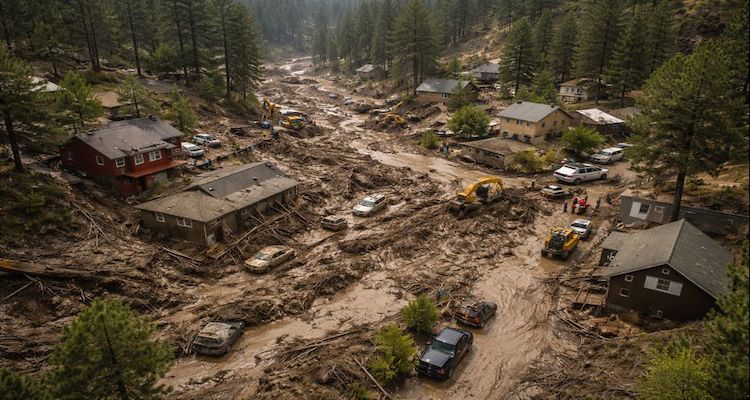
A relentless holiday storm tore through Southern California this week, leaving mountain communities grappling with mudslides, flooding, and widespread damage. While rainfall finally eased Friday, residents in hard-hit Wrightwood are only beginning to understand the scale of destruction, and what comes next.
As atmospheric river storms grow more frequent and intense, the damage in this small resort town offers a stark reminder of the region’s growing vulnerability to extreme weather.
A Holiday Storm That Overwhelmed Southern California
Three days of torrential rain finally loosened their grip on Southern California by Friday, bringing a brief sense of relief after widespread flooding and mudslides battered the region. The storm, which arrived around Christmas Eve, soaked the greater Los Angeles basin and nearby mountain ranges with rainfall totals rarely seen over such a short period.
According to the National Weather Service, some parts of the Los Angeles area recorded up to six inches of rain, while lower-elevation mountain regions east of the city measured more than a foot. The intense downpours overwhelmed drainage systems, saturated hillsides, and triggered debris flows in vulnerable communities.
Although the rain was tapering off, flood watches remained in effect across much of Southern California as authorities warned that saturated ground could still give way.
Atmospheric Rivers and a Perfect Storm Scenario
The system responsible was the latest in a series of atmospheric river storms, long, narrow bands of moisture pulled from the Pacific Ocean and funneled inland by strong winds. While these systems can help replenish reservoirs, they also pose serious risks when they stall over populated areas.
This storm arrived with more than rain. Powerful gusts toppled trees, knocked down power lines, and caused scattered outages across the region. In higher elevations, heavy snowfall piled up, complicating travel and emergency response.
Forecasters had warned days in advance that the combination of intense rainfall, strong winds, and already weakened terrain could lead to dangerous outcomes, particularly in areas scarred by past wildfires.
Wrightwood at the Center of the Damage
Among the hardest-hit locations was Wrightwood, a mountain town of roughly 5,000 residents nestled in the San Gabriel Mountains northeast of Los Angeles. Rivers of mud surged through parts of the community on Wednesday, slamming into homes, burying vehicles, and blocking roads.
San Bernardino County safety inspectors began initial damage assessments as soon as conditions allowed. Officials said several dozen homes sustained major damage, with some partially submerged in thick layers of mud and debris.
“Evacuation warnings for Wrightwood are still in effect, and all the roads in the area are closed, except to residents,” said Ryan Beckers, a spokesperson for the San Bernardino County Fire Department. Emergency crews remained on alert for additional debris flows as runoff continued from surrounding hillsides.
Homes Overrun by Mud and Debris
For residents and property owners, the destruction was deeply personal. Misty Cheng, a 49-year-old accountant who owns a vacation home in Wrightwood, learned her property was being swallowed by a mudslide through a video sent by a neighbor.
“My house is buried in over five feet of mud,” Cheng said in a phone interview from her primary residence in nearby Upland, where she had been staying when the storm hit.
The force of the debris flow crushed a wall in her attached garage, allowing mud to surge into the home’s living space. By the time she returned to assess the damage, the mud had hardened into a dense mass sturdy enough to stand on.
Cheng managed to salvage a truckload of belongings from the home’s second floor, which remained largely untouched. Without flood insurance, she has since turned to crowdfunding to help cover the cost of repairs.
Emergency Rescues and a Narrow Escape
Despite the scale of the destruction, authorities reported no deaths or serious injuries in Wrightwood. Beckers said emergency teams rescued dozens of people over the holiday period after floodwaters and debris trapped them in vehicles or homes.
Aerial footage released by the fire department showed streets choked with mud, vehicles half-buried, and heavy equipment working to clear access routes. Front-loaders and crews labored to reopen roadways while inspectors evaluated which homes were safe to enter.
Officials credited early evacuation warnings and public compliance with reducing the risk of casualties.
Why Wildfire Scars Made Things Worse
Many of the areas affected by mudslides lie near hillsides that burned in recent wildfires. When vegetation is stripped away by fire, soil loses its ability to absorb water, making debris flows more likely during heavy rain.
Authorities issued evacuation warnings before the storm reached its peak, urging residents in high-risk zones to leave early and advising motorists to avoid travel unless absolutely necessary. Those precautions proved critical as rainfall intensified.
What Comes Next for Southern California
Meteorologists said the region is expected to dry out over the weekend, offering a brief window for cleanup and recovery. However, officials cautioned that damaged infrastructure, unstable slopes, and clogged drainage systems will take time to repair.
Beyond Southern California, the same weather pattern is contributing to extreme conditions elsewhere. A major winter storm is forecast to dump potentially record-breaking snowfall across parts of New York state starting Friday night, underscoring the widespread reach of this turbulent weather cycle.
A Warning Sign for the Future
The destruction in Wrightwood highlights the growing challenges facing communities across California as climate-driven weather extremes become more common. Atmospheric rivers are delivering larger volumes of rain in shorter bursts, increasing the risk of flash flooding and mudslides, particularly in mountainous and fire-prone areas.
For residents digging out from under layers of mud, recovery will be slow and costly. But the storm also serves as a reminder of the importance of early warnings, emergency preparedness, and long-term planning in an era of increasingly volatile weather.
As Southern California dries out at least for now, the question facing communities is not whether another storm will come, but when.
ALSO READ: Argentina Approves First Milei-Era Budget After Turbulent Years
Disclaimer:
The information presented in this article is based on publicly available sources, reports, and factual material available at the time of publication. While efforts are made to ensure accuracy, details may change as new information emerges. The content is provided for general informational purposes only, and readers are advised to verify facts independently where necessary.