









When the Ocean Reached Out: A Message Children Could Hear
The sea has always spoken, through tides, storms, and silence. But recently, its message seemed to land somewhere unexpected: with children.
What unfolded wasn’t a single event, but a growing pattern. From classrooms to coastlines, young people are beginning to engage with the ocean not just as a distant body of water, but as something urgent, alive, and increasingly vulnerable.
Across the world, schools are introducing ocean literacy programs, documentaries about marine life are finding younger audiences on platforms like Netflix and YouTube, and social media clips of coral bleaching or plastic pollution are circulating widely among teenagers. The result is a quiet shift, one that feels less like education and more like awakening.
A message carried by waves and screens
The ocean’s “message” isn’t delivered in words. It’s being translated through images of sea turtles tangled in plastic, rising sea levels swallowing coastlines, and once-vibrant coral reefs turning ghostly white.
Organizations like National Geographic and the BBC have long documented these changes, but what’s different now is accessibility. A child with a smartphone can watch the same footage that once required a television broadcast or a classroom screening.
Platforms like TikTok and Instagram have amplified this visibility. Short, emotionally charged clips about marine conservation are being shared at scale, often simplified but impactful. For a generation growing up online, the ocean is no longer out of sight.
Why now?
The timing isn’t accidental. Climate change has pushed ocean-related issues into sharper focus. Rising global temperatures are warming oceans, disrupting ecosystems, and intensifying storms. Reports from scientific bodies like the IPCC have repeatedly highlighted the ocean’s central role in regulating the planet’s climate.
At the same time, education systems are evolving. Environmental awareness is no longer treated as an optional topic. In countries like the United States, the United Kingdom, and India, schools are gradually incorporating sustainability into their curricula.
The convergence of digital access and climate urgency has created a moment where the ocean’s condition is no longer abstract. It’s immediate and visible.
Why it matters
For children, understanding the ocean is not just about science. It shapes how they see the world.
A child who learns about overfishing or plastic pollution is also learning about consumption, responsibility, and interconnected systems. The ocean becomes a gateway to understanding broader environmental challenges.
There’s also a psychological dimension. Exposure to environmental issues at a young age can create a sense of concern, even anxiety. But it can also foster agency. Initiatives like beach clean-ups, school projects, and youth-led climate movements offer ways to respond, not just observe.
Companies and institutions are beginning to notice. Brands like Adidas have partnered with organizations such as Parley for the Oceans to create products from recycled ocean plastic. While these efforts are often criticized for being symbolic, they also reflect a shift in consumer awareness, one increasingly influenced by younger generations.
What feels different this time
Environmental awareness is not new. Previous generations have also been taught about pollution and conservation. But the scale and immediacy are different now.
In the past, the ocean was often framed as vast and resilient, capable of absorbing human impact. Today, that narrative is changing. The focus is on fragility.
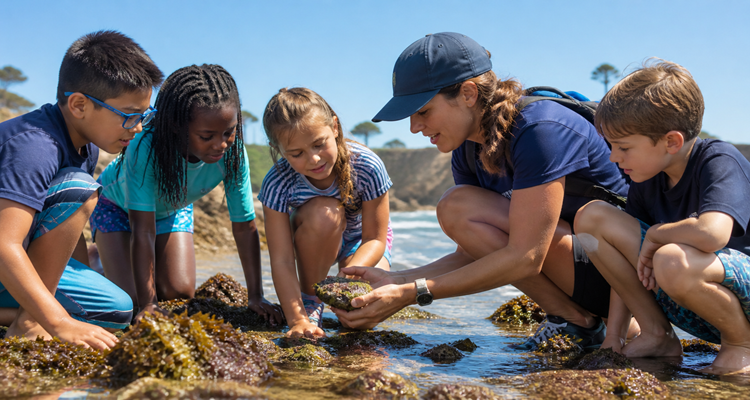
Technology has also altered the experience. Virtual reality tools now allow students to “dive” into coral reefs from their classrooms. Google Earth and similar platforms provide detailed views of coastal changes over time. The ocean is no longer distant; it’s interactive.
This shift from abstraction to immersion is significant. It transforms learning from passive to experiential.
The broader ripple effect
What starts with children rarely stays there. Families, communities, and even markets tend to follow.
When children bring home questions about plastic use or energy consumption, it often leads to conversations and sometimes changes in household behavior. Schools adopting sustainability programs can influence local policies, especially when combined with community engagement.
Globally, youth-led movements have already demonstrated their impact. Climate strikes organized by students have drawn attention from governments and corporations alike. While these movements are not limited to ocean issues, the themes are interconnected.
The ocean, in many ways, has become a symbol. It represents both the scale of the problem and the possibility of collective action.
A shift in how we listen
The most striking aspect of this moment is not just that children are hearing the ocean’s message, but that they are responding differently.
There is less skepticism and more urgency. Less distance and more personal connection.
This reflects a broader behavioral shift. Younger generations are growing up in a world where environmental consequences are not hypothetical. They are visible, measurable, and increasingly unavoidable.
That changes how information is processed. It’s not just knowledge, it’s a lived context.
What comes next
The long-term impact of this shift is still unfolding. Education systems will likely continue to integrate environmental topics more deeply. Technology will make the ocean even more accessible, both visually and interactively.
At the same time, there are challenges. Ensuring that information is accurate, balanced, and actionable is critical. Overexposure to negative imagery without solutions can lead to disengagement rather than action.
Policymakers, educators, and media platforms will play a role in shaping this narrative. The goal is not just awareness, but understanding and ultimately, meaningful change.
The ocean’s message has always been there. What’s changing is who is listening and how early they begin.
This content is published for informational or entertainment purposes. Facts, opinions, or references may evolve over time, and readers are encouraged to verify details from reliable sources.