










Kenya’s Pastoral Heartland Buckles Under Relentless Drought
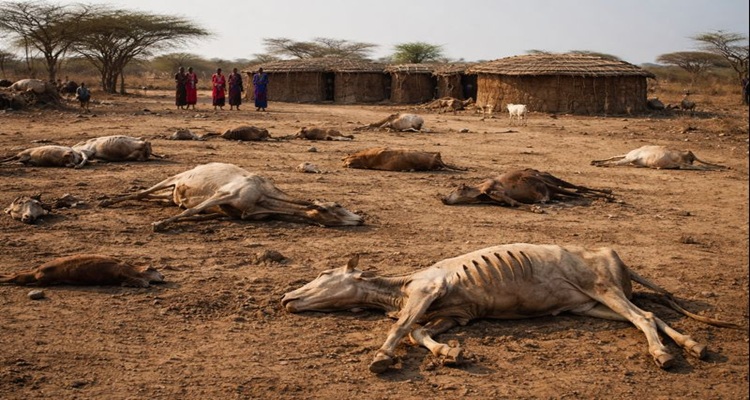
Across Kenya’s grasslands, a slow-moving disaster is unfolding. Prolonged drought is wiping out livestock, draining household incomes, and pushing pastoral families toward hunger and displacement.
What makes this crisis especially alarming is not just its severity, but its spread into regions that once escaped the worst effects of climate shocks.
A Family Compound Turned Graveyard
In Kajiado County, just south of Nairobi, the land around Maria Katanga’s homestead tells a grim story. Carcasses of cows and goats lie scattered across the family compound, stark evidence of how deeply the drought has cut into daily survival.
Katanga, a 24-year-old Maasai herder, has lost more than 100 cattle and 300 goats since August. The animals that remain are skeletal, too weak to produce milk, once a cornerstone of her family’s diet and income.
For pastoral households like hers, livestock are not just assets. They are food, savings, cultural identity, and security rolled into one. When the animals die, everything else begins to unravel.
A Familiar Crisis, Now Worse and Wider
Kenya has endured devastating droughts before. The most recent major crisis in 2022 decimated herds across the arid north and northeast, pushing millions into food insecurity.
This time, the pattern feels different. Climate shocks are arriving more frequently—and their reach is expanding. Areas like Kajiado, which borders the capital and historically received more reliable rainfall, are now being pulled into the emergency.
What was once considered a buffer zone is becoming a frontline.
Livestock Values Collapse Overnight
As animals weaken, their market value collapses with them. Emmanuel Loshipae, Katanga’s 19-year-old stepson, described how prices have plummeted as desperate families rush to sell before their herds die.
Cattle that once fetched between 60,000 and 70,000 Kenyan shillings now sell for a fraction of that—sometimes as low as 5,000 shillings.
These distress sales are not strategic choices. Families are selling animals simply to afford feed, water, or transport in the absence of grazing land. Each sale buys time, but also shrinks the herd that might have helped them recover.
Migration in Search of Grass and Water
With pastures exhausted, herders are on the move. Local administrator Lemaiyan Samuel Kureko said groups of pastoralists are traveling farther than ever in search of water and grazing land, even crossing into neighboring Tanzania.
Seasonal migration has always been part of pastoral life. What’s changing is the scale and desperation behind it.
“There have been droughts before in this region,” Kureko said, “but this one is the worst.”
Such movements increase pressure on already scarce resources and raise the risk of disputes between communities competing for survival.
Rising Risk of Conflict
Kenya’s National Drought Management Authority (NDMA) warned last month that repeated drought cycles are intensifying competition over water and pasture, heightening the risk of violent conflict.
As herders converge on shrinking resources, tensions can escalate quickly, particularly in border areas or regions with overlapping land claims.
Climate stress, experts warn, is becoming a multiplier of existing social and economic vulnerabilities.
A Regional Emergency Across the Horn of Africa
Kenya’s struggle is part of a much larger regional crisis. Across the Horn of Africa, failed rainy seasons are pushing millions closer to hunger.
Somalia declared a national drought emergency in November after repeated rainfall failures. According to the United Nations World Food Programme, millions of Somalis are now facing severe food insecurity at a time when international aid funding is shrinking.
The agency has warned that child malnutrition is reaching alarming levels, with nearly half of Somali children affected and many requiring urgent treatment.
The combination of climate shocks and reduced humanitarian funding is leaving aid groups overstretched just as needs surge.
Forecast Offers Little Relief
Any hope of near-term recovery now hinges on the coming rainy season. But forecasts offer limited reassurance.
The Kenya Meteorological Department said this week that Kajiado is likely to receive near-average to below-average rainfall during the March–May monsoon. For communities already on the brink, even average rainfall may not be enough to reverse months of losses.
Once herds are gone, recovery can take years, if it happens at all.
Aid Gaps Leave Some Regions Exposed
Last month, the NDMA said it had distributed cash assistance to more than 130,000 households in Kenya’s historically arid northern counties to help offset rising hunger.
But Kajiado was not included in those relief efforts.
The omission highlights a growing challenge for policymakers: climate impacts are outpacing traditional classifications of “arid” and “non-arid” regions, leaving newly affected communities without safety nets.
“The Livestock Are Gone”
For local officials on the ground, the human cost is becoming harder to ignore.
“So far, no people have died,” Kureko said. “But the livestock are gone, and the sun grows hotter every day.”
Without animals, families lose food, income, and the ability to withstand future shocks. What remains is uncertainty and prayer.
“We have been weakened to such a level,” he added, “that we can only ask for God’s help.”
What Comes Next for Kenya’s Pastoralists
The current drought underscores how climate change is reshaping life across East Africa. What were once cyclical challenges are becoming chronic emergencies, testing the resilience of communities, governments, and aid systems alike.
For pastoralists, adaptation may require new support systems, better early warning mechanisms, diversified livelihoods, and relief programs that recognize shifting climate realities.
Without those changes, the next drought may arrive before families have even begun to recover from this one.
(According to a Reuters report, with inputs from Kenyan authorities, humanitarian agencies, and local administrators.)
ALSO READ: Hong Kong Shatters 20 Weather Records in 2025 Heatwave
This content is published for informational or entertainment purposes. Facts, opinions, or references may evolve over time, and readers are encouraged to verify details from reliable sources.