








Why Perfect AI Humans Still Feel Unsettling

A face smiles naturally on screen. The eyes blink at the right moment. The voice sounds calm, polished, even warm. Yet something feels wrong almost instantly.
That uneasy reaction is becoming increasingly common as AI-generated humans spread across social media, advertising, podcasts, gaming, and online entertainment. Digital influencers now promote products, AI avatars host videos, and synthetic personalities appear in content streams that once belonged entirely to real people. The technology keeps improving, but public discomfort has not disappeared with the glitches. In many cases, it has grown stronger.
The strange part is that the creepiness often peaks when AI looks almost perfect.
The modern version of the uncanny valley
Psychologists and robotics researchers have long discussed the “uncanny valley,” a concept suggesting that human replicas become more unsettling as they approach realism without fully achieving it. A cartoon character feels harmless. A real human feels familiar. But something that exists between the two can trigger discomfort.
Older versions of this effect appeared in robotic dolls, animated films, or lifelike mannequins. Today, AI has pushed the idea into a far more personal space. Instead of seeing artificial humans in science fiction, people now encounter them in everyday digital environments.
An AI-generated creator may appear in a beauty tutorial on TikTok. A synthetic podcast host may speak with flawless pacing and emotion. A virtual influencer might build a loyal audience despite not existing in the physical world. The line between performance and identity becomes harder to recognize.
That uncertainty is part of what makes modern AI humans feel different from earlier digital experiments.
Realism is no longer the main problem
For years, the biggest challenge in computer-generated humans was visual quality. Poor animation, unnatural movement, and awkward facial expressions immediately revealed that something was fake.
Now the problem has shifted.
AI systems can generate highly realistic skin textures, voices, facial movements, and conversational patterns. Many digital humans no longer fail because they look artificial. They fail because they appear emotionally empty while imitating emotional depth.
Humans are highly sensitive to subtle social cues. Tiny delays in speech, unnatural eye focus, overly symmetrical expressions, or responses that feel slightly disconnected can create distrust. Even when viewers cannot explain what feels off, the brain notices inconsistencies.
This reaction becomes stronger when AI attempts to simulate intimacy.
A virtual assistant giving directions rarely feels disturbing. But an AI-generated personality pretending to be relatable, vulnerable, or emotionally authentic can trigger a very different response. The discomfort comes less from appearance and more from perceived intention.
People instinctively want to know who, or what, they are interacting with.
Social media accelerated the effect
Platforms built around personality-driven content have become the perfect environment for AI-generated humans. Online influence depends heavily on consistency, appearance, and engagement, all areas where AI performs remarkably well.
Unlike real creators, synthetic influencers do not age, burn out, miss upload schedules, or create scandals unless intentionally programmed to do so. Brands see efficiency. Platforms see endless content potential.
Audiences, however, often experience something more complicated.
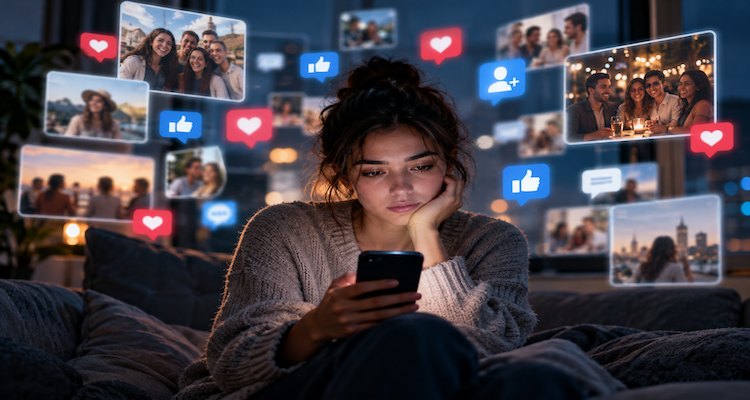
The rise of AI personalities arrives at a time when many users already feel exhausted by curated online identities. Filters, staged lifestyles, and algorithmic content have already blurred authenticity across the internet. AI-generated humans push that tension even further by removing the human element entirely while preserving the illusion of connection.
That creates a psychological contradiction. The content feels personal, but there is no actual person behind it.
For some viewers, that disconnect creates fascination. For others, it creates unease.
The fear goes beyond visuals
Public anxiety around AI humans is not only about appearance. It is also tied to trust, identity, and control.
Deepfakes have shown how easily realistic AI can manipulate video and audio. Fake interviews, cloned voices, and fabricated clips have raised concerns about misinformation and reputation damage. As synthetic media becomes harder to detect, the idea of “seeing is believing” weakens.
This shift affects more than politics or celebrity culture. It changes everyday digital behavior.
People increasingly question whether online interactions are genuine. A customer service representative might be AI-generated. A podcast guest could be synthetic. A viral creator may not exist at all. Even professional networking, education, and dating platforms may eventually face similar questions about digital identity.
The deeper concern is not simply whether AI can imitate humans. It is whether humans will gradually stop expecting authenticity online.
Why younger audiences react differently
One interesting shift is that younger internet users often appear more comfortable interacting with digital personalities than older generations.
Gaming culture, VTubers, virtual streamers, and animated online identities have already normalized non-human personas in entertainment spaces. For many younger users, authenticity is no longer tied strictly to physical reality. A creator can feel “real” emotionally even if they are fictional visually.
But this acceptance has limits.
Audiences tend to respond more positively when artificial identities are openly artificial. Stylized virtual creators are often less unsettling than hyper-realistic AI humans trying to pass as real people. Transparency changes the emotional relationship between the viewer and technology.
This may explain why obviously fictional digital personalities often feel safer than realistic synthetic humans designed to blend invisibly into human spaces.
The business world is paying close attention
Companies are increasingly experimenting with AI-generated presenters, support agents, educators, and influencers because digital humans offer scalability and cost efficiency. A virtual spokesperson can operate globally, speak multiple languages, and produce content continuously.
Yet businesses also face a growing authenticity challenge.
Consumers still place emotional value on human presence, especially in industries built around trust. Healthcare, education, journalism, financial services, and customer support depend heavily on credibility and empathy. If users feel manipulated or emotionally deceived, even advanced technology can damage brand perception.
This creates an important insight for the future of AI communication: realism alone may not be the winning strategy.
The most effective digital experiences may come from systems that balance capability with transparency instead of trying to erase every sign of artificiality. People are often more comfortable with AI when they clearly understand what they are interacting with.
In other words, the future may belong less to invisible AI humans and more to honest digital companions.
The next stage of digital identity
AI-generated humans are no longer experimental curiosities. They are becoming part of mainstream digital culture, entertainment, marketing, and communication. The technology will continue improving rapidly, and synthetic personalities will likely become more common across platforms.
But human psychology evolves more slowly than software.
The discomfort surrounding AI humans reveals something important about how people define trust and connection. Realism alone does not automatically create emotional acceptance. In some cases, it produces the opposite effect.
The closer AI moves toward human imitation, the more carefully society may need to decide where imitation helps and where it crosses into emotional confusion.
That tension is what makes AI-generated humans so fascinating, and so unsettling at the same time.
This content is published for informational or entertainment purposes. Facts, opinions, or references may evolve over time, and readers are encouraged to verify details from reliable sources.