










U.S. Strikes ISIS in Nigeria After Claims of Christian Killings
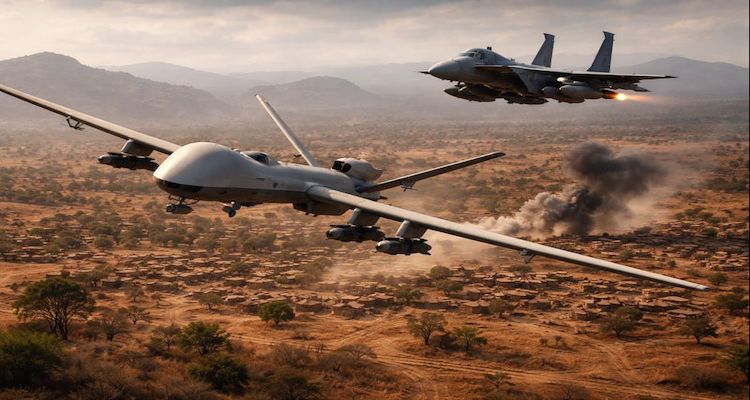
The United States has carried out a rare airstrike inside Nigeria, targeting Islamic State militants in the country’s northwest at the request of Abuja. The operation, publicly confirmed by Washington, highlights rising U.S. concern over extremist violence in West Africa and renewed political focus on religiously motivated attacks.
The strike also signals a deeper phase of U.S.–Nigeria security cooperation, as insurgent threats expand beyond the country’s long-troubled northeast.
A Rare U.S. Military Action in Nigeria
The U.S. military confirmed on Thursday that it conducted an airstrike against Islamic State fighters operating in Sokoto state, a region in northwestern Nigeria that has seen escalating militant activity.
According to U.S. Africa Command (AFRICOM), the operation was launched at the formal request of the Nigerian government and resulted in the deaths of multiple ISIS militants. No civilian casualties were reported in the initial assessment.
The strike marks one of the most direct U.S. military actions inside Nigeria in recent years, underscoring Washington’s growing alarm over the spread of ISIS-linked groups across West Africa.
Trump Frames Strike Around Christian Targeting
U.S. President Donald Trump announced the operation in a Christmas Day post on his Truth Social platform, using unusually blunt language to describe the militants and the rationale behind the strike.
Trump claimed the targeted ISIS cell had been “viciously killing, primarily, innocent Christians” in northwest Nigeria, arguing that the violence had reached levels unseen for decades. He said the strike was ordered under his authority as commander in chief.
The president’s comments reflect a broader narrative he has promoted since late October, warning that Christianity faces what he has called an “existential threat” in Nigeria due to militant attacks and communal violence.
Nigerian Government Confirms Joint Security Effort
Nigeria’s foreign ministry acknowledged the strikes, describing them as part of an ongoing security partnership with the United States. In a statement posted on X, the ministry said the operation followed intelligence sharing and strategic coordination between the two governments.
Officials said the cooperation had enabled “precision hits on terrorist targets” in the country’s northwest, a region increasingly affected by armed gangs and extremist-linked groups.
While Nigeria has welcomed U.S. intelligence and logistical support, officials have consistently emphasized that the country’s security crisis is complex and not rooted solely in religious persecution.
Pentagon Signals More Operations Ahead
The U.S. Department of Defense released video footage showing at least one projectile being launched from a U.S. warship, though specific operational details were not disclosed.
U.S. Defense Secretary Pete Hegseth publicly thanked Nigeria’s government for its cooperation, adding a brief but pointed message: “More to come…”
That remark has fueled speculation that additional joint operations could follow, particularly as U.S. surveillance activity over Nigeria has reportedly increased in recent weeks.
Intelligence Flights and Growing U.S. Presence
Earlier this week, Reuters reported that the United States has been conducting intelligence-gathering flights over large parts of Nigeria since late November. The flights suggest heightened monitoring of militant movements, especially as ISIS affiliates expand beyond their traditional strongholds.
Nigeria has long battled Boko Haram and Islamic State West Africa Province (ISWAP) in the northeast, but northwest states like Sokoto have seen a rise in attacks linked to extremist factions and heavily armed criminal networks.
Security analysts say the overlap between banditry and ideological militancy has complicated Nigeria’s counterterrorism efforts.
Nigeria Pushes Back on Religious Framing
Despite cooperating with the U.S. strike, Nigerian officials have pushed back against claims that Christians are uniquely targeted. Abuja maintains that militant violence affects both Muslim and Christian communities and is driven by a mix of ideology, poverty, and organized crime.
Government spokespersons have argued that portraying the crisis as religious persecution oversimplifies the reality and risks inflaming sectarian tensions in a country already divided along regional and religious lines.
Nigeria’s population is roughly split between a predominantly Muslim north and a largely Christian south, with significant diversity in beliefs and ethnic groups across the country.
Fresh Violence Underscores Ongoing Crisis
The airstrike came on the same day Nigerian police reported another deadly attack in the country’s northeast. Authorities said a suspected suicide bomber killed at least five people and wounded 35 others, highlighting the persistent threat posed by Islamist insurgents.
The attack served as a grim reminder that, despite years of military operations, extremist violence remains deeply entrenched in parts of Nigeria.
Tinubu Calls for Unity and Religious Tolerance
In a Christmas message posted earlier on X, Nigerian President Bola Ahmed Tinubu struck a conciliatory tone, calling for peace and mutual respect among Nigerians of different faiths.
Tinubu reaffirmed his commitment to protecting religious freedom and safeguarding Christians, Muslims, and all citizens from violence. His message appeared aimed at easing tensions amid heightened international scrutiny.
The president has repeatedly emphasized that national unity remains central to Nigeria’s long-term stability and security.
A Broader Pattern of U.S. Military Action
The Nigeria strike follows recent U.S. military operations elsewhere. Last week, the U.S. launched large-scale strikes against dozens of ISIS targets in Syria after a suspected attack on American personnel.
Taken together, the actions suggest a more assertive U.S. posture against Islamic State networks globally, even as the group no longer controls large territories as it once did.
What Comes Next for U.S.-Nigeria Relations
The strike is likely to deepen security cooperation between Washington and Abuja, particularly in intelligence sharing and aerial operations. However, it may also raise questions about sovereignty, civilian risk, and the long-term effectiveness of foreign military involvement.
For Nigeria, balancing international support with domestic political sensitivities will be critical. For the U.S., framing its role carefully could determine whether cooperation strengthens stability or fuels controversy.
A Signal, Not a Solution
The U.S. airstrike in northwest Nigeria sends a clear message about Washington’s willingness to act against ISIS beyond traditional battlefields. Yet it also highlights the limits of military power in resolving deeply rooted security crises.
As Nigeria confronts insurgency, criminal violence, and communal tensions, sustained reforms, local trust-building, and regional cooperation will matter as much as air power. The strike may disrupt militants in the short term, but the path to lasting peace remains far more complex.
ALSO READ: China’s One-Child Policy Legacy Sparks Anger at Official’s Death
Disclaimer:
The information presented in this article is based on publicly available sources, reports, and factual material available at the time of publication. While efforts are made to ensure accuracy, details may change as new information emerges. The content is provided for general informational purposes only, and readers are advised to verify facts independently where necessary.