







U.S. Coast Guard Hunts Sanctioned Oil Tanker Near Venezuela
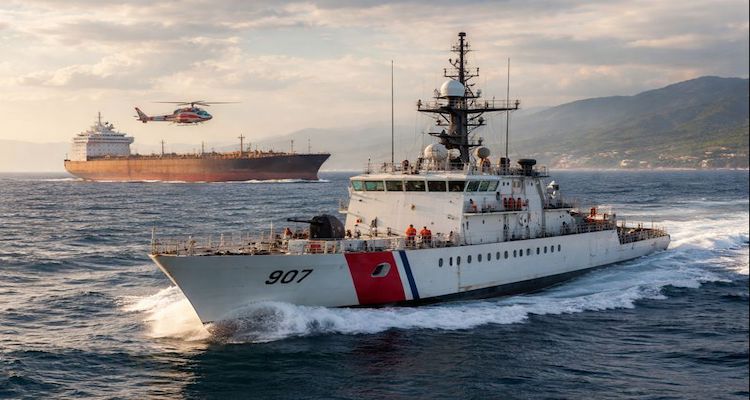
The United States has intensified its crackdown on illicit oil shipments tied to Venezuela, with the U.S. Coast Guard now actively pursuing a sanctioned tanker in international waters near the country. The operation underscores Washington’s escalating pressure campaign against President Nicolás Maduro and raises fresh questions about global oil flows, maritime security, and geopolitical risk in the Caribbean.
A New Chase at Sea
U.S. officials confirmed on Sunday that the Coast Guard is tracking an oil tanker believed to be part of Venezuela’s so-called “dark fleet,” a network of vessels accused of evading international sanctions. If the pursuit results in a seizure, it would mark the third Venezuela-linked tanker intercepted by the United States in less than two weeks.
“This vessel is operating under sanctions, flying a false flag, and is subject to a judicial seizure order,” a U.S. official said, speaking on condition of anonymity because of the sensitivity of the operation.
Authorities declined to name the exact location of the pursuit or confirm whether the ship has been boarded, noting that interceptions can involve close surveillance by ships or aircraft rather than a direct boarding at sea.
The Vessel Under Scrutiny
Maritime risk firm Vanguard and a U.S. maritime security source identified the tanker as Bella 1, a very large crude carrier already sanctioned by the U.S. Treasury Department. According to U.S. officials, the vessel has links to Iran and has previously been involved in sanctioned oil trades.
Data from TankerTrackers.com showed Bella 1 was empty as it approached Venezuelan waters on Sunday. However, its past activity has drawn attention from regulators. In 2021, the tanker transported Venezuelan crude to China, according to internal documents from state-run oil company PDVSA. Vessel monitoring services have also linked it to shipments of Iranian crude in earlier years.
These movements have placed Bella 1 squarely within Washington’s enforcement crosshairs as the U.S. expands its efforts to disrupt oil flows tied to sanctioned governments.
Trump’s Renewed Pressure Campaign
The pursuit comes days after President Donald Trump announced what he described as a “blockade” targeting all sanctioned oil tankers entering or leaving Venezuela. The move marks a sharp escalation in the administration’s strategy to choke off revenue to the Maduro government.
Beyond economic measures, Trump’s pressure campaign has included a heightened U.S. military presence in the region. Over the past several weeks, U.S. forces have carried out more than two dozen strikes on vessels in the Pacific Ocean and Caribbean Sea near Venezuela, according to officials. Those operations have reportedly resulted in at least 100 deaths.
The White House did not respond to requests for comment on Sunday regarding the latest tanker pursuit.
Recent Seizures Signal a Pattern
The operation follows two recent tanker seizures linked to Venezuela’s oil trade. The most prominent involved The Skipper, a very large crude carrier seized by U.S. authorities on December 10. On Sunday, the vessel arrived at the Galveston Offshore Lightering Area (GOLA) near Houston.
Because supertankers like The Skipper cannot navigate the shallow Houston Ship Channel, they typically offload crude at GOLA onto smaller vessels for transport to U.S. refineries.
Kevin Hassett, director of the White House’s National Economic Council, defended the seizures in a television interview, emphasizing that the ships were allegedly operating outside legitimate markets.
“These were black market ships providing oil to countries under sanctions,” Hassett said on CBS’ Face the Nation. He added that the limited number of seizures should not cause concern about rising fuel prices in the United States.
Market Reaction and Analyst Views
Despite those assurances, oil markets reacted cautiously. In early Asian trading on Monday, Brent crude futures rose 42 cents, or 0.7%, to $60.89 a barrel. U.S. West Texas Intermediate crude climbed 37 cents, or 0.7%, to $56.89 per barrel.
Analysts say traders are closely watching whether the U.S. actions signal a broader clampdown that could disrupt supply.
UBS analyst Giovanni Staunovo warned that the seizures could be seen as an escalation, particularly because one tanker intercepted over the weekend was not previously under U.S. sanctions.
“More Venezuelan barrels could be at risk,” Staunovo said, noting that uncertainty itself can drive price volatility even before physical supply is affected.
Venezuela Pushes Back
Venezuelan President Nicolás Maduro has dismissed U.S. efforts to derail the country’s oil trade. Speaking last week, Maduro insisted that Venezuela will continue exporting crude despite mounting pressure from Washington.
Still, energy experts say the focus on oil tankers could have swift and damaging consequences for the country’s economy, which depends heavily on petroleum exports.
Francisco Monaldi, director of the Latin America Energy Program at Rice University’s Baker Institute, said Venezuela could feel the impact sooner than many expect.
“If export volumes fall sharply, storage tanks will fill up quickly,” Monaldi explained. “That would force production cuts, which would directly hit government revenue.”
Broader Implications for Global Shipping
The latest pursuit highlights growing risks for shipping companies operating near sanctioned states. Vessels accused of falsifying flags, disabling tracking systems, or conducting ship-to-ship transfers are increasingly vulnerable to interdiction.
For insurers, port operators, and traders, the message is clear: compliance scrutiny is intensifying, and the cost of violating sanctions is rising.
At the same time, the U.S. strategy could reshape shipping routes and trade patterns, as operators seek to avoid enforcement zones or exit high-risk markets altogether.
What Comes Next
Whether the Coast Guard ultimately seizes Bella 1 remains uncertain. But the operation itself signals a decisive shift toward more aggressive maritime enforcement.
For Venezuela, the pressure threatens to further constrain oil exports at a time when the country is already struggling with declining production and limited access to global markets.
For global energy markets, the situation adds another layer of geopolitical uncertainty, one that traders, policymakers, and shipping firms will be watching closely in the weeks ahead.
ALSO READ: UK Jobs Market Slows as Pay Rises Defy Hiring Slump
Disclaimer:
The information presented in this article is based on publicly available sources, reports, and factual material available at the time of publication. While efforts are made to ensure accuracy, details may change as new information emerges. The content is provided for general informational purposes only, and readers are advised to verify facts independently where necessary.