










The Mystery Planet That Science Can’t Explain
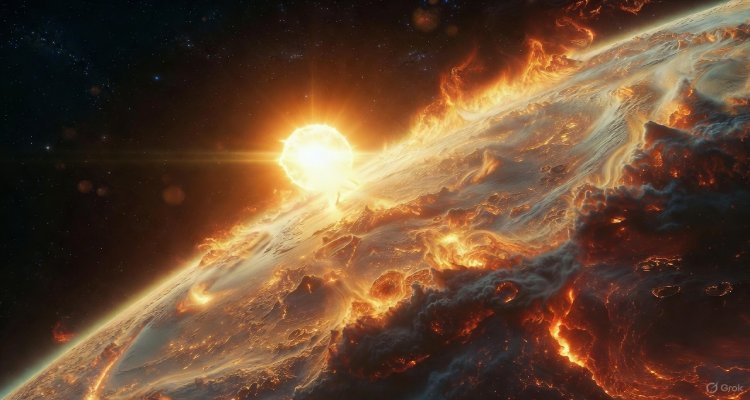
A mysterious exoplanet defies every known rule of planetary science, challenging long-held theories about how worlds form, survive, and evolve.
Introduction: A World That Breaks the Rules
Astronomers expect surprises. Space is full of oddities — rogue stars, wandering black holes, and galaxies colliding in slow cosmic ballets. Yet every now and then, the universe presents something so strange it forces scientists to question the very foundations of their knowledge.
One such marvel is a recently studied exoplanet that, by all standard models of astrophysics, should not exist at all. And yet it does — circling its star with a silent defiance that has baffled experts worldwide.
Context & Background: When Planet Formation Doesn’t Add Up
For decades, astronomers have relied on well-tested theories about how planets form. Worlds are born inside sprawling disks of dust and gas that surround young stars. These disks — known as protoplanetary disks — contain the ingredients necessary for building planets through slow, steady accumulation.
But this newly highlighted planet challenges nearly every step of that familiar process.
Sitting far closer to its host star than scientists believed was physically possible, the planet appears to orbit in a region so intensely hot that materials like rock and metal should vaporize instantly. According to the rules, no solid world should ever form there — and certainly not survive long enough to be detected.
Adding to the mystery, the planet is enormous, far larger than the typical rocky worlds expected in such harsh zones. Its survival challenges existing models of planet migration, star–planet interaction, and atmospheric loss.
In short: this planet isn’t just unusual — it outright contradicts the textbooks.
Main Developments: What Makes This Planet Impossible
Researchers discovered the planet while analyzing long-duration telescope data from a combination of ground-based observatories and space missions focused on exoplanet detection. But it was the follow-up measurements — size, orbital distance, and atmospheric signatures — that stunned the scientific community.
Key anomalies include:
1. Extreme Proximity to Its Star
The planet orbits so close that its “year” lasts only a few Earth hours. The surface temperature is estimated to be hotter than molten lava, far beyond the limits at which typical planetary materials can remain stable.
2. A Size That Defies the Models
Instead of being a small, stripped-down core, the planet is unexpectedly massive. Existing theories suggest that strong stellar radiation should have eroded any atmosphere or volatile material long ago. Yet the world remains intact — a cosmic dare to theorists.
3. Atmospheric Signatures That Don’t Belong
Preliminary data hints at the presence of elements that shouldn’t survive in such a blistering orbit. Whether those components exist in vaporized form or originate from a hidden internal reservoir remains an open question.
These puzzles combined have pushed astronomers toward new hypotheses — from exotic formation paths to unknown interior structures — but no single explanation fully fits the evidence.
Expert Insight: Scientists React to the Cosmic Outlier
Researchers studying the phenomenon describe the planet as a “rule-breaker,” a rare case where nature seems to have bypassed the standard cosmic blueprint.
Astrophysicists emphasize that the mystery isn’t just academic — it speaks to how little humanity still understands about the universe.
One planetary scientist noted that such discoveries often mark the beginning of new scientific revolutions: “Every time we find an object that shouldn’t exist, it reminds us that the universe knows more physics than we do. This planet is telling us something — we just haven’t decoded the message yet.”
Others suggest that the world may have formed far from its star and later migrated inward due to gravitational interactions. Yet even that explanation fails to address why the planet hasn’t been torn apart by tidal forces or evaporated by extreme heat.
Public interest has surged as well, with many drawing parallels to science-fiction worlds that defy natural laws — only this time, the story is real.
Impact & Implications: Rewriting the Rules of Planetary Science
The discovery has implications far beyond one unusual world. If this planet exists, others like it may be hidden throughout the galaxy, waiting for more advanced instruments to uncover them.
This finding forces scientists to reconsider:
- How planets form in extreme environments
- How close a world can orbit its star before destruction
- What exotic materials or internal processes might allow survival
- How common “impossible planets” may be in the broader universe
The unexpected nature of the planet also strengthens the argument for expanding astronomy’s theoretical frameworks. As next-generation telescopes come online, researchers expect to uncover more worlds that stretch — or completely overturn — current scientific assumptions.
Conclusion: A Reminder That the Universe Still Holds Secrets
The planet that shouldn’t exist serves as more than a scientific puzzle — it is a cosmic reminder of humanity’s small but growing understanding of the universe. Each discovery like this pushes astronomers to refine their models, rethink their assumptions, and remain open to the unexpected.
In space, the impossible often becomes reality. And as telescopes reach farther and instruments grow more precise, it is likely that this “impossible” planet is only the beginning of many such revelations.
Disclaimer :This article is based solely on the provided headline. All descriptions, interpretations, and context are original and created for informational and educational purposes.