










The Discovery That Could Rewrite Earth’s Origin Story
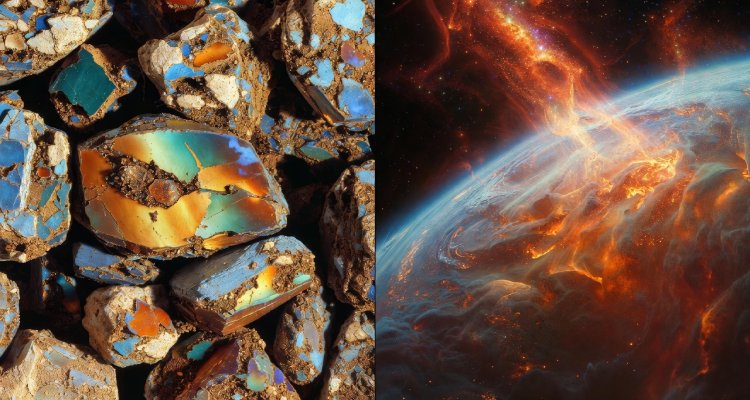
A new scientific discovery suggests Earth’s origins may be more complex and cosmic than once believed, potentially rewriting how our planet—and life itself—began.
Introduction: A Clue Hidden in Deep Time
For centuries, humanity has asked a deceptively simple question: How did Earth begin? Now, a quiet but profound scientific discovery is forcing researchers to revisit that story. Buried within ancient minerals and cosmic debris is evidence suggesting that Earth’s earliest formation may have been far more complex—and far more intertwined with the wider universe—than previously believed. If confirmed, this finding could reshape not only how scientists understand Earth’s birth, but also how life itself became possible.
Context & Background: What We Thought We Knew About Earth’s Birth
The prevailing model of Earth’s origin has long rested on a familiar narrative. Around 4.5 billion years ago, a swirling disk of gas and dust surrounded the young Sun. Over time, particles collided, clumped together, and gradually formed the rocky planets—including Earth. Heat from constant impacts, radioactive decay, and gravitational compression melted the planet’s interior, allowing heavy elements to sink and lighter ones to rise.
While this framework explains much about Earth’s structure, it leaves unresolved questions. How did Earth retain enough water to support life? Why do some ancient minerals contain chemical signatures that don’t match known solar system materials? And how did Earth stabilize quickly enough to become habitable within a relatively short cosmic window?
These gaps have driven scientists to search for deeper clues—often in the smallest, oldest remnants of the planet itself.
Main Developments: What Scientists Found and Why It Matters
The discovery centers on ultra-ancient mineral grains and isotopic patterns found in Earth’s oldest rocks and meteorite fragments. These microscopic time capsules appear to preserve chemical signatures that predate Earth’s final assembly. What makes them remarkable is that they don’t align neatly with the traditional model of a locally formed planet.
Instead, the evidence suggests Earth may have inherited a more diverse mix of materials from across the early solar system—and possibly beyond it. Some isotopic ratios hint that Earth’s building blocks were not uniformly mixed, but instead arrived in stages, potentially influenced by stellar events predating the Sun itself.
If true, this would imply that Earth’s origin story is not a closed chapter that began with the solar nebula, but a continuation of much older cosmic processes. The planet may be, in part, a legacy of ancient stars whose material seeded the conditions necessary for life long before Earth existed.
Expert Insight and Scientific Reaction
“This kind of evidence forces us to rethink where Earth’s most essential ingredients came from,” said one planetary geochemist familiar with the research. “It suggests the planet wasn’t just assembled—it was inherited.”
Other experts urge caution. The signals are subtle, and alternative explanations remain possible. Geological recycling over billions of years can blur original chemical fingerprints, making interpretation difficult. Still, the growing consistency across independent samples has caught the attention of the scientific community.
Among researchers, the reaction has been a mix of excitement and restraint. Many see the discovery as a reminder that planetary science is still evolving, and that even Earth—the most studied planet of all—can surprise us.
Impact & Implications: Rethinking Earth, Life, and the Cosmos
If Earth’s origins are more cosmically entangled than once thought, the implications are far-reaching. It could help explain how Earth acquired water and organic compounds early enough to support life. It may also influence how scientists search for habitable planets elsewhere.
Rather than looking only for Earth-like planets formed under identical conditions, astronomers may begin to consider whether diverse cosmic histories can also produce life-friendly worlds. Earth’s success might lie not in its similarity to other planets, but in its unique, layered inheritance.
This shift could reshape planetary formation models, astrobiology research, and even how humanity understands its place in the universe.
Conclusion: A Planet With a Deeper Past Than Imagined
Earth’s origin story has never been static. With each generation, science refines, revises, and sometimes overturns what we thought we knew. This latest discovery doesn’t discard earlier theories—but it deepens them, suggesting that Earth is not merely a product of local chaos, but a mosaic of ancient cosmic history.
As research continues, one thing is clear: the ground beneath our feet carries echoes of stars long gone. And in listening to those echoes, humanity may finally understand not just how Earth formed—but why it became alive.
The information presented in this article is based on publicly available sources, reports, and factual material available at the time of publication. While efforts are made to ensure accuracy, details may change as new information emerges. The content is provided for general informational purposes only, and readers are advised to verify facts independently where necessary.