









Startup Shifts Defining 2025: Five Trends You Can’t Ignore
The startup world in 2025 looks markedly different from just a few years ago. Founders are navigating tighter funding, smarter technology, and more demanding consumers, all at once. Understanding where innovation is actually heading has become essential not just for entrepreneurs, but for investors, employees, and policymakers watching the next wave of economic growth.
What follows is a grounded look at the top startup trends in 2025, based on real market movements, expert commentary, and observable shifts, not hype.
A Changed Startup Landscape After the Boom Years
The post-pandemic startup boom created a generation of fast-growing companies, many of which struggled once easy money disappeared. By 2025, the ecosystem has matured.
Capital is more selective. Customers are more skeptical. Regulators are more active. In response, startups are building differently, leaner, more focused, and often more sustainable.
This reset has given rise to several defining trends that are shaping how new companies launch, scale, and survive.
1. Profitable Growth Replaces “Growth at All Costs”
One of the clearest startup trends in 2025 is the shift away from reckless expansion.
After years of prioritizing user growth over revenue, founders are under pressure to demonstrate clear paths to profitability. Venture capital firms now scrutinize unit economics, cash flow, and customer retention more closely than vanity metrics.
According to Mary Meeker, longtime tech investor and former Kleiner Perkins partner, “The era of infinite runway is over. Startups that survive will be those built for durability, not just speed.”
As a result, many early-stage startups are launching with smaller teams, narrower product scopes, and realistic revenue goals from day one.
2. AI-First Startups Move Beyond Chatbots
Artificial intelligence is no longer a novelty in 2025, it’s infrastructure.
While earlier AI startups focused heavily on generative chat tools, today’s founders are embedding AI directly into workflows across healthcare, finance, logistics, and cybersecurity.
The trend is toward vertical AI, solutions designed for specific industries rather than general-purpose tools. These startups often replace entire manual processes, not just individual tasks.
Industry analyst Benedict Evans notes that AI startups gaining traction now are “less about magic demos and more about boring reliability,” emphasizing accuracy, compliance, and trust.
This shift reflects a market that values practical outcomes over flashy experimentation.
3. Climate and Energy Startups Enter a Commercial Phase
Climate tech has moved past pilot projects and into real-world deployment.
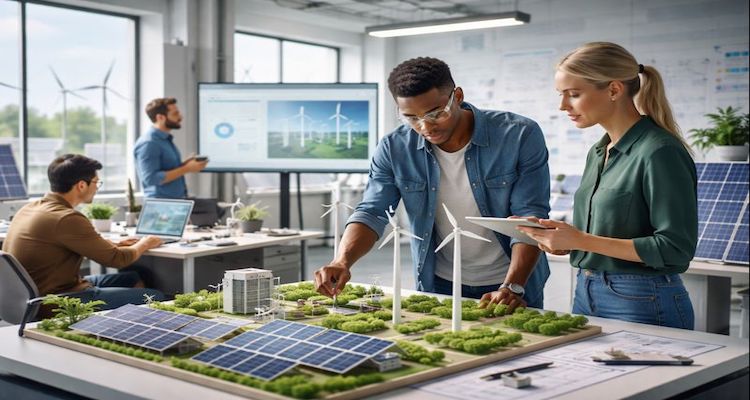
In 2025, startups focused on renewable energy, grid optimization, battery storage, and carbon tracking are signing long-term contracts with governments and corporations. Many are no longer dependent solely on subsidies.
The urgency of climate adaptation, driven by extreme weather, energy price volatility, and regulation, has made these solutions commercially viable.
Public sentiment has also evolved. Consumers increasingly expect businesses to show measurable environmental impact, not just sustainability branding.
This has positioned climate-focused startups as both mission-driven and revenue-ready.
4. The Rise of Solo Founders and Micro-Startups
Another notable startup trend in 2025 is the normalization of very small teams.
Advances in no-code tools, cloud infrastructure, and AI automation allow solo founders or two-person teams to build products that once required dozens of employees.
These micro-startups often target niche markets with highly specific problems, reaching profitability faster by avoiding heavy overhead.
Platforms like Stripe, Webflow, and GitHub continue to lower technical barriers, while distribution through newsletters, communities, and marketplaces reduces reliance on traditional marketing.
Venture funding isn’t always the goal, many of these founders prioritize independence and steady income over hypergrowth.
5. Regulation-Savvy Startups Gain an Advantage
In sectors like fintech, healthtech, and AI, regulation is no longer an afterthought, it’s a competitive edge.
Startups in 2025 are hiring compliance experts earlier and working closely with regulators to design products that can scale without legal roadblocks.
This approach contrasts sharply with earlier “move fast and break things” strategies that often led to fines, shutdowns, or forced pivots.
Former U.S. regulator Rohit Chopra has publicly emphasized that “innovation works best when consumer protection is built in, not bolted on later.”
Startups that embrace this reality are finding it easier to partner with banks, hospitals, and public institutions.
What These Trends Mean for Founders and Investors
Taken together, these developments signal a more disciplined startup era.
Founders must balance ambition with accountability. Investors are backing fewer companies, but with longer-term conviction. Employees are choosing stability and mission alignment over inflated valuations.
Importantly, innovation hasn’t slowed. It has simply become more intentional.
The startups succeeding in 2025 are those solving real problems, understanding their markets deeply, and building trust with users from the start.
A More Sustainable Startup Future
The startup ecosystem in 2025 is less noisy, but more resilient.
While unicorns still emerge, the spotlight has shifted toward companies that can endure economic cycles, regulatory scrutiny, and evolving consumer expectations.
For anyone building, investing in, or working at a startup, the message is clear: the future belongs to those who combine smart technology with sound fundamentals.
In that sense, 2025 may not be about disruption for its own sake, but about building businesses that actually last.
ALSO READ: Yen Slips as Bank of Japan’s Caution Reignites Carry Trades
Disclaimer:
The information presented in this article is based on publicly available sources, reports, and factual material available at the time of publication. While efforts are made to ensure accuracy, details may change as new information emerges. The content is provided for general informational purposes only, and readers are advised to verify facts independently where necessary.