









Navy’s Heritage Vessel INSV Kaundinya Sets Sail to Oman, Reviving India’s Ancient Maritime Memory
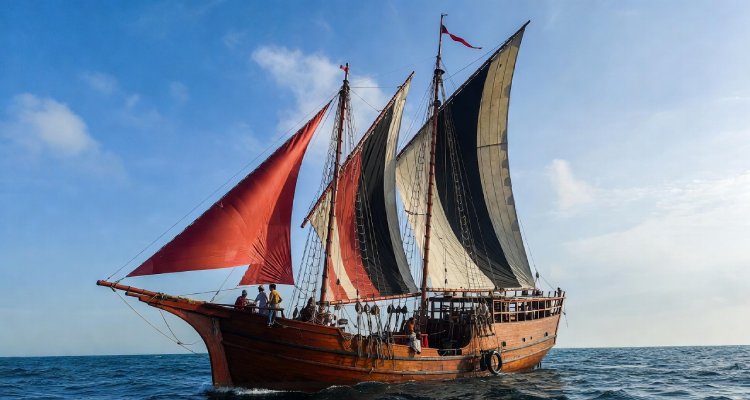
INSV Kaundinya begins its maiden voyage to Oman, retracing ancient Indian Ocean trade routes and reviving India’s fifth-century stitched shipbuilding heritage.
Introduction: A Voyage That Carries History Across the Sea
When the Indian Naval Sailing Vessel INSV Kaundinya slipped into open waters from Porbandar on December 29, it was more than the start of a maiden overseas voyage—it was the revival of a forgotten chapter of Indian maritime history. Bound for Muscat, Oman, the traditionally stitched sailing vessel is retracing ancient sea routes that once connected India’s western coast to the Arabian Peninsula, routes that enabled trade, diplomacy, and civilisational exchange long before modern navies existed.
This journey marks a rare moment where history, craftsmanship, and naval science converge, transforming an archaeological idea into a living, sailing reality.
Context & Background: Rebuilding a Fifth-Century Ocean Voyager
INSV Kaundinya is not a replica in the conventional sense. It is a recreation of a fifth-century stitched ship, inspired by iconographic evidence, including a painting from the Ajanta Caves. With no surviving blueprints of such vessels, the project demanded deep historical inference, technical imagination, and experimental validation.
The ship is named after Kaundinya, the legendary Indian mariner believed to have sailed across the Indian Ocean to Southeast Asia, symbolising India’s long-standing maritime outreach. His name evokes an era when Indian traders and explorers navigated vast waters using wind patterns, stars, and inherited seafaring knowledge.
The project formally began in July 2023, following a tripartite agreement between the Ministry of Culture, the Indian Navy, and Hodi Innovations, with funding provided by the Ministry of Culture. The keel was laid in September 2023, and after months of painstaking craftsmanship, the vessel was launched in February 2025 at Hodi Shipyard in Goa. It was inducted into the Indian Navy in May 2025.
Main Developments: A Ship Built Without Nails or Engines
What sets INSV Kaundinya apart from any modern naval vessel is its method of construction. The ship has been built entirely using traditional techniques and raw materials, without nails or mechanical fasteners.
Artisans from Kerala, led by master shipwright Babu Sankaran, executed thousands of hand-stitched joints, binding wooden planks together using coir rope, coconut fibre, and natural resin. Over several months, the hull was slowly “sewn” together, a method once common across the Indian Ocean world but now nearly extinct.
The ship’s design posed unprecedented challenges. Unlike modern ships, the stitched vessel uses square sails and steering oars, technologies unfamiliar to contemporary naval architecture. With no historical schematics to rely on, the Indian Navy collaborated closely with the shipbuilder to reconstruct the hull geometry and rigging.
To ensure seaworthiness, the design underwent hydrodynamic model testing at the Department of Ocean Engineering, IIT Madras, alongside internal technical assessments. Every element—from sail balance to hull stability—had to be reimagined and tested from first principles.
The voyage to Oman is the first real-world validation of this ambitious experiment.
Expert Insight & Public Reaction: Heritage Meets Naval Science
Naval historians and maritime scholars have hailed the voyage as a rare fusion of intangible heritage and modern scientific rigor. Experts note that stitched ships were once remarkably resilient, flexible in rough seas, and well-suited for long-distance trade across the monsoon-driven Indian Ocean.
Within naval circles, the project is viewed as a demonstration of the Indian Navy’s expanding role—not just as a security force, but as a custodian of India’s maritime legacy. Public response has been equally enthusiastic, with cultural commentators describing the voyage as a “floating museum,” one that restores India’s identity as a historic seafaring civilisation rather than a purely continental power.
The symbolic destination—Oman—adds another layer of resonance. For centuries, Indian and Omani sailors exchanged goods, stories, technologies, and beliefs across these waters, shaping shared coastal cultures that endure even today.
Impact & Implications: More Than a Ceremonial Journey
INSV Kaundinya’s voyage has implications that extend beyond heritage celebration. It reinforces India’s growing emphasis on the Indian Ocean as a cultural and strategic space, not merely a geopolitical arena.
For the Indian Navy, the project strengthens soft power diplomacy, offering a non-militarised narrative of maritime engagement rooted in shared history. For scholars and shipbuilders, it provides a rare experimental platform to study ancient naval engineering under real sea conditions.
The voyage may also inspire future heritage-led initiatives, including educational programs, museum collaborations, and further experimental reconstructions of historic vessels. At a time when maritime traditions are rapidly disappearing, Kaundinya stands as proof that lost technologies can still be revived—patiently, authentically, and with purpose.
Conclusion: Sailing Forward by Looking Back
As INSV Kaundinya charts its course toward Muscat, it carries with it more than sails and cargo—it carries memory. Memory of artisans who once stitched ships by hand, of sailors who trusted wind and water, and of a civilisation that reached outward across oceans long before modern borders existed.
In bringing this vessel to life and sending it back onto ancient routes, the Indian Navy has transformed history from static record into lived experience. The voyage to Oman is not an end, but a beginning—a reminder that India’s maritime story is still sailing, stitched carefully between past and future.
The information presented in this article is based on publicly available sources, reports, and factual material available at the time of publication. While efforts are made to ensure accuracy, details may change as new information emerges. The content is provided for general informational purposes only, and readers are advised to verify facts independently where necessary.