






Mansa Devi Janm Katha: The Serpent Goddess of Wishes
In the vast tapestry of Hindu mythology, few goddesses embody both fear and faith as powerfully as Mansa Devi. Revered as the remover of poison and the fulfiller of heartfelt wishes, her story blends devotion, rejection, resilience, and divine justice.
From Bengal to North India, her legend continues to shape rituals, folk traditions, and spiritual belief systems that endure even today.
Who Is Mansa Devi? A Goddess Born of the Mind
Watch: The mysterious legend of Mansa Devi explained in brief.
Mansa Devi is widely regarded as the Manas Putri, the mind-born daughter, of Lord Shiva. Her name itself derives from “Manas,” meaning mind. In certain Puranic traditions, she is said to have emerged from Shiva’s spiritual essence, which is why she holds a unique place among divine beings.
Another version of her birth connects her to Kadru, the mythical mother of serpents. Because of this association, Mansa Devi is also considered the sister of Vasuki, the king of serpents.
This dual identity, daughter of Shiva and sister of the serpent king, places her at the crossroads of ascetic spirituality and primal cosmic power.
A Childhood Marked by Rejection
Despite her divine lineage, Mansa Devi’s early life was not one of acceptance. Many legends describe her as the stepdaughter of Goddess Parvati, who reportedly did not fully acknowledge her.
This rejection became a defining part of Mansa’s narrative. According to mythological retellings, the lack of maternal acceptance pushed her toward penance and devotion.
Lord Shiva, recognizing her power and devotion, granted her authority over Naglok, the serpent realm, cementing her position as a powerful serpent goddess.
Mythologists often interpret this as a symbolic tale of legitimacy and self-assertion within divine hierarchies.
The Serpent Goddess: Symbolism and Iconography
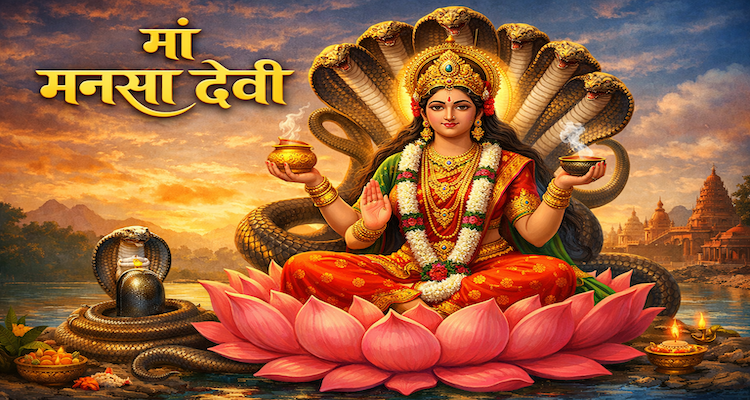
Mansa Devi is typically depicted seated upon a lotus, surrounded or sheltered by seven serpents. In some representations, she holds both nectar (amrit) and poison (vish) in her hands.
This imagery is rich with symbolism.
- Serpents represent transformation, fertility, and hidden knowledge.
- Lotus signifies purity rising above adversity.
- Poison and nectar together reflect life’s duality, death and healing, destruction and salvation.
Because of her power to neutralize venom, she is also called Vishaharini, the remover of poison. In regions prone to snakebites, her worship historically carried deep practical and emotional significance.
Mansa Devi as Astika’s Mother
Another important dimension of her story links her to sage Jaratkaru. In some traditions, Mansa herself is also called Jaratkaru. She married the sage and gave birth to Astika.
Astika later became instrumental in saving the serpent race from annihilation during King Janamejaya’s snake sacrifice (Sarpa Satra).
This episode strengthens Mansa Devi’s role not just as a serpent goddess, but as a protector of balance and continuity in cosmic order.
The Mansa Mangal: Faith, Ego, and Redemption
Watch: The dramatic tale of Chand Saudagar and Goddess Mansa.
One of the most dramatic and widely celebrated narratives associated with Mansa Devi comes from the 15th-century Bengali text Mansa Mangal Kavya.
The epic centers on Chand Saudagar, a wealthy merchant and ardent devotee of Lord Shiva. Mansa sought recognition and worship from him, but he refused, unwilling to accept her divinity.
What followed was a divine test of ego and devotion.
Legends recount that Mansa inflicted severe losses upon Chand Saudagar, including the tragic deaths of his sons. His business empire crumbled, and sorrow overtook his household.
Yet even in grief, the merchant refused to bow.
It was ultimately his wife’s devotion that shifted the course of events. She offered prayers to Mansa Devi, and in response, the goddess restored their son Lakshinder to life.
The story is often interpreted not merely as divine vengeance, but as a moral tale about humility, acknowledgment, and the acceptance of evolving spiritual authority.
Cultural and Regional Significance
Mansa Devi’s worship is especially prominent in Bengal, Assam, Jharkhand, and parts of Uttar Pradesh and Uttarakhand.
In Bengal, her annual festivals include dramatic performances and recitations of Mansa Mangal, blending literature, devotion, and folk art. Clay idols often portray her crowned with serpents, emphasizing her authority over venom and fate.
In North India, she is associated with wish fulfillment. Devotees visit temples seeking blessings for health, prosperity, and protection from unseen dangers.
Her identity bridges classical Puranic mythology and regional folk traditions, an example of how local faith practices shape broader Hindu theology.
Expert Interpretation: Symbol of Fear and Faith
Cultural historians often describe Mansa Devi as a “folk goddess who rose to theological prominence.”
Dr. Ananya Chatterjee, a scholar of South Asian religious traditions, has noted in public lectures that serpent worship historically emerged from agrarian anxieties. In snake-prone regions, deifying serpents created a spiritual framework for coping with natural threats.
Over time, Mansa evolved from a localized serpent spirit into a recognized goddess with scriptural legitimacy.
Her narrative reflects how communities transform fear into faith, and vulnerability into ritual protection.
Why Her Story Still Matters Today
In modern times, Mansa Devi’s temples continue to attract thousands of devotees.
Beyond ritual practice, her story resonates on a psychological level. Themes of rejection, resilience, recognition, and eventual acceptance feel deeply human.
She represents:
- The quest for acknowledgment
- The power of devotion
- The transformation of suffering into strength
For many believers, she is not just a serpent goddess but a divine force who listens to unspoken desires.
Impact and Contemporary Devotion
Mansa Devi’s influence extends beyond mythology into public health awareness in rural areas, where faith-based snakebite awareness campaigns sometimes align with temple outreach.
Her legend also continues to inspire theatre, poetry, and regional literature.
As conversations around indigenous traditions and regional storytelling grow globally, figures like Mansa Devi offer insight into how mythology evolves with community identity.
The Goddess Who Commands Respect
The story of Mansa Devi is not just about serpents or miracles. It is about legitimacy, perseverance, and the timeless human need to be acknowledged.
From being an unrecognized divine child to becoming a widely worshipped goddess, her journey reflects the transformative power of faith.
In honoring Mansa Devi, devotees honor resilience, the ability to rise, to endure, and ultimately, to be seen.
ALSO READ: OM Hill: The Himalayan Peak Shaped by Faith and Nature
This content is published for informational or entertainment purposes. Facts, opinions, or references may evolve over time, and readers are encouraged to verify details from reliable sources.