









India, New Zealand Conclude Free Trade Agreement, Marking a New Chapter in Indo-Pacific Economic Ties
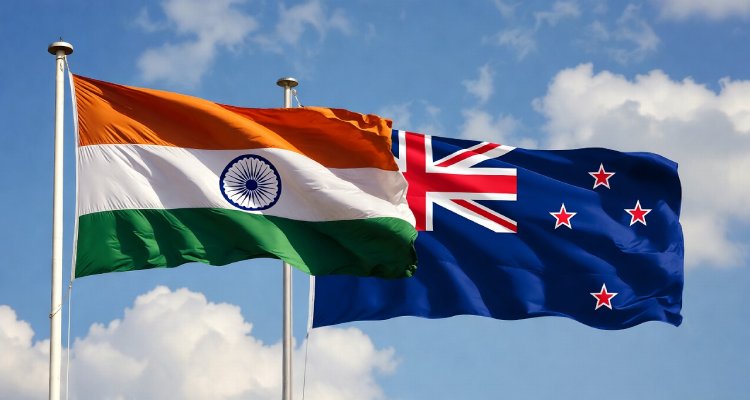
India and New Zealand conclude a fast-tracked Free Trade Agreement, boosting trade, skilled mobility, investment, and Indo-Pacific economic cooperation.
Introduction: A Fast-Tracked Deal with Long-Term Impact
In a rapidly shifting global trade environment, India and New Zealand have taken a decisive step to deepen their economic and strategic partnership. On December 22, the two countries concluded negotiations for a landmark Free Trade Agreement (FTA), signaling a new phase in India’s engagement with the Indo-Pacific region. Notably, the pact stands out as one of the fastest-concluded FTAs in India’s recent trade history, reflecting shared urgency, economic complementarity, and growing geopolitical alignment.
The agreement, expected to be formally signed in the first half of next year, establishes a comprehensive framework designed to expand trade, facilitate skilled mobility, encourage long-term investment, and strengthen agricultural and services cooperation between the two democracies.
Context & Background: A Relationship Built Over Centuries
India–New Zealand relations are rooted in history, migration, and shared institutional values. Indians first arrived in New Zealand in the late 18th century aboard British East India Company ships, supplying Australian convict settlements. Early migrants, primarily from Gujarat and Punjab, laid the foundation for a vibrant Indian community. In 1920, they formed the Auckland Indian Association, which celebrated its centenary in 2020.
Both nations became independent in the same year and share enduring similarities—Commonwealth membership, common law traditions, and democratic governance models that accommodate diverse societies. India established its diplomatic presence in New Zealand in 1950 with a Trade Commission, later upgraded to a High Commission.
Recognizing India’s growing global economic role, New Zealand identified India as a priority partner under its “Opening Doors to India” policy announced in 2011 and reiterated in 2015. Over the years, education and tourism have emerged as key growth sectors, with India now the second-largest source of international students in New Zealand.
Main Developments: Inside the India–New Zealand FTA
The negotiations for the FTA were formally launched on March 16, 2025, during a meeting between India’s Commerce and Industry Minister Piyush Goyal and New Zealand’s Minister for Trade and Investment Todd McClay. What followed were five rounds of continuous and intensive negotiations, culminating in the agreement’s conclusion on December 22.
At its core, the FTA establishes a high-quality economic partnership aimed at boosting employment, enabling skill mobility, expanding trade and investment, fostering innovation in agriculture, and enhancing the participation of micro, small, and medium enterprises (MSMEs).
One of the most significant outcomes is New Zealand’s commitment to eliminate tariffs on 100 percent of its tariff lines, granting duty-free access to all Indian exports. This move substantially enhances the competitiveness of India’s labor-intensive sectors, including textiles, apparel, leather, footwear, marine products, gems and jewellery, handicrafts, engineering goods, and automobiles.
In parallel, India has secured meaningful commitments in services trade across high-value sectors such as IT and IT-enabled services, professional services, education, financial services, tourism, construction, and other business services—opening new pathways for high-skill employment and service exports.
Expert Insight and Public Sentiment: A Strategic and Economic Win
Trade analysts and industry stakeholders have widely described the agreement as a “strategic economic multiplier.” The speed of negotiations has been interpreted as a sign of strong political will on both sides and recognition of mutual economic advantage.
Business groups in India see the FTA as a catalyst for deeper integration into global value chains, especially for MSMEs and export-driven industries. Meanwhile, education providers, IT firms, and service exporters have welcomed the expanded market access and mobility provisions as a long-awaited breakthrough.
The Indian diaspora in New Zealand—numbering around 300,000 people and accounting for nearly 5 percent of the country’s population—has also reacted positively. Long viewed as a cultural and economic bridge, the community is expected to play an even stronger role in boosting trade, investment, and people-to-people ties under the new framework.
Impact & Implications: Trade, Mobility, Investment, and Agriculture
The economic implications of the FTA are wide-ranging. Bilateral merchandise trade stood at $1.3 billion in 2024–25, while total trade in goods and services reached approximately $2.4 billion in 2024, with services trade alone accounting for $1.24 billion. The agreement provides a stable and predictable framework to unlock the full potential of this growing relationship.
A major highlight is the introduction of a Temporary Employment Entry Visa pathway for Indian professionals. Under this provision, up to 5,000 visas can be issued at any given time, allowing stays of up to three years. The pathway covers diverse professions such as AYUSH practitioners, yoga instructors, Indian chefs, and music teachers, along with high-demand sectors including IT, engineering, healthcare, education, and construction. This marks a significant step forward in workforce mobility and services trade.
Agriculture is another critical pillar. Dedicated agri-technology action plans focusing on kiwifruit, apples, and honey aim to enhance productivity through technology transfer, research collaboration, quality improvement, and value-chain development. These initiatives are expected to strengthen domestic capabilities and support income growth for Indian farmers.
On the investment front, New Zealand has committed to facilitating $20 billion in investments into India over the next 15 years, supporting manufacturing, infrastructure, services, innovation, and employment under the ‘Make in India’ vision. Indian enterprises, in turn, are expected to leverage their presence in New Zealand to access broader Pacific Island markets.
Conclusion: A Forward-Looking Economic Partnership
The India–New Zealand Free Trade Agreement represents more than a trade deal—it is a strategic statement about shared economic ambitions in the Indo-Pacific. By expanding market access, enabling skilled mobility, encouraging long-term investment, and strengthening agricultural productivity, the agreement lays the groundwork for sustained, inclusive growth.
As the two countries move toward formal signing and implementation, the FTA is poised to reshape bilateral ties, empower workers and businesses, and reinforce India and New Zealand’s roles as trusted economic partners in a rapidly evolving global order.
The information presented in this article is based on publicly available sources, reports, and factual material available at the time of publication. While efforts are made to ensure accuracy, details may change as new information emerges. The content is provided for general informational purposes only, and readers are advised to verify facts independently where necessary.