










India Markets Poised for Lift After Landmark U.S. Trade Deal
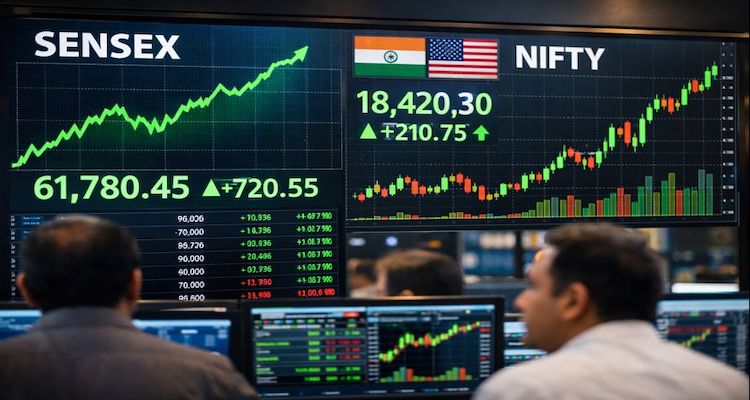
Indian financial markets are heading into Tuesday with renewed momentum after a surprise trade breakthrough between New Delhi and Washington. The agreement eases long-standing tariff tensions and could redraw how global investors view India at a time when emerging markets are competing fiercely for capital.
Beyond stocks and currency moves, the deal carries deeper implications for geopolitics, energy strategy, and India’s position in global trade networks.
A trade reset between Washington and New Delhi
India and the United States have reached a trade agreement that sharply reduces U.S. tariffs on Indian goods to 18%, down from a punitive 50%. In return, India has agreed to halt purchases of Russian crude oil and lower several trade barriers, according to a Reuters report.
The announcement immediately lifted expectations for Indian equities and the rupee, both of which have struggled to keep pace with broader emerging market rallies over the past year.
While formal details and implementation timelines are still awaited, the headline terms alone have eased one of the most persistent concerns hanging over Indian markets: the risk of escalating trade friction with its largest export destination.
Why tariffs mattered more than the numbers suggest
On paper, exports to the United States account for less than 5% of India’s gross domestic product. But market participants say the symbolic weight of the relationship far outweighs the raw economic math.
Lakshman Venkitaraman, associate portfolio manager at Wastach Global in Salt Lake City, noted that U.S.–India trade tensions had been weighing disproportionately on foreign investor sentiment.
According to him, global capital over the past year has gravitated toward markets tied closely to artificial intelligence supply chains, such as Taiwan and South Korea. India, despite strong domestic fundamentals, was often viewed as being caught in potential U.S. trade crosshairs.
The deal, he said, shifts the narrative. It brings India back into focus as a stable, long-term growth story rather than a geopolitical risk.
ALSO READ: Rupee Jumps in Offshore Trade After US–India Deal
Domestic investors held the line
One notable feature of India’s recent market performance is who stayed invested. Even as foreign portfolio investors trimmed exposure, domestic investors continued to pour money into Indian equities.
Venkitaraman pointed out that this domestic commitment has created a strong base for any revival in overseas inflows. With trade uncertainty easing, global investors may now feel more comfortable re-entering Indian markets that they had previously sidelined.
That combination of local confidence and renewed foreign interest could amplify market gains in the near term.
Sectors that could benefit first
Prashant Paroda, a portfolio manager at Allspring Global, described the deal as removing a key overhang that had been limiting upside in Indian equities.
He emphasized the broader political significance of the agreement, calling it a step that strengthens ties between the world’s two largest democracies.
From a sectoral perspective, Paroda expects financial companies to benefit from improved sentiment and potential capital inflows. He also highlighted renewable energy firms with U.S. exposure and select textile exporters as likely winners once the tariff cuts are implemented.
India has underperformed the broader emerging markets index over the past year, he noted. With this announcement, foreign investors who have been net sellers may reassess their positioning and increase allocations to India.
A delayed rally finds new fuel
For some strategists, the announcement feels overdue.
Ben Laidler, head of equity strategy at Bradesco BBI in London, said India had largely missed out on the emerging market rally of the past two years because of fears that it would be dragged into a U.S.-led trade conflict.
He described the deal as a “double benefit” for India, coming on the heels of trade liberalization with two of its largest global partners.
Still, Laidler cautioned against expecting instant transformation. Trade agreements of this scale take time to finalize, implement, and translate into real economic gains. The positive effects, he said, are more likely to unfold gradually rather than in a single market surge.
What it means for the Indian rupee
The currency angle adds another layer to the story.
Lloyd Chan, senior currency analyst at MUFG in Singapore, said the shift in U.S.–India trade policy introduces a new geopolitical and macroeconomic factor for Asian foreign exchange markets.
The Indian rupee has recently faced depreciation pressure due to weak portfolio inflows and concerns around the current account balance. Reduced tariff uncertainty and improved export competitiveness could help stabilize the currency over the medium term.
However, Chan flagged a trade-off that investors cannot ignore.
India’s agreement to move away from discounted Russian crude could push up import costs, complicating the inflation and current account outlook. That dynamic may limit how quickly or how far the rupee can strengthen.
Energy policy meets market reality
India’s reliance on cheaper Russian oil has helped cushion domestic fuel prices over the past two years. Walking away from those discounts introduces new cost pressures at a time when global energy markets remain volatile.
While the trade deal may improve access to U.S. markets, higher energy import bills could partially offset those gains, especially if oil prices rise.
This balancing act between geopolitical alignment and economic pragmatism will be closely watched by both policymakers and investors.
What happens next
Much now depends on execution.
Formal documentation, sector-specific exemptions, and enforcement mechanisms will determine how meaningful the tariff cuts are in practice. Markets are likely to react to each incremental update as details emerge.
For India, the deal reinforces its broader strategy of positioning itself as a trusted trade and investment partner amid shifting global alliances.
For investors, it reduces uncertainty a powerful catalyst in itself.
Looking ahead
The U.S.–India trade agreement does not eliminate all of India’s challenges, nor does it guarantee a sustained market rally. But it clears a major psychological hurdle that had kept many global investors on the sidelines.
As trade tensions ease and capital flows potentially return, India’s long-term growth narrative may once again take center stage.
(With inputs from Reuters.)
ALSO READ: Dollar Steadies as Data, Central Banks Shape FX Mood
The information presented in this article is based on publicly available sources, reports, and factual material available at the time of publication. While efforts are made to ensure accuracy, details may change as new information emerges. The content is provided for general informational purposes only, and readers are advised to verify facts independently where necessary.