







How Shiva’s Symbolism Speaks to Everyday Life
Ancient symbols endure when they continue to explain ordinary experience. That may be one reason Shiva remains so deeply embedded in public imagination across India and beyond.
For many people, Shiva is not only a figure of devotion but also a source of practical insight. His symbolism speaks to self-control, detachment, equality, and the hard work of changing oneself before trying to change the world.
Background / Context
In Hindu thought, Shiva is often approached through multiple forms and names, each emphasizing a different dimension of meaning. He is associated with meditation and family life, ferocity and compassion, wilderness and inner stillness. That layered character has made Shiva one of the most versatile moral and philosophical figures in Indian tradition.
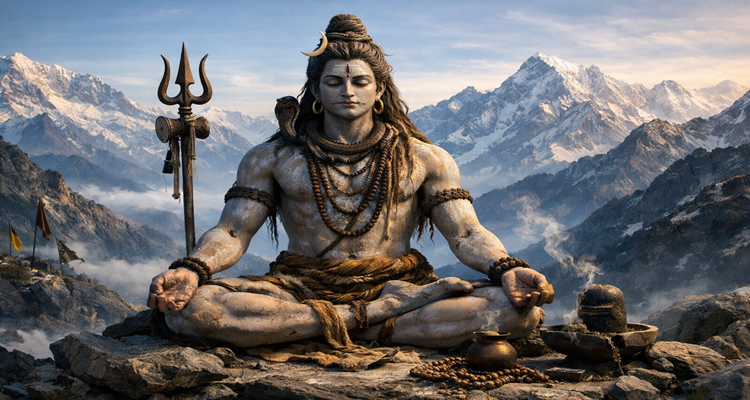
Over time, a vast symbolic vocabulary has grown around him: the serpent, the river, the ash, the blue throat, the mountain, the third eye, the trident, the drum. These are not isolated mythic details. They are interpretive tools, used to think through the pressures of desire, anger, mortality, knowledge, and social difference.
The result is a body of symbolism that lends itself naturally to modern reflection.
Self-Control in an Age of Reaction
One of the most compelling lessons attached to Shiva’s imagery is restraint. In popular understanding, the image of the blue throat points to a striking moral idea: not every poison must be passed on.
Read symbolically, that insight is deeply modern. People now live in systems built for reaction. Social media rewards outrage. Workplaces normalize emotional spillover. Public speech is often driven by impulse rather than reflection.
Shiva’s symbolism suggests another possibility. Harmful force can be contained without being allowed to spread. The lesson is not denial. It is control.
This has obvious real-world implications. Families, offices, and institutions are often damaged not only by external crises but by people who cannot metabolize conflict responsibly. The inability to hold anger, ego, or fear without discharging it onto others is now a major social problem. Shiva’s symbolic restraint offers a counter-model.
Detachment Is Not Indifference
Another major theme in Shiva’s philosophical appeal is detachment. This idea is frequently misunderstood. Detachment does not mean apathy, emotional coldness, or disengagement from the world. It means refusing to be enslaved by possession, vanity, or compulsive attachment.
That distinction is particularly relevant in a culture of over-identification. People tie self-worth to jobs, appearances, follower counts, and public approval. When those markers weaken, the self collapses with them.
Shiva’s ascetic imagery points to a different center of gravity. Human beings can participate in the world without allowing the world to define them completely. One can care deeply while remaining inwardly steady.
This is one reason Shiva often resonates beyond strictly religious communities. In practical terms, detachment is a survival skill. It allows people to act with seriousness without becoming consumed by every outcome.
Equality Through Coexistence
Shiva’s symbolic world also offers an underappreciated vision of coexistence. In many traditional depictions, opposing forces appear within the same sacred space: wildness and order, animal energy and disciplined consciousness, danger and protection.
That layering can be read as an argument for equality more subtle than slogans. Differences do not need to end in hostility. Power does not have to erase vulnerability. The sacred does not belong only to the refined, the orderly, or the socially elevated.
This has implications for social thought. A society that claims to value equality but only respects sameness has not really embraced coexistence. Shiva’s symbolic universe is more demanding. It asks whether people can hold complexity without ranking every life by utility, status, or familiarity.
Such a reading becomes relevant in conversations about caste, exclusion, environmental ethics, and even urban life. Coexistence is not an abstract virtue. It is a daily discipline.
The Importance of Destroying the Right Things
Shiva is often associated with destruction, but this is best understood carefully. The deeper lesson is not the celebration of ruin. It is the necessity of ending what has become false, harmful, or stagnant.
In everyday life, that may mean habits rather than worlds. Destructive thinking, chronic resentment, vanity, envy, cruelty, self-deception, and moral laziness all survive because people are reluctant to confront them directly. Reform becomes impossible when nothing is allowed to end.
That is where Shiva’s symbolism becomes unexpectedly practical. Personal growth is often described as addition, new skills, new routines, and new goals. But just as often, growth is subtraction. A person becomes clearer by removing what distorts judgment.
This editorial lesson is especially useful at a time when self-improvement is often commodified. Real transformation is not always glamorous. Sometimes it looks like relinquishing a grudge, breaking a dependency, or admitting a long-protected illusion.
Knowledge Begins With Humility
Another thread running through interpretations of Shiva is the relationship between knowledge and not-knowing. Wisdom, in this framework, is not arrogance. It begins with emptiness, with the recognition that the mind must make room before it can genuinely learn.
That idea feels increasingly urgent. Contemporary culture encourages the performance of knowledge more than the pursuit of it. People are often rewarded for certainty, speed, and visibility rather than depth. Yet meaningful learning begins when a person recognizes the limits of what they know.
This is where Shiva’s association with stillness and inwardness becomes significant. Reflection is not merely a spiritual luxury. It is an epistemic discipline. Without humility, information remains noise.
Seen this way, Shiva’s symbolism offers a critique of modern intellectual culture. Learning is not accumulation alone. It is also unlearning, quieting, and reordering perception.
Insight / Interpretation
What makes Shiva’s symbolism durable is that it can be read at the level of daily conduct. The symbols do not belong only to metaphysical debate. They speak to anger, ego, attachment, discipline, and social relations, the raw materials of ordinary life.
That is why Shiva remains so relevant in editorial and cultural discussion. He embodies a difficult but necessary proposition: strength without self-control becomes violence, and spirituality without courage becomes escape.
The deeper invitation is ethical. Build what should endure. End what should not. Stay steady enough to tell the difference.
Real-World Impact
These ideas continue to influence how people think about mental discipline, grief, caregiving, leadership, and moral responsibility. Shiva’s symbolism shows up not only in temples and festivals, but in personal language around resilience, letting go, and self-mastery.
In workplaces, the lesson of restraint is relevant to leadership. In family life, detachment can help reduce control and anxiety. In social life, coexistence and equality remain urgent civic values. In personal growth, the call to destroy destructive habits may be more useful than endlessly chasing new affirmations.
That continuing applicability explains why Shiva’s symbolism survives across generations. It does not merely demand belief. It invites practice.
Conclusion
Shiva’s symbolism continues to speak to everyday life because it addresses realities that never disappear: anger, attachment, change, ego, mortality, and the longing for clarity. Its language is ancient, but its practical reach is modern.
At a time when so much of life feels overstimulated and unstable, Shiva remains a powerful reminder that inner discipline, moral courage, and humility are not abstract ideals. They are habits that shape how people live with themselves and with one another.
Continue Exploring:
What Nataraja Teaches a World Living in Upheaval
Why Shiva Endures as a Symbol of Cosmic Balance
Shiva’s Frequency: Ancient Mysticism, New Age Resonance
This content is published for informational or entertainment purposes. Facts, opinions, or references may evolve over time, and readers are encouraged to verify details from reliable sources.