










Forest Signals: Nature’s Climate Early Warning

Long before satellites detect a hurricane’s path or meteorologists issue a red alert, forests are already reacting. Trees shift their chemistry, roots whisper underground, and leaves subtly alter their behavior.

Scientists are now uncovering how forests communicate warnings before climate disasters strike, and what that means for humanity in a warming world.
A Hidden Language Beneath the Canopy
Forests have long been seen as passive victims of climate change, burned by wildfires, flattened by storms, or parched by drought. But emerging research suggests they are far from silent.
Through complex biological systems, forests can detect environmental stress and transmit signals across vast landscapes. These signals act as early warnings, often days or even weeks before visible damage appears.
This phenomenon is sometimes described as the forest’s “silent sixth sense.”
Unlike human communication, forest signaling doesn’t rely on sound or sight. Instead, it unfolds through chemical exchanges, underground fungal networks, and subtle physiological changes in leaves and roots.
How Trees Send Climate Warnings
Chemical Signals in the Air
When trees experience stress, such as extreme heat, drought, or insect attacks, they release volatile organic compounds (VOCs).
These airborne chemicals can alert neighboring trees, triggering defensive responses before the threat reaches them.
In drought conditions, for example, stressed trees emit chemical signals that encourage nearby trees to conserve water by closing their stomata, the tiny pores on leaves responsible for gas exchange.
Scientists have documented this “chemical conversation” in various ecosystems, showing that trees don’t respond in isolation. They prepare collectively.
Underground Networks: The “Wood Wide Web”
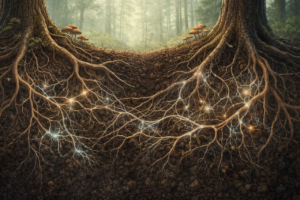
Perhaps the most fascinating discovery in forest ecology is the role of underground fungal networks.
Mycorrhizal fungi form symbiotic relationships with tree roots. Through these networks, trees exchange nutrients, and information.
Researchers often refer to this interconnected system as the “wood wide web.”
When one tree senses environmental stress, it can transmit warning signals through this underground web. Neighboring trees, even of different species, can receive these cues and adjust their growth or defense mechanisms accordingly.
Dr. Suzanne Simard, a forest ecologist at the University of British Columbia, has described forests as “cooperative communities” rather than collections of competing individuals. In public lectures and published studies, she explains that these networks allow forests to respond to threats as unified systems.
Early Stress Signals Before Climate Disasters
Scientists are increasingly observing measurable forest responses before major climate events such as wildfires, prolonged droughts, and heatwaves.
Drought Detection
Satellite data combined with ground-based monitoring has revealed that trees alter their water use efficiency before drought conditions become extreme.
Leaves may reduce photosynthesis rates, and tree canopies can thin slightly, changes detectable through remote sensing technologies.
These early shifts suggest forests can sense atmospheric changes in temperature and humidity before humans fully recognize a drought pattern.
Pre-Wildfire Stress Responses
In fire-prone regions, researchers have found that prolonged heat stress leads to distinct chemical emissions and shifts in tree physiology.
Monitoring these emissions may eventually help improve wildfire prediction models.
Forests under extreme heat often display subtle changes in leaf reflectance, meaning the way leaves reflect sunlight changes slightly. Satellite-based instruments can detect these patterns, offering potential early indicators of heightened fire risk.
While this field is still developing, environmental monitoring agencies are exploring how forest-based signals could complement traditional climate forecasting.
Why Forest Communication Matters
Forests cover roughly one-third of the planet’s land surface and store vast amounts of carbon. They play a critical role in regulating climate systems.
If forests are capable of signaling environmental stress before disasters intensify, that knowledge could reshape how we approach climate adaptation.
Early detection could:
- Improve wildfire preparedness
- Enhance drought forecasting models
- Inform conservation strategies
- Support biodiversity protection efforts
Forests are not just carbon sinks; they are living, sensing systems. Understanding their signals may help governments and communities respond faster to escalating climate risks.
Expert Perspectives
Ecologists emphasize that forest communication is not mystical, it is biological.
Dr. Monica Gagliano, a researcher known for studying plant behavior, has argued in academic discussions that plants exhibit complex signaling processes once thought unique to animals. These processes include memory-like responses and adaptive learning behaviors under stress conditions.
Meanwhile, climate scientists caution against overstating the phenomenon. Forest signaling does not replace meteorology or satellite data. Rather, it complements existing climate science.
Environmental policy experts suggest that integrating forest health data into early-warning systems could become an important tool as climate disasters grow more frequent.
Public and Policy Implications
As climate change accelerates, extreme weather events are becoming more intense and unpredictable. Communities across the globe, from California to Australia to parts of Southern Europe—are grappling with megafires and prolonged droughts.
Incorporating forest stress signals into monitoring systems could help local governments allocate resources earlier.
For example:
- Pre-positioning firefighting crews
- Managing controlled burns
- Issuing early agricultural advisories
- Protecting vulnerable ecosystems
However, challenges remain. Monitoring forest chemical emissions and underground networks at scale requires advanced sensors, satellite integration, and sustained research funding.
There is also a broader conservation message. Forests that are fragmented or degraded may lose their communication networks. Deforestation and habitat destruction could weaken these natural early-warning systems.
In other words, protecting forests may also mean preserving their ability to “speak.”
What Happens Next?
Researchers are now exploring how artificial intelligence and remote sensing technology can decode forest signals in real time.
By combining satellite imagery, drone monitoring, and biochemical sensors, scientists aim to create predictive models based on tree stress patterns.
The goal is not to romanticize forests, but to better understand their biological intelligence.
As climate disasters increase in scale, humanity may need every available source of information. Forests, it turns out, have been gathering data for millions of years.
A Living Alarm System
The idea that forests communicate warnings before climate disasters strike challenges traditional views of nature as passive scenery.
Instead, forests emerge as dynamic, interconnected systems capable of sensing and responding to environmental threats long before catastrophe unfolds.
Listening to these silent signals won’t stop climate change.
But it may give us something equally powerful: time.
And in the age of accelerating climate disruption, time is one of the most valuable resources we have left.
ALSO READ: How Much of Your Lifespan Is Written in Your Genes?
This content is published for informational or entertainment purposes. Facts, opinions, or references may evolve over time, and readers are encouraged to verify details from reliable sources.