







China Gains Ground in Bangladesh as India Faces New Reality
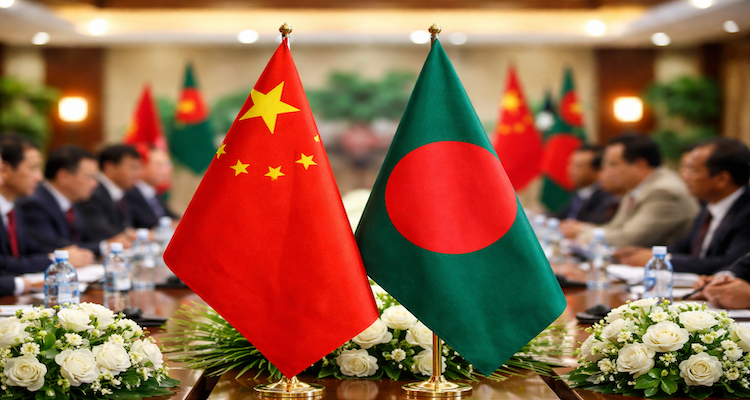
Bangladesh’s February 12 election is more than a domestic political contest. It is a geopolitical inflection point in South Asia, where China is expanding its footprint just as India grapples with the fallout of losing a long-time ally in Dhaka.
The outcome will shape regional trade, security, and diplomacy for years, with implications stretching from Beijing to New Delhi and beyond.
A Political Reset After Hasina’s Fall
Bangladesh goes to the polls less than a year after the dramatic removal of Sheikh Hasina, the prime minister who ruled uninterrupted from 2009 until her ouster in 2024. Hasina, widely viewed as New Delhi’s closest partner in Dhaka, is now in self-imposed exile in India. Her Awami League has been banned from contesting elections.
The two leading contenders, historically skeptical of India’s role in Bangladesh, signal a clear shift from the political era Hasina dominated for 15 years. While neither side is openly advocating a break with India, the tone has changed noticeably.
Analysts say this transition has created an opening for China to consolidate its position in a country that sits at the crossroads of South and Southeast Asia.
China Steps Up Its Presence in Dhaka
Beijing has moved quickly to deepen ties with Bangladesh’s political and economic establishment. Chinese diplomats have been highly visible in recent months, holding frequent meetings with politicians, bureaucrats, and journalists, according to public embassy communications.
Infrastructure remains at the heart of the relationship. Discussions have centered on large-scale projects worth billions of dollars, reinforcing China’s role as Bangladesh’s most significant development partner.
One of the most sensitive moves came recently with a defense agreement to establish a drone manufacturing facility near Bangladesh’s border with India, a development closely watched in New Delhi.
China has been Bangladesh’s largest trading partner for over a decade. Annual bilateral trade hovers around $18 billion, with Chinese imports accounting for roughly 95% of the total, underscoring Dhaka’s heavy economic reliance on Beijing.
India’s Image Problem in Bangladesh
Public sentiment toward India has deteriorated sharply since Hasina’s removal. Critics across the political spectrum accuse New Delhi of enabling her rule and turning a blind eye to alleged abuses.
Humaiun Kobir, foreign affairs adviser to Bangladesh Nationalist Party (BNP) leader Tarique Rahman, has said many Bangladeshis view India as complicit in the violence linked to Hasina’s downfall.
Rahman himself has tried to strike a balanced tone, emphasizing a foreign policy based on national interest rather than alignment with any single power. He has publicly stated that his priority would be maintaining friendly relations with all countries while safeguarding Bangladesh’s sovereignty.
Still, resentment toward India has become a recurring theme on the campaign trail.
Cricket Diplomacy Turns Sour
Tensions between Dhaka and New Delhi have spilled into sports, particularly cricket, which commands enormous public passion in both countries.
Relations worsened after a prominent Bangladeshi bowler was dropped from an Indian Premier League team amid pressure from Hindu groups following attacks on Bangladesh’s Hindu minority. Dhaka responded by banning domestic broadcasts of the league.
Bangladesh also requested that its men’s World Cup matches scheduled for February and March be moved from India to Sri Lanka. When the International Cricket Council rejected the request, Bangladesh was dropped from the tournament altogether, further inflaming public anger.
Visa restrictions have since tightened on both sides, and high-profile diplomatic engagements have largely dried up.
Limited Diplomatic Channels Remain Open
Despite the chill, ties have not completely frozen. Indian Foreign Minister S. Jaishankar met Tarique Rahman in Dhaka in December to express condolences following the death of Rahman’s mother, former prime minister Khaleda Zia.
Bangladesh’s interim government has repeatedly sought Sheikh Hasina’s extradition from India, particularly after a Dhaka court sentenced her to death for ordering a violent crackdown on protesters. A United Nations report estimated that up to 1,400 people were killed and thousands injured, though Hasina has denied issuing such orders.
India has not acted on the extradition requests, further straining relations.
Foreign Policy Becomes an Election Issue
As voting day approaches, foreign influence has become a political weapon. The BNP and Islamist Jamaat-e-Islami, its closest rival, have traded accusations of being too close to outside powers.
Jamaat has alleged that the BNP maintains quiet ties with India, while the BNP has highlighted Jamaat’s historical connections with Pakistan. At rallies, BNP leader Rahman has framed the election as a choice rooted in sovereignty, invoking the slogan: “Bangladesh before everything.”
Indian officials privately concede that New Delhi will have to work with whoever emerges victorious, regardless of past affiliations.
Beijing’s Strategic Advantage
China’s expanding role is not limited to economics. Analysts say Beijing has benefited from deteriorating India-Bangladesh relations and a perceived decline in U.S. engagement in the region.
Constantino Xavier of the Centre for Social and Economic Progress in New Delhi notes that China has positioned itself as a steady, predictable partner at a time when global trade tensions and tariff disputes have disrupted traditional alliances.
Chinese investment has accelerated since Hasina’s exit, while Indian conglomerates that expanded aggressively during her tenure, including the Adani Group, have seen no major new deals materialize.
Why China Appeals to Dhaka’s Next Leaders
Beyond money, China offers something else Bangladesh’s politicians find appealing: political neutrality. Unlike India, Beijing avoids entanglement in sensitive domestic issues, including controversies involving Bangladesh’s Hindu minority during periods of unrest.
This hands-off approach, analysts say, reduces diplomatic friction and makes Chinese engagement easier to sustain.
Thomas Kean of the International Crisis Group argues that if relations with India continue to deteriorate, future governments in Dhaka will have strong incentives to accelerate cooperation with Beijing.
Why India Still Matters
Even as China’s influence grows, experts caution against assuming Bangladesh will pivot exclusively toward Beijing.
Geography alone makes India indispensable. Bangladesh is surrounded by India on three sides, relying on it for transit routes, trade access, and security coordination. New Delhi, in turn, depends on Dhaka’s cooperation to manage its long and sensitive land border.
Trade between the two countries has remained stable at around $13.5 billion annually, dominated by Indian exports. Indian companies have also increased power supplies to Bangladesh in recent months to ease electricity shortages, despite criticism in Dhaka over tariff terms negotiated during Hasina’s rule.
A Complicated Historical Relationship
India’s role in helping Bangladesh gain independence from Pakistan in 1971 still resonates, but long-standing grievances persist. These include disputes over water sharing, border killings, and perceptions that New Delhi propped up an increasingly unpopular Hasina government.
Among younger voters, skepticism toward India runs particularly deep. Leaders of the Gen Z-backed National Citizen Party, aligned with Jamaat-e-Islami, have framed Indian influence as a core election issue rather than campaign rhetoric.
What Comes Next
Most analysts agree Bangladesh’s next government will pursue a pragmatic balancing act, deepening economic ties with China while keeping India engaged out of necessity.
Lailufar Yasmin of Dhaka University notes that no administration can afford to ignore India, regardless of ideological leanings. The challenge will be managing public sentiment while navigating an increasingly competitive regional landscape.
A Delicate Balancing Act
Bangladesh’s election marks a turning point, not a rupture. China is well positioned to expand its influence, but India remains too intertwined—geographically, economically, and historically, to be sidelined.
The real test for Dhaka’s next leaders will be maintaining autonomy in a region where great-power competition is intensifying, and where every diplomatic choice carries long-term consequences.
(With inputs from Reuters.)
ALSO READ: Trump’s Own Voters Push for Softer Tone, Domestic Focus
The information presented in this article is based on publicly available sources, reports, and factual material available at the time of publication. While efforts are made to ensure accuracy, details may change as new information emerges. The content is provided for general informational purposes only, and readers are advised to verify facts independently where necessary.