









Why Tomorrow’s Electricity Might Be Grown, Not Generated
Why future electricity may be grown from living systems like bacteria, plants, and fungi—reshaping clean energy, sustainability, and power generation.
Introduction: When Power Starts to Feel Alive
For more than a century, electricity has come from places that feel distant and industrial—smokestacks, spinning turbines, roaring dams, and humming reactors. Power has always been something we extract, burn, or force into motion. But a quieter, more radical idea is beginning to take root: what if electricity didn’t have to be generated at all? What if it could be grown—cultivated the way crops are, shaped by biology rather than brute force?
Across research labs and clean-energy startups, scientists are experimenting with living systems that can produce electricity continuously. From bacteria that release electrons as they metabolize waste, to algae, fungi, and engineered plant systems that generate power as they grow, the future of electricity may look less like a power plant and more like a greenhouse.
Context & Background: The Limits of How We Power the World
Modern electricity systems were built for scale, not subtlety. Coal, oil, gas, and nuclear energy centralized power production, while even renewables like solar and wind rely on large infrastructure, mined materials, and favorable weather. Despite impressive gains, today’s clean energy transition still faces three stubborn challenges: storage, environmental cost, and accessibility.
Batteries depend on rare minerals. Solar panels and wind turbines require energy-intensive manufacturing. Grid expansion struggles in remote or economically fragile regions. These pressures have pushed scientists to ask a deeper question—not just how to generate cleaner electricity, but whether electricity itself can be produced in a fundamentally different way.
Biological electricity isn’t a new concept. Nature has been moving electrons around for billions of years. Microbes exchange electrons in soil, plant roots interact electrically with fungi, and even the human body runs on bioelectric signals. What’s new is the growing ability to capture and scale these processes for usable power.
Main Developments: How Electricity Can Be “Grown”
The idea of grown electricity centers on bioelectrochemical systems, where living organisms generate or transfer electrons as part of their natural life processes.
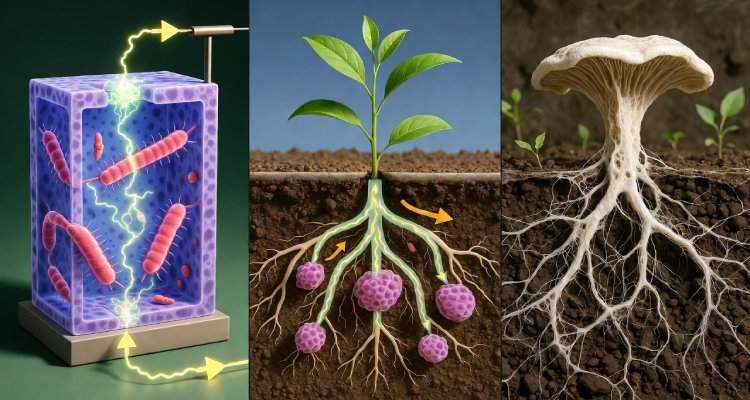
One promising approach uses electrogenic bacteria—microorganisms that release electrons outside their cells while breaking down organic matter. In microbial fuel cells, these electrons are captured by electrodes, producing a steady electrical current. Unlike traditional generators, the system runs continuously as long as the bacteria are alive and fed.
Another frontier involves plants and algae. Through photosynthesis, plants move electrons using sunlight, water, and carbon dioxide. Researchers are developing methods to tap into these electron flows without harming the plant, effectively turning living vegetation into a low-power energy source. In wetlands and rice paddies, experiments have shown that root-microbe interactions can generate electricity directly from soil.
There is also growing interest in fungal networks. Mycelium—the underground thread-like structure of fungi—conducts electrical signals naturally. Early studies suggest that fungal systems could one day form self-repairing, biodegradable electrical networks.
What makes these systems compelling is not raw output. Grown electricity doesn’t aim to replace large power plants overnight. Its strength lies in sustainability, resilience, and decentralization. These living systems regenerate themselves, adapt to their environment, and operate with minimal external input.
Expert Insight & Public Reaction: A Shift in Energy Thinking
Energy researchers increasingly describe biological power as a “paradigm shift.” Instead of forcing nature to release energy, these systems collaborate with it. Scientists emphasize that the true breakthrough isn’t efficiency alone, but longevity. Living power systems don’t degrade the way mechanical ones do; they evolve.
Public interest is also growing, particularly as climate anxiety rises. The idea that electricity could come from wastewater, farmland, or living infrastructure resonates with communities seeking local, low-impact solutions. Environmental advocates see potential in regions where traditional grids are unstable or nonexistent.
Skepticism remains, especially around scalability and reliability. Critics note that biological systems produce relatively low voltage and require careful ecosystem management. Still, many experts compare today’s bioelectric research to the early days of solar power—once dismissed as impractical, now essential.
Impact & Implications: Who Benefits and What Comes Next
If grown electricity matures, its impact could be profound. Remote villages could generate power from local biomass. Urban wastewater plants could double as energy sources. Agricultural land could quietly produce electricity without competing with food crops. Even disaster zones could deploy living power systems that self-sustain without fuel deliveries.
Economically, this could shift energy ownership away from massive utilities toward communities and municipalities. Environmentally, it reduces dependence on mining, combustion, and toxic waste. Technologically, it blurs the line between infrastructure and ecosystem.
The next phase will focus on hybrid systems—combining biological electricity with traditional renewables and smart grids. Rather than replacing solar or wind, grown electricity may complement them, filling gaps where conventional systems fall short.
Conclusion: From Power Plants to Living Power
The future of electricity may not be louder or faster—but quieter, greener, and alive. As science learns to work with nature instead of against it, power generation could become something we nurture rather than extract. Electricity grown from living systems challenges the very definition of energy infrastructure, turning soil, water, and biology into partners in powering civilization.
Tomorrow’s electricity might not come from burning fuel or spinning blades. It might grow slowly, steadily, and sustainably—reshaping how humanity lights its cities and charges its future.
Disclaimer :This article is for informational and educational purposes only. It is based on emerging scientific research and does not constitute technical, financial, or policy advice.