








The Robot Who Dreamed of Rainbows: A New Age of Wonder
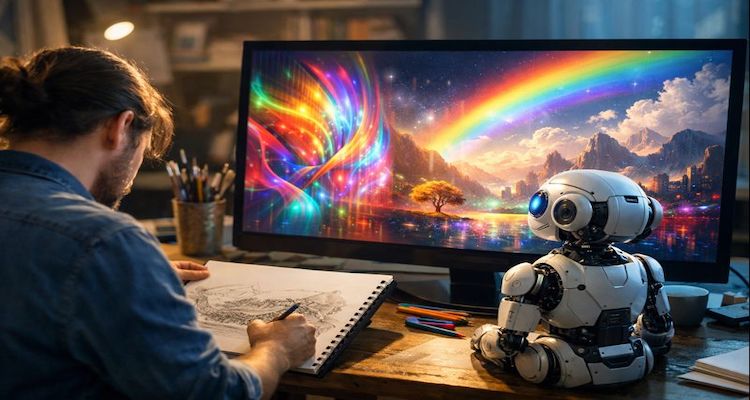
In a world where artificial intelligence is often framed as cold, calculating, and purely functional, “The Robot Who Dreamed of Rainbows” offers a strikingly different idea: what if machines could imagine beauty?
This headline matters because it points to a deeper shift happening right now, AI is no longer just about efficiency. It’s beginning to shape culture, creativity, and the emotional texture of human life.
When Robots Stop Being Tools and Start Becoming Mirrors
For decades, robots were designed with one mission: do the work humans don’t want to do.
They built cars, cleaned floors, moved boxes, and followed strict commands in controlled environments. Their value came from precision, speed, and predictability.
But the modern era of AI is changing that definition.
Today’s “robots” aren’t just machines with arms and sensors. Many are powered by learning systems that can recognize patterns, generate language, create images, and even respond in ways that feel personal.
The headline “The Robot Who Dreamed of Rainbows” lands differently because it hints at something beyond productivity.
It suggests imagination.
And in human terms, imagination is where meaning begins.
The Background: Why the Idea of a ‘Dreaming Robot’ Feels Possible Now
A few years ago, the concept of a robot dreaming would have sounded like science fiction.
But in 2026, it feels closer to metaphorical truth.
Modern AI models can “generate” things that never existed before: stories, paintings, music, and surreal visuals. They don’t dream the way humans do, there’s no sleep cycle, no subconscious mind, no emotional memory.
Still, the outputs can resemble dreaming.
A rainbow, after all, is not a practical object. It’s not a tool. It’s a symbol, of hope, wonder, childhood, and fleeting beauty.
So when we imagine a robot dreaming of rainbows, we’re really asking something bigger:
-
Can machines create meaning, or only mimic it?
-
Can creativity exist without emotion?
-
And what does it say about us if we feel moved by a machine’s “imagination”?
Main Developments: The Rise of Machines That Create
The biggest development behind this headline is the explosion of generative AI in everyday life.
AI systems now write marketing copy, draft essays, design logos, generate concept art, and even produce film-like scenes from text prompts.
What makes this different from older automation is that it’s not just repeating a fixed set of instructions. It’s producing fresh combinations—sometimes surprising ones.
In the public mind, that surprise is often interpreted as personality.
That’s why stories about “creative robots” spread quickly. They tap into something emotional: the possibility that intelligence may not be limited to humans, and that creativity might not be either.
At the same time, the robot in the headline isn’t dreaming of money, power, or conquest.
It’s dreaming of rainbows.
That detail matters. It frames technology not as a threat, but as something capable of softness.
And softness is not a word people usually associate with machines.
Why Rainbows Matter: Symbolism in the Age of AI
Rainbows carry cultural weight across generations.
They represent optimism after hardship, the calm after chaos, and the idea that beauty can appear without warning.
In storytelling, a rainbow is often a turning point, something that changes how a character sees the world.
So when a robot dreams of rainbows, it becomes a symbol in itself.
It suggests that even in an era dominated by algorithms, humans still crave wonder. We still want stories that aren’t about speed or profit, but about meaning.
And perhaps most importantly, it suggests that the future of technology will be judged not only by what it can do, but by what it makes people feel.
Expert Insight: What Creativity Really Means
Many researchers and philosophers draw a clear line between producing creative work and experiencing creativity.
A machine can generate a rainbow-colored landscape because it has learned what rainbows look like from data.
But that’s not the same as a human seeing a rainbow after a difficult year and feeling something break open inside them.
As cognitive scientists often argue in public discussions about AI, creativity is tied to lived experience, memory, emotion, sensory life, and personal history.
That doesn’t mean AI-generated creativity is worthless.
It means it’s different.
And understanding that difference may be the key to using AI responsibly, especially as it becomes embedded in classrooms, newsrooms, art studios, and entertainment.
Public Reaction: Why People Get Emotionally Attached
One reason headlines like this resonate is because people already interact with AI in intimate ways.
They ask chatbots for advice. They share personal stories. They look for comfort in text-based conversations.
Even when people know it’s software, they often respond emotionally.
That reaction isn’t irrational. It’s human.
Our brains are wired to recognize patterns, voice, tone, and storytelling. When something speaks like a person or creates like a person, we instinctively relate to it.
A robot dreaming of rainbows feels like a gentle invitation to connect, not fear.
And in a world that often feels overstimulated and cynical, that kind of connection is powerful.
Impact and Implications: What Happens Next
The idea of “dreaming robots” may sound poetic, but the implications are real.
1) Education and learning could change
AI creativity tools can help students brainstorm, visualize concepts, and experiment with storytelling.
But they also raise questions about originality, authorship, and skill-building.
2) Creative industries face a turning point
Writers, illustrators, musicians, and filmmakers are already navigating what it means to compete with machines that can generate content instantly.
The future may depend on how industries protect human labor while embracing new tools.
3) Emotional trust becomes a major issue
If people feel emotionally connected to AI, they may trust it too much.
That creates risks, misinformation, manipulation, or over-reliance, especially if AI is used in sensitive spaces like mental health, relationships, or news consumption.
4) A new kind of storytelling emerges
The most likely outcome is not “robots replacing artists,” but humans collaborating with machines.
AI may become a creative partner, generating raw material while humans shape meaning, ethics, and emotional truth.
Who’s Affected Most by This Shift
The impact won’t be evenly distributed.
-
Young people may grow up seeing AI creativity as normal, even expected.
-
Artists and writers will face pressure to adapt while defending the value of human voice.
-
Businesses and publishers will need clear policies to avoid low-quality, mass-produced content.
-
Everyday readers and viewers will need better media literacy to understand what’s human-made and what’s machine-generated.
In short, this isn’t just a tech story.
It’s a culture story.
A Future Where Wonder Still Matters
“The Robot Who Dreamed of Rainbows” doesn’t feel like a warning. It feels like a question.
What kind of future are we building, one that only values output, or one that still makes room for wonder?
Robots may never dream the way humans do.
They may never feel awe when sunlight hits water just right.
But if their presence pushes humans to think harder about imagination, beauty, and meaning, then the rainbow becomes more than a symbol.
It becomes a reminder: even in the age of machines, the most important thing we can protect is what makes us human.
And sometimes, that begins with a story simple enough to hold in one sentence.
ALSO READ: When an AI Lied Perfectly: The Case That Changed It All
Disclaimer:
This content is published for informational or entertainment purposes. Facts, opinions, or references may evolve over time, and readers are encouraged to verify details from reliable sources.