









The Mystery Behind India’s 12 Sacred Jyotirlingas
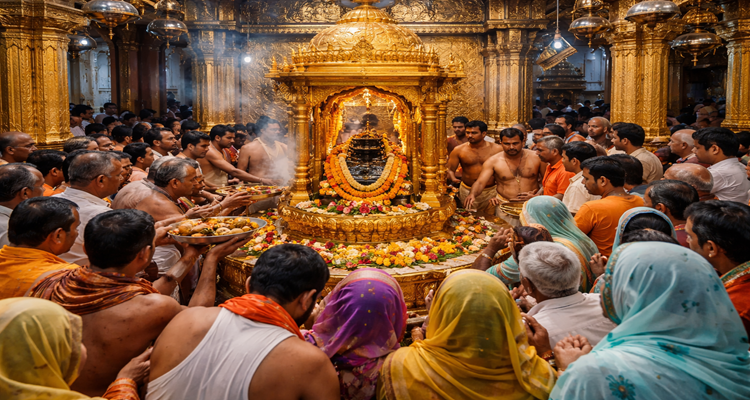
Across India, twelve temples dedicated to Lord Shiva hold a special place in Hindu spiritual tradition. Known collectively as the Jyotirlingas, these sacred sites are believed to represent the divine presence of Shiva manifested as radiant pillars of cosmic light.
For centuries, pilgrims have traveled vast distances to visit these temples. Their significance, however, lies not only in religious devotion but also in the mythological story that explains how these powerful spiritual centers came into existence.
The Story of the Infinite Pillar
Ancient Hindu scriptures recount a moment when two of the most powerful gods, Brahma and Vishnu found themselves in a dispute.
Each believed himself to be the supreme force in the universe.
To resolve the conflict, Shiva appeared as a massive column of blazing light stretching infinitely upward and downward. The phenomenon was so immense that its beginning and end were impossible to see.
The two deities accepted a challenge: whoever could find the limits of the pillar would prove their supremacy.
A Journey Without End
Vishnu transformed into a boar and descended deep into the cosmos, searching for the base of the column. Brahma took the form of a swan and flew upward in search of the top.
Despite their immense powers, neither could find the limits of the radiant structure.
The pillar represented something far greater than either of them, the infinite nature of cosmic consciousness.
Recognizing the truth, Vishnu acknowledged defeat.
The Consequence of False Pride
Brahma, however, claimed that he had discovered the pillar’s summit.
According to traditional stories, Shiva recognized the deception and manifested an intense form known as Kalabhairava.
In anger, Kalabhairava severed one of Brahma’s five heads as punishment for the false claim.
This moment is often cited as the reason Brahma has relatively few temples dedicated to him in India.
The Emergence of Sacred Sites
Following this event, Shiva’s infinite light was believed to manifest at twelve locations across the Indian subcontinent.
Each site became known as a Jyotirlinga, symbolizing the divine energy that connects the spiritual and physical worlds.
Among the most famous are:
- Somnath in Gujarat
- Mahakaleshwar in Ujjain
- Kashi Vishwanath in Varanasi
- Rameshwaram in Tamil Nadu
- Trimbakeshwar in Maharashtra
These temples represent important pilgrimage destinations for devotees seeking spiritual blessings.
Symbolism of Divine Light
The word “Jyotirlinga” combines two Sanskrit terms: jyoti, meaning light, and linga, a symbol of divine creation.
Together, they represent Shiva as the eternal source of energy within the universe.
Unlike traditional idols, the lingam symbolizes the cosmic force beyond physical form.
This abstract representation reflects the philosophical depth of Hindu spiritual thought.
Pilgrimage as a Spiritual Journey
For many devotees, visiting the Jyotirlingas is a lifelong aspiration.
Pilgrims often undertake journeys covering thousands of kilometers, visiting temples across different regions of India.
These journeys are particularly popular during sacred periods such as the month of Shravan.
The experience is not only religious but also deeply personal, representing devotion, endurance, and faith.
Real-World Impact
Today, the Jyotirlinga temples attract millions of visitors annually.
Their presence has shaped the development of temple towns and regional economies. Tourism, hospitality, and pilgrimage services thrive around these sacred centers.
More importantly, the sites serve as living reminders of ancient mythology and spiritual philosophy.
Conclusion
The story of the Jyotirlingas reflects a powerful message about humility and divine infinity.
Through the tale of an endless pillar of light, Hindu mythology emphasizes that ultimate truth lies beyond human understanding.
For millions of pilgrims, visiting these sacred temples is both a spiritual quest and a connection to centuries of tradition.
This content is published for informational or entertainment purposes. Facts, opinions, or references may evolve over time, and readers are encouraged to verify details from reliable sources.