










Tesla Adds New Model Y Variant as EV Market Cools
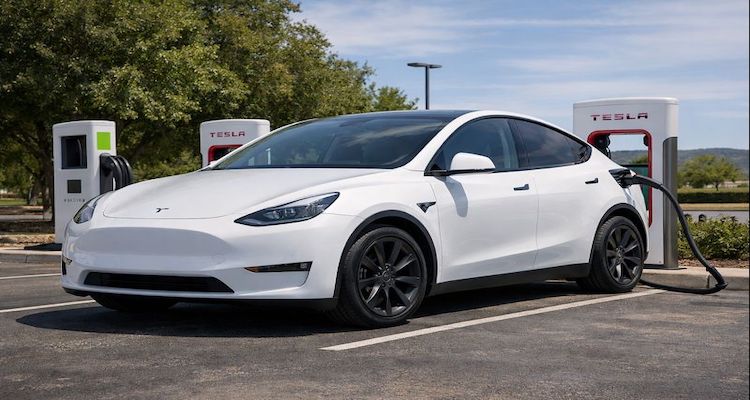
Tesla has rolled out a new version of its best-selling Model Y in the United States, adjusting its lineup at a time when electric vehicle demand is showing clear signs of strain. The move highlights how even market leaders are rethinking pricing, production, and strategy amid shifting policy and consumer sentiment.
As government incentives fade and competition intensifies, Tesla’s latest decision offers a window into the pressures reshaping the global EV industry.
Tesla Expands Model Y Lineup in the U.S.
Electric vehicle maker Tesla has introduced a new all-wheel drive variant of its popular Model Y SUV in the U.S., pricing it at $41,990, according to the company’s official website. The launch quietly expands the Model Y range rather than replacing existing trims.
The newly listed version sits above Tesla’s more affordable “standard” Model Y, which was introduced late last year as part of a broader effort to keep prices competitive. While the all-wheel drive configuration typically appeals to buyers seeking enhanced performance and stability, its higher price underscores Tesla’s attempt to balance margins with volume.
The Model Y remains Tesla’s top-selling vehicle globally, making any changes to its pricing or variants particularly significant for investors and the broader EV market.
A Strategic Shift After Cheaper Models
The new variant arrives just months after Tesla took a notably different approach. In October, the company launched stripped-down versions of both the Model Y SUV and the Model 3 sedan, cutting prices by roughly $5,000 compared with previous base models.
That move was widely seen as defensive. Tesla was responding to slowing demand and the loss of federal incentives that had helped drive EV adoption in the U.S. For price-sensitive buyers, the cheaper trims were designed to keep Tesla competitive against both traditional automakers and newer EV rivals.
By adding a higher-priced all-wheel drive Model Y now, Tesla appears to be testing whether demand still exists for more premium configurations alongside budget-oriented offerings.
EV Demand Weakens After Tax Credit Changes
The timing of Tesla’s announcement reflects broader industry challenges. Demand for electric vehicles has softened across the sector since late September, when the Trump administration ended $7,500 federal EV tax credits.
Those incentives had played a major role in making electric vehicles more affordable for middle-class buyers. Their removal has forced automakers to rely more heavily on price cuts, financing incentives, or new trims to maintain sales momentum.
Tesla, once insulated from many competitive pressures due to its scale and brand recognition, is now navigating a market where buyers are more cautious and alternatives are plentiful.
Rising Competition at Home and Abroad
Tesla’s challenges are not limited to U.S. policy shifts. Globally, competition in the EV space has intensified, particularly from Chinese manufacturers that offer aggressively priced vehicles with increasingly sophisticated technology.
In Europe and Asia, Tesla has been forced to adjust pricing multiple times over the past year to defend market share. Meanwhile, legacy automakers are accelerating their EV rollouts, often leveraging existing dealer networks and brand loyalty.
Against this backdrop, the addition of a new Model Y variant may be less about expansion and more about fine-tuning Tesla’s lineup to meet varied consumer expectations in a crowded market.
Musk Signals a Bigger Production Pivot
The Model Y update also comes as Tesla’s leadership signals major changes beyond passenger vehicles. Last week, CEO Elon Musk said the company plans to end production of the Model S and Model X, its two longest-running vehicle lines.
According to Musk, Tesla intends to repurpose space at its California factory to focus on building humanoid robots, a project the company has increasingly highlighted as a long-term growth opportunity.
While Musk did not provide a detailed timeline, the statement suggests Tesla is gradually shifting resources away from lower-volume, higher-priced vehicles toward future technologies that could redefine the company’s identity.
Expert and Market Reaction
Industry analysts have interpreted Tesla’s recent moves as signs of a company adapting to a more mature EV market. Rather than relying solely on rapid growth, Tesla is now managing trade-offs between affordability, profitability, and innovation.
Market observers note that introducing a higher-priced Model Y alongside cheaper trims allows Tesla to appeal to a wider spectrum of buyers without abandoning its premium positioning entirely. At the same time, scaling back legacy models like the Model S and X signals a sharper focus on efficiency and next-generation products.
Public reaction has been mixed. Some consumers welcome more choice within the Model Y lineup, while others see the frequent pricing and trim changes as a sign of uncertainty.
What This Means for Tesla’s Future
Tesla’s latest Model Y addition reflects a company in transition. The EV boom that once fueled near-automatic growth has given way to a tougher environment shaped by policy changes, economic pressures, and fierce global competition.
By adjusting its lineup rather than launching entirely new vehicles, Tesla appears to be prioritizing flexibility and cost control. The emphasis on humanoid robots, meanwhile, suggests that the company is already looking beyond cars for its next major revenue stream.
For investors and industry watchers, the key question is whether Tesla can maintain its dominance in electric vehicles while simultaneously betting on unproven technologies.
Looking Ahead
The introduction of a new Model Y variant may not grab headlines on its own, but it speaks volumes about the state of the EV market and Tesla’s evolving strategy. As incentives fade and competition grows, incremental changes rather than bold launches are shaping the industry’s direction.
Tesla’s ability to navigate this phase will likely determine whether it remains the defining force in electric mobility or becomes one of many players in an increasingly crowded field.
(With inputs from Reuters.)
ALSO READ: India Markets Poised for Lift After Landmark U.S. Trade Deal
The information presented in this article is based on publicly available sources, reports, and factual material available at the time of publication. While efforts are made to ensure accuracy, details may change as new information emerges. The content is provided for general informational purposes only, and readers are advised to verify facts independently where necessary.