










School’s Out, AI’s In: How Education Changed by 2026
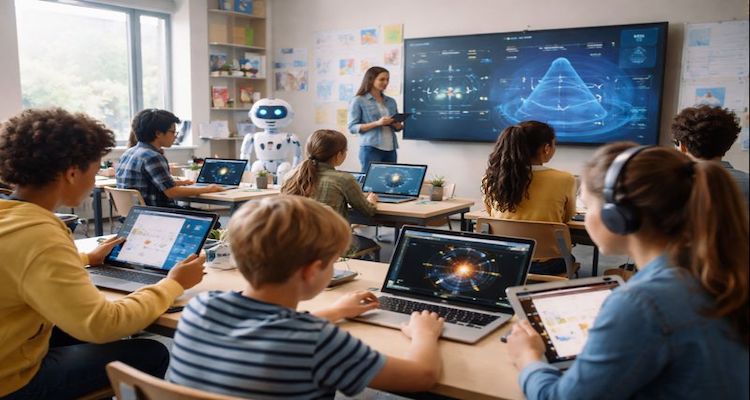
By 2026, education no longer ends when the school bell rings.
Artificial intelligence has quietly reshaped how students learn, teachers teach, and classrooms function, blurring the line between school, home, and the digital world.
What began as experimental tools and emergency solutions has evolved into a structural shift, forcing educators, parents, and policymakers to rethink what learning truly means in an AI-powered age.
A System Under Pressure Before AI Took Hold
Even before AI became mainstream in classrooms, education systems were strained.
Teachers faced overcrowded classrooms, outdated curricula, and growing demands for personalized learning. Students, meanwhile, struggled with uneven access to quality instruction, especially across socioeconomic lines.
The pandemic-era shift to remote learning exposed deep structural gaps. It also accelerated the adoption of educational technology setting the stage for AI to move from novelty to necessity.
By the mid-2020s, the question was no longer whether AI belonged in education, but how it would be used responsibly.
ALSO READ: Why the Next Academic Revolution Will Happen Outside Schools
From Smart Tools to Learning Companions
By 2026, AI is no longer limited to grading quizzes or suggesting practice problems.
Modern AI systems function as adaptive learning companions, adjusting lesson difficulty in real time based on how students respond. A struggling student receives additional explanations and examples, while an advanced learner moves ahead without waiting for the rest of the class.
Language models assist with reading comprehension, math problem-solving, and even early-stage coding, acting less like answer machines and more like guided tutors.
Crucially, these tools are embedded within structured learning environments, not operating in isolation.
Teachers Aren’t Replaced-They’re Repositioned
One of the biggest misconceptions surrounding AI in education was that it would replace teachers.
In practice, the opposite has happened.
Teachers in 2026 spend less time on repetitive tasks like grading, attendance tracking, and test preparation. AI handles administrative overhead, freeing educators to focus on mentoring, critical thinking, and classroom engagement.
Lesson planning has also evolved. Teachers use AI-generated insights to identify learning gaps, tailor instruction, and intervene earlier when students fall behind.
As one veteran educator put it during a national education forum, “AI didn’t take my job, it gave me my classroom back.”
ALSO READ: How Education Is Splitting Into Two Parallel Realities
Personalized Learning Becomes the Default
Perhaps the most significant change is the normalization of personalized education.
AI-driven platforms now create individualized learning paths, factoring in pace, strengths, weaknesses, and even preferred learning styles. This approach has reduced one-size-fits-all teaching, particularly in large public school systems.
Students with learning disabilities benefit from customized support tools, while multilingual learners receive real-time language assistance without stigma.
The result is a quieter revolution: fewer students slipping through the cracks simply because they learn differently.
Public Reaction: Optimism Tempered by Caution
Public response to AI-driven education has been mixed, but increasingly pragmatic.
Parents appreciate real-time insights into their children’s progress, while students value flexibility and on-demand support. At the same time, concerns around data privacy, screen time, and over-reliance on technology remain central to public debate.
Education policy analysts emphasize that AI works best as an augmentation tool, not a replacement for human judgment.
“Technology doesn’t teach values, empathy, or ethics,” noted a senior education researcher at a global policy institute. “That responsibility still rests with humans.”
Equity and Access: A Defining Challenge
While AI promises personalization, it also raises serious equity concerns.
Well-funded schools adopt advanced AI systems faster, while under-resourced districts risk falling further behind. Governments and nonprofits have responded by prioritizing open-source tools and subsidized platforms to prevent a digital divide from becoming a permanent educational gap.
By 2026, many education departments treat AI access as essential infrastructure, similar to textbooks or internet connectivity.
The long-term success of AI in education hinges on whether these access gaps continue to narrow, or widen.
ALSO READ: Why the Smartest Students Are Rejecting ‘Smart’ Learning Tools
Redefining Assessment and Academic Integrity
Traditional exams have not disappeared, but they no longer dominate.
AI-assisted learning has pushed educators to rethink assessment itself. Project-based evaluation, oral exams, and real-world problem-solving are increasingly favored over memorization-heavy testing.
At the same time, concerns about AI misuse have led schools to emphasize process over output, how students think, not just what they submit.
Academic integrity policies now focus on transparency and responsible use, acknowledging that AI literacy is itself a necessary life skill.
What Happens Next for Education?
Looking ahead, the future of education appears hybrid by design.
Physical classrooms remain central for social development, collaboration, and mentorship. AI complements this foundation by extending learning beyond school hours, adapting to individual needs, and providing scalable support.
The defining challenge for educators in the coming years is not adopting AI, but governing it wisely.
Used responsibly, AI has the potential to make education more humane, not less.
Learning Beyond the Bell
By 2026, “school’s out” no longer means learning stops.
AI has transformed education into a continuous, adaptive experience, one that follows students wherever curiosity takes them. The technology is powerful, but its success depends on thoughtful integration, ethical guardrails, and human leadership.
Education hasn’t been replaced. It’s been reinvented.
ALSO READ: What Schools Never Teach About How Humans Actually Learn
Disclaimer:
The information presented in this article is based on publicly available sources, reports, and factual material available at the time of publication. While efforts are made to ensure accuracy, details may change as new information emerges. The content is provided for general informational purposes only, and readers are advised to verify facts independently where necessary.