







India’s Broadband Subscriber Base Crosses 100 Crore Mark
India’s broadband subscriber base crosses 100 crore in November 2025, marking a sixfold rise in a decade and reshaping the country’s digital economy.
Introduction: A Digital Milestone for a Connected Nation
India has quietly crossed a historic digital milestone. For the first time, the country’s broadband subscriber base has surged past the 100 crore (one billion) mark, underscoring how deeply internet connectivity has become woven into everyday life. The achievement, confirmed by the Telecom Regulatory Authority of India (TRAI) on December 31, reflects a decade-long transformation that has reshaped communication, commerce, governance, and social interaction across the country.
From urban centers powered by high-speed fiber to rural regions accessing services through mobile networks, broadband is no longer a luxury—it is infrastructure. The crossing of this symbolic threshold marks not just numerical growth, but India’s emergence as one of the world’s largest digitally connected societies.
Context & Background: A Decade of Rapid Digital Expansion
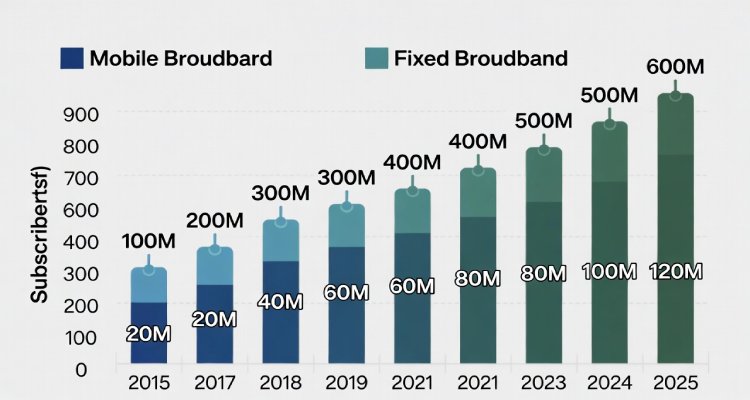
The journey to 100 crore broadband subscribers has been anything but linear. In November 2015, India had 131.49 million (13.15 crore) broadband users. Internet access at the time was uneven, speeds were inconsistent, and affordability remained a challenge for large segments of the population.
The turning point came with a combination of policy reforms, aggressive market competition, declining data costs, and smartphone penetration. Over the last ten years, India’s broadband subscriber base has expanded more than six times, driven primarily by wireless broadband adoption.
As of October 2025, India had 99.98 crore broadband subscribers, with 95.49 crore on wireless networks and 4.48 crore on fixed-line connections. Just a month later, in November 2025, the country officially crossed the one-billion threshold, reaching 100.37 crore broadband subscribers.
This growth coincided with broader telecom expansion. TRAI data shows that the total telecom subscriber base grew to 123.45 crore in November, including 118.74 crore wireless and 4.7 crore wireline connections.
Main Developments: Market Leaders and Subscriber Breakdown
Wireless Broadband Dominates Growth
India’s broadband story remains overwhelmingly wireless-led. Mobile internet continues to be the primary access point for users, particularly in semi-urban and rural areas where laying fiber infrastructure is slower and more expensive.
The November figures confirm that wireless broadband accounts for the vast majority of subscribers, reinforcing the role of smartphones and mobile data in driving digital inclusion.
Jio Maintains Market Leadership
Reliance Jio continues to dominate India’s broadband landscape. The company reported 51 crore broadband subscribers, making up more than half of the country’s total broadband user base. This includes:
- 49.69 crore wireless broadband subscribers
- 1.35 crore fixed-line broadband connections
Jio’s scale reflects its early bet on affordable data, nationwide 4G rollout, and bundled digital services, which reshaped user expectations and forced competitors to recalibrate their strategies.
Airtel Strengthens Its Position
Bharti Airtel remains the second-largest broadband provider, with 31.42 crore broadband subscribers. Its subscriber mix includes:
- 30.42 crore wireless broadband users
- Over 1 crore wired broadband connections
Airtel’s steady growth has been supported by network upgrades, premium broadband offerings, and expanding fiber-to-home services in urban markets.
Vodafone Idea and BSNL Hold Strategic Ground
Vodafone Idea (Vi) reported 12.77 crore wireless broadband subscribers, maintaining its presence despite financial and competitive pressures.
State-owned BSNL continues to play a critical role, particularly in fixed-line connectivity and rural outreach. The operator reported:
- 2.94 crore wireless broadband subscribers
- 44.5 lakh fixed-line broadband connections
While its overall market share is smaller, BSNL’s footprint remains strategically important for connectivity in underserved regions.
Expert Insight & Public Reaction: Broadband as Economic Infrastructure
Telecom analysts view the 100-crore milestone as a signal that broadband has transitioned from a consumer service to national infrastructure.
Industry experts note that broadband expansion has enabled the rapid growth of digital payments, online education, telemedicine, e-commerce, and remote work, especially after the pandemic accelerated digital adoption.
Public sentiment mirrors this shift. For millions of users, broadband access is now tied directly to livelihood opportunities, access to government services, and participation in the digital economy. Affordable data plans and wider coverage have narrowed the digital divide, even as challenges persist in speed consistency and quality of service.
Impact & Implications: What the 100-Crore Mark Means for India
Economic Growth and Digital Inclusion
Crossing one billion broadband users places India among the world’s most connected nations. The scale creates new opportunities for startups, content creators, digital platforms, and service providers, while also attracting global investment into India’s digital ecosystem.
Pressure on Infrastructure and Policy
The surge also brings challenges. Network congestion, spectrum availability, cybersecurity, and data privacy will demand greater regulatory attention. As usage deepens, quality of service—not just access—will become the next battleground.
Fixed Broadband’s Untapped Potential
Despite explosive wireless growth, fixed-line broadband remains relatively underpenetrated, with fewer than five crore connections nationwide. Experts believe that future growth will increasingly focus on fiber expansion, especially as demand rises for high-bandwidth applications like streaming, cloud services, and AI-driven tools.
Conclusion: A Defining Moment in India’s Digital Journey
India crossing 100 crore broadband subscribers is more than a statistical achievement—it is a reflection of how connectivity has reshaped the nation’s social and economic fabric. In just ten years, broadband access has expanded sixfold, transforming how Indians learn, work, trade, and communicate.
As the telecom sector looks ahead, the next phase will be defined not just by adding users, but by improving quality, resilience, and inclusivity. With the foundation now firmly in place, India’s digital future appears not only connected—but deeply integrated into everyday life.
The information presented in this article is based on publicly available sources, reports, and factual material available at the time of publication. While efforts are made to ensure accuracy, details may change as new information emerges. The content is provided for general informational purposes only, and readers are advised to verify facts independently where necessary.