










How Animals Are Learning to Hack Human Technology
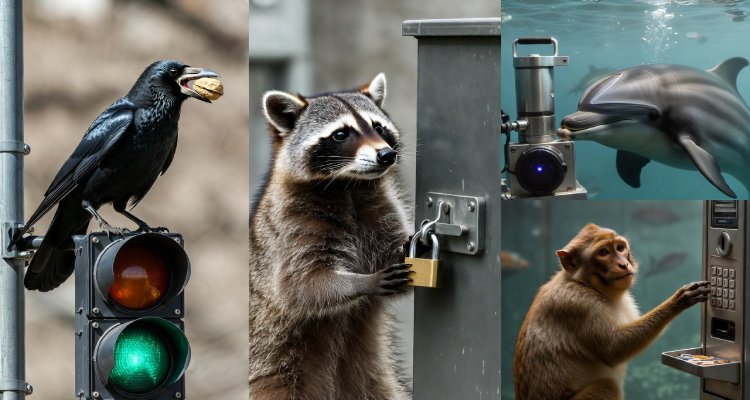
Animals worldwide are learning to exploit human technology—from traffic lights to trash bins—revealing surprising intelligence and adaptation.
Introduction: When the Wild Outsmarts the Wired
In a quiet Tokyo neighborhood, a crow drops a walnut onto a pedestrian crossing, waits patiently for the traffic light to turn red, then swoops down to retrieve the cracked prize. In a Florida marina, dolphins tap underwater sensors to summon fish, while raccoons in North America have learned to defeat “animal-proof” trash bins faster than manufacturers can redesign them.
These are not isolated curiosities. Across the world, animals are increasingly interacting with—and manipulating—human technology in ways that appear startlingly intentional. What once looked like instinctive coincidence is now raising a provocative question: are animals learning to “hack” human systems?
Context & Background: Intelligence Meets Infrastructure
Human technology has expanded rapidly into natural habitats. From smart traffic systems and automated doors to touchscreens, security cameras, and fishing equipment, animals are now surrounded by tools never meant for them.
Historically, animal intelligence has been studied in controlled environments—mazes, puzzles, and memory tests. But today’s real-world laboratory is the modern city itself. Urbanization, climate stress, and shrinking ecosystems have pushed animals to adapt quickly or risk extinction.
Researchers increasingly describe this phenomenon as behavioral innovation—the ability of animals to observe patterns, test outcomes, and adjust strategies in response to human-made systems.
Main Developments: Real-World Examples of Animal “Hacks”
Crows, Parrots, and Birds That Beat the System
Crows are among the most documented technological opportunists. Studies from Japan and Europe show crows using traffic signals to crack nuts safely, timing their actions based on human infrastructure rather than natural cues.
Parrots in Australia have been filmed opening garbage bins by mastering a sequence of movements—lifting lids, balancing weight, and pulling materials aside. The behavior spread socially, suggesting cultural learning rather than random trial and error.
Mammals Outsmarting Security and Automation
Raccoons have earned a reputation for breaching locks, latches, and motion-sensor trash containers. In some US cities, they outperform domestic pets in problem-solving tests.
In India and Southeast Asia, monkeys have learned to exploit vending machines, snatching items during restocking or activating mechanisms by imitation. In several cases, they observed humans closely before attempting the action themselves.
Marine Animals and Underwater Tech
Dolphins interacting with fishing technology have become so adept that some fishermen consider them competitors. In research environments, dolphins quickly learn how to activate underwater sensors, manipulate acoustic signals, and even disengage safety mechanisms.
Octopuses—already famous for intelligence—have been observed shutting off aquarium lights, opening sealed tanks, and escaping through filtration systems.
Pets and Touchscreens
Even domestic animals are joining the trend. Dogs and cats increasingly learn to activate touchscreens, voice assistants, and automatic feeders. While often guided by humans, some pets initiate interactions independently—triggering routines without prompts.
Expert Insight: Adaptation or Intelligence Revolution?
Dr. Alex Thornton, an evolutionary biologist specializing in animal cognition, argues that these behaviors reflect adaptive intelligence under pressure, not coincidence.
“Animals aren’t suddenly becoming more intelligent,” Thornton explains. “They’re revealing intelligence that evolution already gave them, now applied to a radically new environment.”
Animal cognition researchers emphasize that many species possess:
- Causal reasoning
- Memory of sequences
- Social learning abilities
- Environmental pattern recognition
What’s new is the scale of exposure to human technology.
Public reaction has ranged from fascination to discomfort. Viral videos often celebrate clever animals, while city officials worry about safety, sanitation, and infrastructure vulnerabilities.
Impact & Implications: What Happens When Animals Learn Our Systems?
Redesigning “Animal-Proof” Technology
Manufacturers are now forced to rethink assumptions. Trash bins labeled “animal-resistant” often fail within weeks. Smart farming equipment must account for wildlife interference. Even airport systems consider bird behavioral adaptation when designing runways and lighting.
Ethical and Environmental Questions
As animals learn to exploit human systems, ethical dilemmas emerge:
- Should cities modify technology to exclude animals—or coexist?
- Are we unintentionally training wildlife into dependency?
- Could punishment-based deterrents cause ecological harm?
A Preview of Human–Animal Coexistence
Some researchers believe this is an early indicator of a future where humans and animals co-adapt technologically. Wildlife corridors, smart deterrents, and AI-based animal recognition systems may become standard urban features.
The bigger implication is humbling: intelligence is not uniquely human—it is situational, adaptive, and shared.
Conclusion: The Cleverness We Can No Longer Ignore
Animals hacking human technology isn’t a sign of nature rebelling—it’s nature responding. Faced with artificial environments, animals are doing what evolution has always favored: learning, adapting, and surviving.
As cities grow smarter, animals are quietly keeping pace. The challenge ahead isn’t stopping them—it’s deciding whether our technologies can evolve just as intelligently.
Disclaimer :This article is based on documented behavioral studies, expert commentary, and observed trends. Interpretations are journalistic and do not attribute human intent or consciousness to animals beyond scientific consensus.