










Dollar Steadies as Data, Central Banks Shape FX Mood
Global currency markets entered the week balancing hard economic data against political uncertainty, with the U.S. dollar holding firm despite renewed shutdown fears in Washington. Strong manufacturing signals, evolving Federal Reserve expectations, and a busy central bank calendar kept investors focused on fundamentals rather than headlines.
As traders assessed fresh developments from the United States, Australia, Japan, and Europe, the foreign exchange landscape reflected cautious optimism rather than outright risk-taking.
Dollar Finds Support From U.S. Economic Signals
The U.S. dollar maintained its recent gains on Tuesday, drawing strength from encouraging domestic data that suggested the American economy remains resilient. Market participants largely looked past the risk of another U.S. government shutdown, choosing instead to focus on signs of renewed momentum in manufacturing activity.
Data from the Institute for Supply Management (ISM) showed U.S. factory activity returning to expansion territory, a development that surprised many analysts who had been bracing for continued weakness. The report reinforced the view that the U.S. economy may be avoiding a sharper slowdown, even as borrowing costs remain elevated.
The stronger-than-expected figures helped offset concerns that a political stalemate in Washington could delay the release of a key U.S. jobs report, an event that normally plays a major role in shaping currency markets.
Fed Leadership Expectations Lift the Greenback
The dollar’s broader upward trend has also been influenced by shifting expectations around U.S. monetary policy leadership. Markets have reacted positively since President Donald Trump nominated Kevin Warsh as the next chair of the Federal Reserve.
Investors broadly believe Warsh would be less inclined toward aggressive or rapid interest rate cuts than some other potential candidates previously under consideration. That perception has helped underpin the dollar, as higher-for-longer interest rate expectations typically favor the U.S. currency.
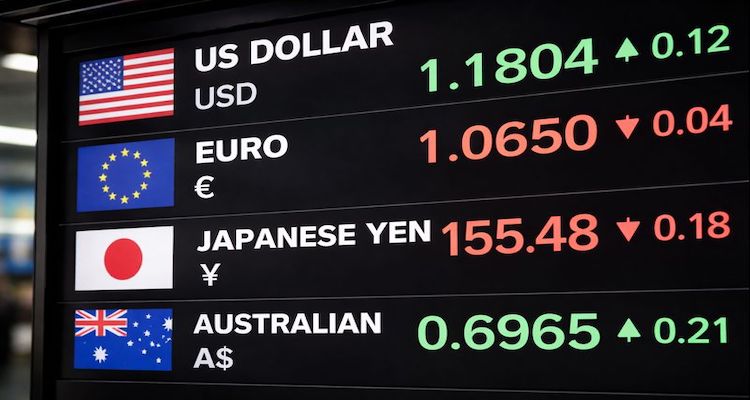
By Tuesday, the dollar index tracking the greenback against a basket of major currencies hovered near 97.50, holding close to the highs reached during a two-day advance. The euro edged modestly higher near $1.1804, while the yen traded around 155.53 per dollar.
Easing Geopolitical Tensions Add to Stability
Beyond domestic data, global geopolitical developments also contributed to a calmer market tone. The United States announced a new trade agreement with India, reducing tariffs on Indian goods in exchange for policy concessions from New Delhi, including steps to curb purchases of Russian oil and ease certain trade barriers.
At the same time, Washington confirmed that nuclear talks with Iran are set to resume later this week in Turkey. While uncertainty remains high, the prospect of renewed dialogue helped reduce immediate geopolitical risk premiums that can weigh on global markets.
According to Rodrigo Catril, a currency strategist at National Australia Bank, recent U.S. developments have provided a supportive backdrop for the dollar. Speaking on a podcast, Catril noted that the surprise strength in the ISM data reinforced confidence in the U.S. outlook. He also pointed to easing tensions between the U.S. and Iran as a factor calming broader market nerves.
Australian Dollar Gains Ahead of Rate Decision
In the Asia-Pacific region, the Australian dollar outperformed peers as investors positioned for a potential interest rate increase from the Reserve Bank of Australia (RBA). The RBA is widely expected to resume its tightening cycle after cutting rates three times last year.
The Aussie climbed about 0.3% to trade near $0.6965, reflecting growing confidence that Australian policymakers are prepared to respond to persistent inflation pressures. The central bank’s decision marks the first of three major monetary policy announcements scheduled this week, with markets also awaiting updates from the European Central Bank and the Bank of England.
New Zealand’s dollar followed a similar path, rising roughly 0.3% to around $0.6017, while Britain’s pound edged slightly higher to $1.3676.
Yen Remains Under Pressure Ahead of Japan Election
The Japanese yen continued to struggle, weighed down by political uncertainty and investor expectations of looser fiscal policy. Traders have been selling the yen and Japanese government bonds in the run-up to Japan’s February 8 election, anticipating that a strong mandate for Prime Minister Sanae Takaichi could lead to more expansionary government spending.
Recent remarks from Takaichi highlighting potential advantages of a weaker currency drew attention and some concern in currency markets. However, Finance Minister Satsuki Katayama sought to defuse the issue on Tuesday, explaining that the prime minister was merely referencing widely accepted economic theory rather than signaling an intentional push to weaken the yen.
Despite those reassurances, the yen saw little immediate relief, as investors remained cautious about Japan’s policy trajectory.
Europe Watches and Waits on Central Banks
In Europe, currency moves were relatively muted as traders looked ahead to policy decisions later in the week. Both the European Central Bank and the Bank of England are expected to keep interest rates unchanged when they announce their decisions on Thursday.
With inflation gradually easing but economic growth still fragile, policymakers on both sides of the Channel face a delicate balancing act. For now, markets appear content to wait for clearer signals before making bolder currency bets.
Crypto Markets Edge Higher
Digital assets saw modest gains alongside the steadier tone in traditional markets. Bitcoin rose around 0.5% to trade near $78,840, while ether added roughly 0.1% to hover around $2,344.
While cryptocurrencies remain volatile, their movement on Tuesday suggested a degree of stability as investors monitored macroeconomic signals rather than reacting to sudden risk-off sentiment.
What Comes Next for Currency Markets?
Looking ahead, investors are likely to remain focused on central bank guidance and incoming economic data. Any delay to U.S. employment figures could temporarily cloud the outlook, but recent manufacturing strength has reinforced confidence in the dollar’s underlying support.
Meanwhile, policy decisions from Australia, Europe, and the UK will help shape regional currency trends, while political developments in Japan may continue to influence the yen.
For now, the foreign exchange market appears anchored by fundamentals rather than fear a sign that traders are prioritizing economic signals over short-term political noise.
(With inputs from a Reuters report.)
ALSO READ: Rupee Jumps in Offshore Trade After US–India Deal
The information presented in this article is based on publicly available sources, reports, and factual material available at the time of publication. While efforts are made to ensure accuracy, details may change as new information emerges. The content is provided for general informational purposes only, and readers are advised to verify facts independently where necessary.