










Data Center Boom Pushes U.S. Power Costs to New Highs
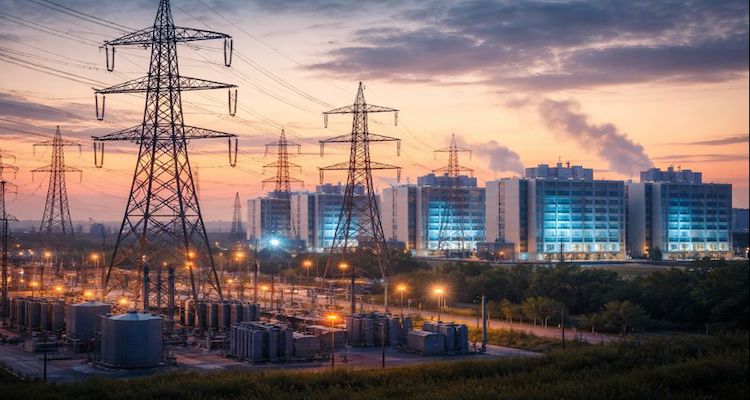
Electricity bills are rising across the PJM grid as record capacity prices expose how fast-growing data center demand is outpacing new power supply.
A Power Shock Hitting Millions
Electricity bills for tens of millions of Americans are headed higher, and the reason has little to do with the weather. Instead, it’s the surging energy appetite of data centers, driven by Big Tech, cloud computing, and artificial intelligence, that is reshaping the U.S. power market. This week, PJM Interconnection, the nation’s largest electric grid operator, confirmed those pressures by posting its highest-ever capacity prices, signaling a widening gap between electricity demand and available supply.
For households and businesses across much of the Mid-Atlantic and Midwest, the message is clear: relief is not coming anytime soon.
Why PJM Matters
PJM Interconnection manages the flow of electricity across a vast 13-state region stretching from Illinois to New Jersey and down to North Carolina. It oversees the largest concentration of energy-hungry data centers anywhere in the world, making it a bellwether for how digital infrastructure is reshaping the power grid.
At the center of the issue is PJM’s capacity market. Unlike energy markets that price electricity by the hour, capacity auctions determine how much power generators are paid simply to be available in the future, ensuring enough supply during peak demand periods. These auctions are designed to prevent blackouts and incentivize investment in new generation.
But that system is now under strain.
Record Prices Signal a Supply Crunch
In PJM’s latest capacity auction, prices surged to $333.44 per megawatt-day, a historic high. That figure represents an increase of roughly 1,000% over the past two years, according to PJM data, an extraordinary jump by any measure.
The driver is demand. Massive data centers supporting cloud services, AI computing, and digital platforms are consuming electricity at a pace that new power plants and transmission upgrades have not been able to match. While capacity prices are meant to encourage developers to build more supply, construction timelines, regulatory hurdles, and financing challenges mean new generation is arriving too slowly.
The latest auction secured 134,479 megawatts of capacity, but PJM officials acknowledged that this fell short of the grid’s reliability target by about 6,600 megawatts, enough electricity to power nearly five million homes.
That shortfall underscores a growing imbalance that is now being felt directly by consumers.
PJM Warns of Structural Challenges
PJM leadership has been blunt about the implications. Stu Bresler, who will assume the role of chief operating officer next month, said the auction results leave little room for doubt.
He noted that electricity demand from data centers continues to outpace new supply additions, and that addressing the issue will require coordinated action. According to Bresler, PJM alone cannot solve the problem; it will take cooperation among grid operators, energy developers, state and federal regulators, and the data center industry itself.
His remarks reflect a broader consensus in the energy sector: the grid was not designed for the speed and scale of today’s digital expansion.
Impact on Consumers: Bills Already Rising
For consumers, the consequences are no longer theoretical. Capacity costs represent one component of utility bills, alongside spending on transmission infrastructure, grid services, and fuel costs such as natural gas. When capacity prices spike, utilities pass at least part of those costs on to customers.
In several PJM states, households and businesses have already seen utility bills climb by more than 20% since last summer. The increases have intensified concerns about affordability, particularly for lower-income residents and energy-intensive industries.
Governors across the PJM region have begun pushing back.
Governors Seek Price Limits
Rising power costs prompted a coalition of PJM-area governors, including Pennsylvania Governor Josh Shapiro, to negotiate temporary price caps within the capacity market. A ceiling and floor were applied starting with the July auction and remained in place for the most recent bidding round.
Now, those governors are urging regulators to extend the limits into future auctions.
In a filing this week with the Federal Energy Regulatory Commission (FERC), Shapiro argued that reforms must be implemented quickly to shield consumers before the next auction cycle. Without intervention, he warned, ratepayers could face even steeper increases as demand continues to climb.
More Auctions, Less Certainty
The pricing turmoil has been compounded by changes in PJM’s auction schedule. Traditionally, capacity auctions were held three years in advance, giving power companies time to plan new projects and secure financing. Regulatory delays in recent years disrupted that timeline, forcing PJM to conduct auctions less than a year before prices take effect.
Energy developers say the compressed schedule has slowed investment, further tightening supply. To correct course, PJM is now running so-called “catch-up” auctions to restore its long-term planning framework.
The prices announced this week will apply to the June 2027–June 2028 planning year, meaning today’s auction results will shape electricity bills several years from now.
Power Producers Cash In
While consumers brace for higher costs, existing power plant owners are poised to benefit. Elevated capacity prices translate directly into higher guaranteed revenues for generators already operating on the PJM grid.
Independent power producer Talen Energy said it expects to earn more than $1 billion in capacity revenue for the 2027–2028 period alone. Investors responded quickly: Talen shares rose 3.7% after the market closed. Other regional generators, including Constellation Energy and Vistra, also posted gains.
The market reaction highlights a central tension in the energy transition, high prices are painful for consumers but lucrative for suppliers, at least in the short term.
A Grid at a Crossroads
The latest PJM auction illustrates a deeper challenge facing the U.S. power system. Data centers are not a temporary trend; they are becoming foundational infrastructure for the modern economy. Yet the pace of grid expansion, generation permitting, and transmission development has not kept up.
Without faster investment and regulatory reform, capacity prices could remain elevated or rise further locking in higher electricity costs for years. Policymakers now face difficult choices: how to encourage new supply without overburdening consumers, and how to balance economic growth with grid reliability.
The Cost of a Digital Future
PJM’s record-breaking capacity prices are more than a market milestone, they are a warning sign. As data centers reshape electricity demand, the gap between digital ambition and physical infrastructure is becoming impossible to ignore.
For millions of Americans, the price of powering the digital economy is already showing up on monthly utility bills. Whether regulators, utilities, and technology companies can act fast enough to close that gap will determine how affordable, and reliable electricity remains in the years ahead.
ALSO READ: The Particle That Could Replace Every Power Plant on Earth