










Command Beneath the Waves: President Murmu’s Rare Sortie Aboard INS Vaghsheer Signals India’s Undersea Resolve
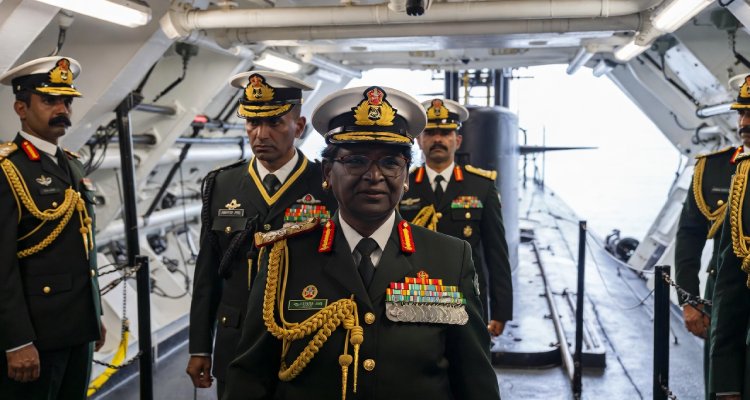
President Droupadi Murmu undertakes a historic submarine sortie aboard INS Vaghsheer, highlighting India’s naval strength, indigenous defence, and maritime readiness.
Introduction: A Rare Presidential Moment Beneath the Waves
In a rare and powerful demonstration of India’s civil-military engagement, President Droupadi Murmu undertook an over two-hour operational sortie aboard the indigenously built submarine INS Vaghsheer on December 28, navigating the depths of the Arabian Sea along India’s western seaboard. The moment was historic not only for its symbolism but also for what it represented: the growing maturity of India’s indigenous defence capabilities and the active involvement of the Supreme Commander of the Armed Forces in operational environments.
With this voyage, President Murmu became only the second President of India to experience a submarine sortie, following Dr. A.P.J. Abdul Kalam’s iconic underwater mission aboard INS Sindhu Rakshak in 2006. The event underscored India’s evolving maritime posture and reaffirmed the Navy’s strategic role in safeguarding national interests across the Indo-Pacific.
Context & Background: The Supreme Commander and the Sea
As the Supreme Commander of the Indian Armed Forces, the President’s role extends beyond ceremonial duties. Engagements such as this submarine sortie signal confidence in the armed forces and highlight the nation’s commitment to operational readiness and technological self-reliance.
President Murmu’s embarkation on INS Vaghsheer follows a pattern of increasing presidential interaction with frontline defence assets. In November 2024, she witnessed an operational demonstration by the Indian Navy aboard INS Vikrant, India’s first indigenously built aircraft carrier. Together, these engagements reflect a broader institutional emphasis on understanding modern warfare environments firsthand.
The submarine sortie was conducted from the Karwar naval base in Karnataka, a key hub of India’s western naval command. Accompanying the President was Chief of Naval Staff Admiral Dinesh K. Tripathi, reinforcing the operational seriousness of the mission.
Main Developments: Inside the Voyage of INS Vaghsheer
INS Vaghsheer is the sixth and final submarine of Project 75, India’s Scorpene-class submarine program, and was commissioned into the Indian Navy in January. Designed for stealth, endurance, and multi-role versatility, the submarine represents a major milestone in India’s underwater warfare capabilities.
During the over two-hour sortie, President Murmu was briefed on the submarine’s operational systems, crew protocols, and mission profiles. The voyage offered a real-time view of undersea navigation, combat readiness, and the demanding environment in which submariners operate.
Why the Sortie Matters
Presidential embarkation aboard an operational submarine is not routine. It serves several strategic purposes:
- Boosts morale among naval personnel operating in high-risk environments
- Signals political confidence in indigenous defence platforms
- Reinforces civilian oversight and understanding of military preparedness
By stepping into one of the Navy’s most complex platforms, the President sent a strong message about India’s trust in homegrown defence manufacturing and its personnel.
INS Vaghsheer: A Silent Sentinel of the Deep
Capabilities and Mission Profile
INS Vaghsheer is engineered to undertake a wide spectrum of missions, including:
- Anti-surface warfare
- Anti-submarine warfare
- Intelligence gathering
- Area surveillance
- Special operations
The submarine is armed with wire-guided torpedoes, anti-ship missiles, and advanced sonar systems, allowing it to detect and neutralize threats with precision. Its modular construction enables future upgrades, including the potential integration of Air Independent Propulsion (AIP) technology, which would significantly enhance underwater endurance and stealth.
These features place INS Vaghsheer among the most capable conventional submarines in the region.
The Legacy Behind the Name ‘Vaghsheer’
The name Vaghsheer is steeped in naval tradition and symbolism. It refers to the sandfish, a lethal deep-water predator of the Indian Ocean known for its stealth and striking power—qualities synonymous with submarine warfare.
The first INS Vaghsheer was commissioned in December 1974 and served the Navy until its decommissioning in April 1997. According to naval parlance, a ship or submarine never truly ceases to exist; instead, it is reincarnated through a successor bearing the same name. The new INS Vaghsheer thus carries forward the legacy, ethos, and operational spirit of its predecessor.
Expert Insight & Broader Sentiment
Defence analysts view the President’s submarine sortie as a meaningful gesture that goes beyond symbolism. It reflects a leadership approach that values operational awareness and direct engagement with the armed forces.
Naval veterans have noted that such interactions enhance trust between civilian leadership and the military, while also drawing public attention to the often unseen, high-stakes world of submarine operations. For aspiring defence professionals and civil services candidates, the event offers a real-world example of constitutional roles intersecting with national security imperatives.
Impact & Strategic Implications
President Murmu’s voyage aboard INS Vaghsheer comes at a time when undersea capabilities are gaining prominence amid evolving regional security dynamics. As India strengthens its maritime footprint, particularly in the Indian Ocean Region, submarines remain a cornerstone of deterrence and intelligence operations.
The event also highlights:
- India’s progress in indigenous defence manufacturing
- The operational readiness of Project 75 submarines
- A growing emphasis on maritime domain awareness
Looking ahead, platforms like INS Vaghsheer are expected to play a critical role in ensuring sea denial, protecting trade routes, and supporting joint-force operations.
Conclusion: A Symbol of Confidence and Continuity
President Droupadi Murmu’s historic sortie aboard INS Vaghsheer stands as a powerful symbol of confidence—in India’s Navy, its indigenous defence ecosystem, and the men and women who operate silently beneath the seas. It bridges constitutional responsibility with operational reality, reinforcing the idea that national security is a shared endeavor between leadership and those on the front lines.
As INS Vaghsheer patrols the depths, it carries not just advanced weaponry, but also the weight of legacy, innovation, and the nation’s strategic aspirations.
The information presented in this article is based on publicly available sources, reports, and factual material available at the time of publication. While efforts are made to ensure accuracy, details may change as new information emerges. The content is provided for general informational purposes only, and readers are advised to verify facts independently where necessary.