








Chile Fuel Prices Surge as Global Oil Shock Hits Economy
Chile is bracing for a sharp rise in fuel prices as global oil markets react to escalating geopolitical tensions. The move underscores how quickly international crises can ripple into everyday costs, especially for countries heavily reliant on imports.
With public finances already under pressure, the government has opted to pass on the price shock to consumers, marking a critical moment for Chile’s economy and households alike.
Government Moves to Adjust Fuel Prices
Chile’s government has activated a clause in its fuel stabilization mechanism, allowing domestic prices to adjust more rapidly in response to global oil spikes. The decision, announced Monday, reflects growing fiscal strain and the limits of state intervention in cushioning price shocks.
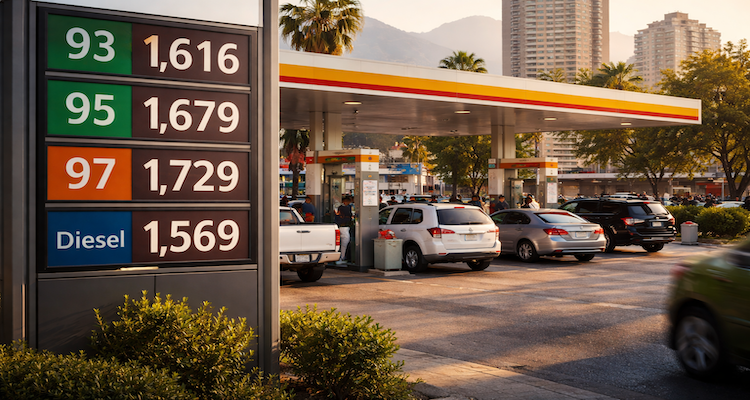
Beginning March 26, gasoline and diesel prices will rise sharply. The Finance Ministry confirmed that 93-octane gasoline will increase by 370 pesos per liter, while diesel will jump by 580 pesos.
In Santiago, these adjustments translate into significant increases, around 30% for gasoline and as much as 60% for diesel. For consumers and businesses alike, the impact will be immediate and substantial.
Global Oil Shock Driving the Increase
The surge in Chile’s fuel prices is tied directly to turmoil in global oil markets. Crude prices have climbed dramatically following heightened tensions in the Middle East.
Brent crude, a key international benchmark, has risen to roughly $101 per barrel, compared to about $70 just weeks earlier. The escalation follows military developments involving the United States and Israel targeting Iran, which has led to disruptions in the Strait of Hormuz, a critical chokepoint for global oil shipments.
The Strait handles a significant share of the world’s oil supply. Any disruption there tends to trigger rapid price increases worldwide, and Chile is feeling those effects acutely.
Chile’s Vulnerability to External Shocks
Chile’s economic structure leaves it particularly exposed to global fuel price volatility. As one of Latin America’s largest oil importers, the country depends heavily on international markets due to limited domestic production.
This reliance means that sudden shifts in global supply or geopolitical instability can quickly translate into higher domestic costs. Unlike oil-producing nations that can buffer price swings, Chile must absorb these fluctuations, or pass them on to consumers.
The current situation highlights this vulnerability, as global developments beyond Chile’s control are now directly affecting local fuel costs.
Strain on Public Finances
For months, Chile has used its fuel stabilization fund to soften the impact of rising oil prices. The mechanism was designed to smooth out volatility and protect consumers from sudden spikes.
However, the cost of maintaining this buffer has become increasingly unsustainable. Weekly expenditures from the fund have reached approximately $140 million and were projected to climb to $160 million if global conditions persist.
According to government estimates, fully absorbing the current price increases would cost as much as $4 billion, a burden Chile’s public finances cannot sustain.
Finance Minister Jorge Quiroz recently announced nearly $4 billion in spending cuts, signaling a broader effort to restore fiscal balance. He noted that the administration inherited limited fiscal space when it took office on March 11.
Chile’s structural deficit stood at 3.6% of GDP last year, the highest level since the COVID-19 pandemic—further limiting the government’s ability to subsidize fuel prices.
Leadership Response and Policy Direction
President Jose Antonio Kast has acknowledged that the fuel stabilization fund cannot fully shield the country from global market forces. In recent statements, he emphasized that difficult decisions are necessary given the current fiscal reality.
Minister Quiroz also sought to reassure the public, stating that any future drop in international oil prices would be reflected in domestic prices just as quickly. The government aims to maintain a balanced approach, passing on both increases and decreases transparently.
To ease the burden on households, authorities have introduced targeted measures. These include controls on public transportation fares and kerosene prices, aimed at protecting lower-income groups from the worst effects of rising fuel costs.
Economic and Social Impact
The fuel price hike is expected to ripple through Chile’s economy in multiple ways. Higher diesel prices, in particular, could drive up transportation and logistics costs, potentially leading to increased prices for goods and services.
For everyday consumers, the impact will be felt at the pump and beyond. Commuting costs are set to rise, while businesses may pass on higher operational expenses to customers.
Public transport users may be partially shielded by government controls, but broader inflationary pressures could still emerge. Economists warn that sustained high energy costs often contribute to wider economic strain, especially in import-dependent economies.
At the same time, the government’s decision to reduce spending reflects a balancing act between fiscal discipline and social protection, a challenge faced by many countries in today’s volatile global environment.
What Lies Ahead for Chile
The trajectory of fuel prices in Chile will largely depend on developments in global oil markets. If geopolitical tensions ease and supply stabilizes, prices could moderate, offering some relief to consumers.
However, if disruptions in the Middle East persist, Chile may face prolonged pressure on both fuel costs and public finances.
The government’s commitment to passing through price decreases provides some reassurance, but the near-term outlook remains uncertain. Policymakers will need to carefully manage both economic stability and public sentiment as the situation evolves.
Conclusion
Chile’s decision to allow fuel prices to rise marks a turning point in its response to global energy shocks. While the move reflects fiscal necessity, it also highlights the country’s vulnerability to international market forces.
As households and businesses adjust to higher costs, the government faces the challenge of maintaining economic stability without overextending public finances. The coming weeks will be critical in determining whether this balance can be sustained.
The information presented in this article is based on publicly available sources, reports, and factual material available at the time of publication. While efforts are made to ensure accuracy, details may change as new information emerges. The content is provided for general informational purposes only, and readers are advised to verify facts independently where necessary.