







Can AI Truly Invent? The Limits of Algorithmic Creativity
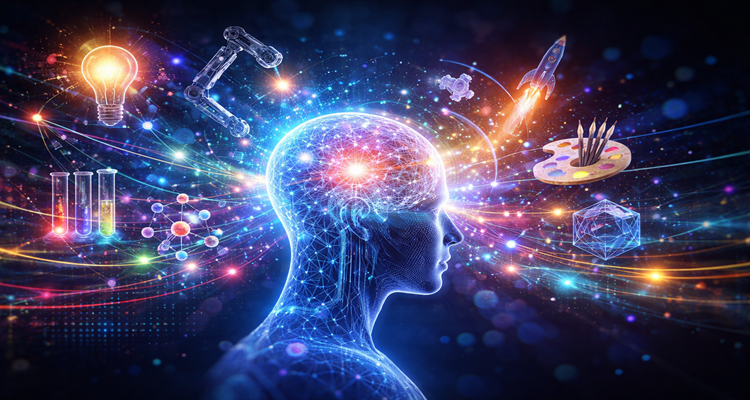
Artificial intelligence is reshaping industries from medicine to filmmaking, but one question still sparks intense debate: can machines genuinely invent something new? As AI systems become more sophisticated, the line between human creativity and algorithmic output is becoming harder to define.
Understanding whether AI can truly innovate matters not only for technology companies but also for artists, scientists, and policymakers navigating the future of creativity.
The Rise of Algorithmic Creativity
Over the past decade, artificial intelligence has evolved from performing narrow tasks to producing outputs that appear strikingly creative. Modern AI models can generate paintings, write music, design products, and even propose scientific hypotheses.
Tools powered by machine learning analyze enormous datasets, identifying patterns and relationships that humans might overlook. By recombining these patterns in novel ways, AI can generate ideas that look remarkably original.
For example, generative AI systems are already helping scientists design new molecules for drug development. In architecture and engineering, AI can propose structural designs optimized for strength and efficiency. Meanwhile, creative industries are experimenting with AI-generated scripts, illustrations, and music.
Yet the question remains: is this true invention, or simply a sophisticated imitation?
What Does It Mean to “Invent”?
To understand the debate, it helps to define invention itself. Traditionally, invention involves creating something genuinely new, an idea, object, or process that did not exist before.
Human invention often emerges from a mix of imagination, experience, intuition, and cultural context. Breakthroughs frequently occur when individuals combine ideas from different fields or challenge established assumptions.
Artificial intelligence approaches creativity differently. Instead of intuition, AI relies on statistical learning. It processes vast amounts of information and generates outputs based on probability and pattern recognition.
In other words, AI doesn’t “imagine” in the human sense. It calculates.
But sometimes those calculations produce surprising results.
When AI Appears to Innovate
There are growing examples where AI systems have generated ideas that seem genuinely novel.
In materials science, machine-learning algorithms have identified previously unknown chemical compounds that could be used in batteries or electronics. In medicine, AI tools have helped researchers uncover potential drug candidates faster than traditional methods.
Even in art and music, AI-generated works are increasingly entering mainstream culture. Digital artists are collaborating with algorithms to produce images that blend styles in unexpected ways. Musicians are experimenting with AI tools that suggest melodies or harmonies outside their usual creative patterns.
These developments raise a compelling possibility: perhaps AI is not merely copying the past but helping humans explore new creative territory.
Still, critics argue that the underlying process remains fundamentally derivative.
The Argument Against True Machine Invention
Skeptics contend that artificial intelligence cannot truly invent because it lacks independent understanding.
AI models learn by training on large datasets containing human-created material. Every output, whether a poem, painting, or engineering design, is influenced by patterns within that data.
According to this view, AI creativity is essentially a remix engine. It rearranges existing ideas in new configurations but does not originate concepts in the same way humans do.
Another limitation is intentionality. Human inventors pursue ideas with purpose: solving problems, expressing emotions, or exploring philosophical questions. AI systems, by contrast, generate outputs only when prompted.
Without goals, curiosity, or self-awareness, critics argue, AI cannot truly claim authorship of invention.
Why Collaboration May Be the Real Breakthrough
Rather than replacing human creativity, many experts believe AI’s greatest potential lies in collaboration.
Artificial intelligence excels at exploring enormous possibilities quickly. Humans, on the other hand, bring context, judgment, and meaning to creative work.
Together, they can accelerate innovation.
Scientists increasingly rely on AI to analyze complex datasets and suggest hypotheses worth investigating. Designers use AI tools to generate multiple concept variations in seconds. Writers and filmmakers experiment with AI as a brainstorming partner rather than a replacement.
In this model, invention becomes a partnership between human imagination and computational exploration.
The result may be ideas that neither humans nor machines could produce alone.
The Ethical and Legal Questions Ahead
As AI-generated ideas become more sophisticated, they raise important legal and ethical questions.
One major issue is intellectual property. If an AI system generates a new design or piece of music, who owns it? The programmer? The user who prompted it? Or no one at all?
Patent law faces similar challenges. Some jurisdictions have already debated whether inventions created with AI assistance can qualify for patents.
Beyond legal concerns, there is also the question of cultural impact. If AI tools flood the world with automated content, will human creativity become diluted, or will it evolve in new directions?
These questions remain unresolved, and policymakers are only beginning to grapple with them.
A New Era of Innovation
Despite the uncertainties, one thing is clear: artificial intelligence is transforming how ideas are generated.
AI may not possess imagination in the human sense, but it expands the landscape of possible solutions. By rapidly exploring combinations of data and patterns, it can reveal unexpected pathways for innovation.
In fields like medicine, climate science, and engineering, that capability could prove invaluable.
Rather than asking whether AI can invent like humans, the more productive question may be how humans and machines can invent together.
The Future of the Algorithmic Imagination
As AI systems grow more powerful, the boundaries of creativity will continue to shift.
Machines may never experience inspiration or curiosity the way humans do. But they can act as powerful engines for discovery, uncovering connections that spark new ideas.
The future of invention may therefore belong not to humans or machines alone, but to the collaboration between them.
In that partnership, the algorithmic imagination becomes less about replacing human creativity and more about amplifying it.
Continue Exploring:
The Quiet Apprentices: AI Learning Human Behavior
Why AI’s Future May Depend on Learning to Forget
Is AI Fueling a Quiet Global Productivity Revival?
This content is published for informational or entertainment purposes. Facts, opinions, or references may evolve over time, and readers are encouraged to verify details from reliable sources.