










Asian Markets Climb as Tech Rally Offsets Tensions
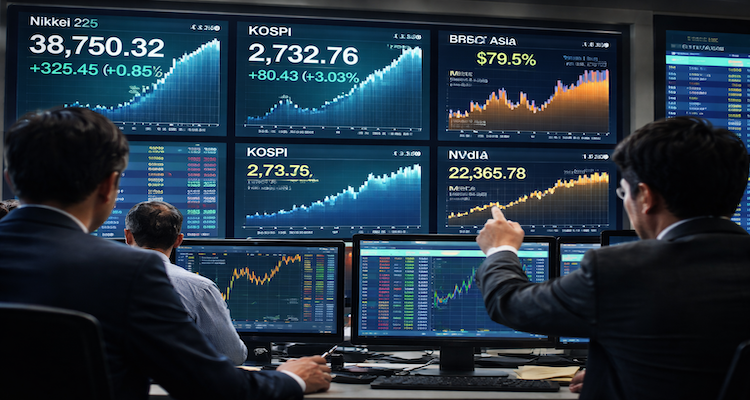
Asian stock markets pushed higher on Thursday, buoyed by renewed strength in U.S. technology shares. Investors, however, remained cautious as geopolitical tensions between Washington and Tehran kept oil prices elevated and supported demand for gold.
Currency markets reflected a firmer U.S. dollar after fresh signals from the Federal Reserve suggested policymakers are not ready to pivot toward interest rate cuts anytime soon.
Tech Stocks Lead Asia’s Gains
Trading across much of Asia was relatively thin due to Lunar New Year holidays in Hong Kong, mainland China, and Taiwan. Even so, regional benchmarks posted solid advances.
MSCI’s broad index of Asia-Pacific shares outside Japan rose 0.5%, while Japan’s Nikkei 225 climbed 0.85%, driven largely by gains in technology names. South Korea’s Kospi surged nearly 3%, touching a record high as semiconductor and chip-related stocks rallied.
The upward momentum followed a strong session on Wall Street, where heavyweight technology companies advanced after Nvidia announced a multi-year agreement to supply Meta Platforms with millions of artificial intelligence chips-both existing models and next-generation versions.
Market strategist Tony Sycamore of IG noted that the technology sector had been struggling earlier in the month after a sharp selloff. Nvidia, he said, had previously been central to last year’s tech rally and now appears to be restoring some investor confidence ahead of its upcoming earnings release.
U.S. stock futures pointed to a relatively steady open, with Nasdaq and S&P 500 contracts edging modestly higher. In Europe, however, futures suggested a slightly weaker start.
Nvidia Deal Revives Tech Sentiment
The Nvidia-Meta partnership injected fresh optimism into markets that had been wrestling with concerns about stretched valuations and slowing momentum in high-growth sectors.
For much of the past year, Nvidia has been emblematic of the AI-driven surge that propelled global equities, particularly in technology. The new chip supply agreement reassured investors that demand for AI infrastructure remains strong.
Analysts say the deal not only underscores Nvidia’s dominant position in the AI hardware market but also reinforces broader confidence in continued corporate investment in artificial intelligence.
With Nvidia set to report earnings next week, traders are watching closely for guidance that could shape the next phase of the tech rally.
Oil Holds Firm Amid U.S.-Iran Frictions
While equities benefited from corporate developments, geopolitical risks continued to cast a shadow over global markets.
Oil prices remained elevated after a sharp surge in the previous session. Brent crude hovered near $70 per barrel after jumping more than 4%, while U.S. West Texas Intermediate held around $65, retaining most of its earlier gains.
The price spike was fueled by investor concerns about potential supply disruptions stemming from escalating tensions between the United States and Iran. Although there has been a visible buildup of military assets in the region, some market observers believe the moves may be part of diplomatic maneuvering rather than a prelude to immediate conflict.
Still, the uncertainty has been enough to keep energy markets on edge.
Gold, often seen as a hedge during times of instability, also found support. The precious metal steadied near recent highs as investors maintained defensive positions.
Federal Reserve Minutes Lift the Dollar
Currency markets were dominated by the U.S. dollar, which strengthened following the release of minutes from the Federal Reserve’s January policy meeting.
The minutes indicated that several Fed officials are willing to consider further rate increases if inflation proves persistent. Policymakers also suggested that the path toward lower inflation may not be as smooth or rapid as some market participants expect.
Charlie Ripley, senior investment strategist at Allianz Investment Management, said the minutes reinforce the view that rate cuts are unlikely in the near term. While some investors may believe inflation is receding decisively, the Fed appears cautious about declaring victory too soon.
The dollar’s strength weighed on other major currencies. The British pound slipped toward a one-month low near $1.35, and the Japanese yen traded close to the 155-per-dollar level. The euro also struggled, remaining below $1.18.
Adding pressure on the single currency was news that European Central Bank President Christine Lagarde plans to leave her position earlier than expected, introducing fresh uncertainty into Europe’s monetary policy outlook.
Meanwhile, the New Zealand dollar edged higher after falling sharply in the previous session. The country’s central bank had tempered expectations of a more aggressive tightening stance, prompting earlier weakness in the kiwi.
What It Means for Global Markets
Thursday’s market action highlights a delicate balancing act.
On one side, optimism around artificial intelligence and corporate investment continues to provide powerful support for equities, particularly in the technology sector. Strong earnings and major supply agreements suggest that AI-driven growth remains a key theme for 2026.
On the other side, geopolitical tensions and inflation concerns persist. Elevated oil prices could complicate efforts to bring inflation under control, potentially influencing central bank decisions in the months ahead.
The Federal Reserve’s cautious tone reinforces the idea that monetary policy will remain restrictive until there is clearer evidence of sustained price stability. That stance has direct implications for bond yields, currency movements, and equity valuations worldwide.
For emerging markets in Asia, a stronger dollar can create additional headwinds by tightening financial conditions and pressuring local currencies.
Looking Ahead
Investors are now turning their attention to upcoming corporate earnings-particularly from major U.S. technology firms-as well as any further developments in the Middle East.
Nvidia’s earnings report next week will be closely scrutinized for signals about AI chip demand and broader capital expenditure trends among technology companies.
At the same time, markets will continue monitoring U.S. inflation data and Federal Reserve commentary for clues about the trajectory of interest rates.
For now, the rally in Asian equities reflects cautious optimism. Yet with geopolitical risks simmering and central banks maintaining a firm stance, volatility could quickly return.
(With inputs from Reuters.)
Continue Exploring:
Markets Drift as IT Stocks Eye AI Signals
Markets Set to Slide as IT Rout Deepens
Gold Rebounds as Jobs Data Shakes Rate Cut Hopes
The information presented in this article is based on publicly available sources, reports, and factual material available at the time of publication. While efforts are made to ensure accuracy, details may change as new information emerges. The content is provided for general informational purposes only, and readers are advised to verify facts independently where necessary.