









Why the Shiva Lingam Represents Cosmic Energy
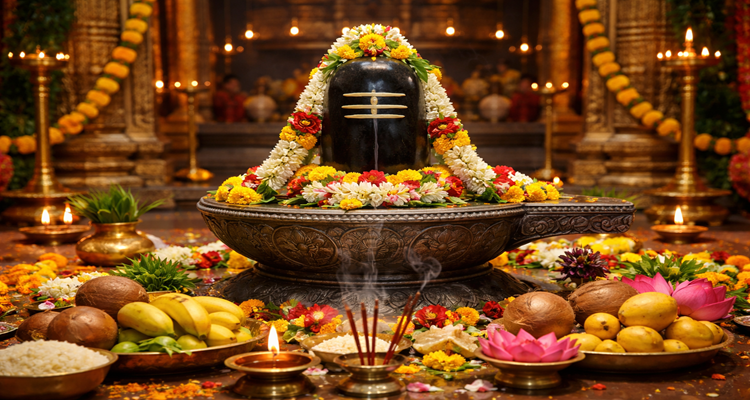
Few religious symbols have sparked as much curiosity and philosophical discussion as the Shiva Lingam. Found in temples and home altars across the Hindu world, the lingam is one of the most widely recognized representations of Lord Shiva.
Yet its meaning goes far beyond physical form. Within Hindu philosophy, the Shiva Lingam represents the universal energy that sustains creation itself.
Understanding the Symbol
The term “lingam” in Sanskrit means mark or sign.
Rather than depicting a human-like figure, the Shiva Lingam symbolizes the abstract nature of divine consciousness.
It represents the formless presence of Shiva that transcends physical representation.
This philosophical approach reflects one of Hinduism’s central ideas: that the ultimate reality cannot be fully expressed through ordinary imagery.
The Lingam and Cosmic Creation
Many interpretations describe the Shiva Lingam as a representation of cosmic energy.
The vertical structure symbolizes the infinite force that drives creation, while the base represents the feminine energy associated with Shakti.
Together, they illustrate the balance of complementary forces within the universe.
This concept reflects the idea that creation arises from the harmony between masculine and feminine principles.
Ritual Worship in Temples
In temples, the Shiva Lingam serves as the focal point of worship.
Devotees perform rituals such as Jal Abhishek, offering water, milk, and sacred substances over the lingam while chanting prayers.
The flowing liquids symbolize purification and the continuous cycle of life.
These rituals are especially common during festivals dedicated to Shiva.
A Symbol Beyond Idols
Unlike anthropomorphic statues, the lingam’s abstract form invites contemplation.
It encourages devotees to focus on the spiritual essence of divinity rather than external appearance.
For many practitioners, the symbol becomes a reminder of the infinite nature of consciousness.
Cultural Presence
The Shiva Lingam appears in countless temples across India and beyond.
Some of the most famous examples are found at the twelve Jyotirlinga temples, where the lingam is believed to represent manifestations of Shiva’s cosmic light.
These sacred sites attract millions of pilgrims each year.
Real-World Impact
Today, the Shiva Lingam continues to serve as one of Hinduism’s most important spiritual symbols.
Its philosophical depth has inspired discussions among scholars, spiritual teachers, and seekers around the world.
The symbol’s simplicity allows it to convey profound ideas about creation, unity, and transcendence.
Conclusion
The Shiva Lingam represents far more than a traditional religious icon.
It stands as a powerful reminder of the universal energy that underlies existence. Through this symbol, generations of devotees have explored the idea that the divine is both infinite and ever-present.
This content is published for informational or entertainment purposes. Facts, opinions, or references may evolve over time, and readers are encouraged to verify details from reliable sources.