










Why Premium Bottled Water Is India’s New Luxury Fix
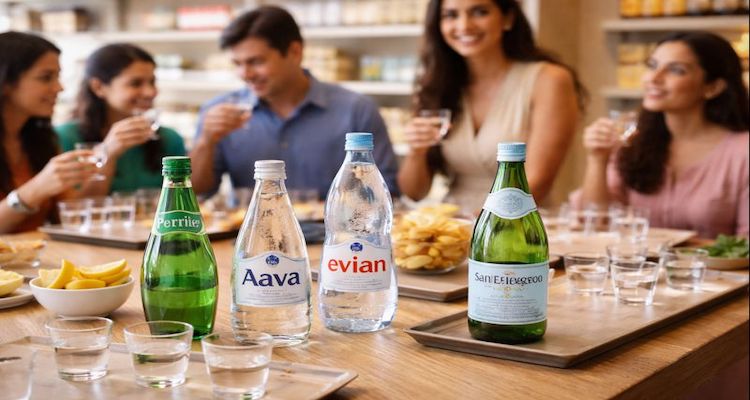
In a country where clean drinking water is still out of reach for millions, a growing segment of affluent Indians is obsessing over something once taken for granted: water quality. From blind tastings to celebrity-backed brands, premium bottled water is fast becoming India’s quietest and fastest-growing luxury trend.
What began as a wellness choice is now a marker of status, health awareness, and distrust in public infrastructure.
From Wine Tastings to Water Tastings
On a recent afternoon inside an Indian gourmet food store, Avanti Mehta stood before a small group of curious participants, guiding them through a blind tasting. Tiny shot glasses were filled, swirled, and sipped much like a wine flight.
But this wasn’t wine.
The samples included Evian from the French Alps, Italy’s San Pellegrino, Perrier from southern France, and Aava, an Indian mineral water drawn from the foothills of the Aravalli range.
Participants compared minerality, carbonation, and salinity, discovering subtle differences that many admitted they had never noticed before.
Mehta, 32, calls herself India’s youngest water sommelier a title more commonly associated with fine dining and wine. Her family owns Aava, one of India’s fastest-growing premium mineral water brands.
Different waters, she explained, serve different nutritional needs. Choosing water, in her view, is no longer just about hydration it’s about health.
A Luxury Category Finds Its Moment
Premium bottled water has quietly become a $400 million business in India, according to market estimates, and it is expanding rapidly as wealth grows and wellness culture deepens.
Domestic premium mineral water typically costs about $1 for a one-liter bottle. Imported brands are far pricier, selling for more than $3 for 750 ml—up to 15 times the cost of India’s most basic bottled water.
This surge is not happening in isolation. India’s overall bottled water market, worth nearly $5 billion annually, is expected to grow at 24% per year, making it one of the fastest-growing water markets globally.
By contrast, bottled water consumption in the United States and China both $30 billion-plus markets is driven largely by convenience and is growing at a far slower pace of 4–5% annually, according to Euromonitor.
Clean Water Remains a Privilege
India’s premium water boom sits against a stark reality. Researchers estimate that around 70% of the country’s groundwater is contaminated. In most cities, tap water remains unsafe to drink without treatment.
The risks are not theoretical. In December, 16 people died in Indore after consuming contaminated tap water, underscoring the fragility of municipal systems.
For most Indians, bottled water is not a luxury but a necessity. Affordable 20-cent bottles are widely available at roadside stalls, restaurants, and hotels, produced largely by multinational giants like PepsiCo and Coca-Cola, alongside Indian market leader Bisleri.
Those who can afford it often install water purifiers at home. While these systems remove contaminants, they also strip water of naturally occurring minerals—one reason premium mineral water is gaining traction.
Health, Trust, and a Status Shift
According to Euromonitor, premium water accounted for 8% of India’s bottled water market last year, up from just 1% in 2021.
“Distrust of municipal water has escalated demand for bottled water,” said Amulya Pandit, a senior consultant at Euromonitor who specializes in the drinks sector. “People now understand the perceived health benefits of mineral water. It’s expensive, but this category is set to boom.”
Among those embracing the trend is New Delhi-based real estate developer B.S. Batra. His household uses only premium mineral water—for drinking, cooking, and even mixing whisky.
“You feel more energetic through the day,” said Batra, 49, who plays badminton regularly. “My kids use it in their smoothies too.”
Celebrities and Corporates Enter the Fray
India’s premium water boom is drawing interest from both celebrities and major corporations.
Bollywood actor Bhumi Pednekar and her sister recently launched Backbay, a premium mineral water brand selling 750 ml cartons for about $2.20.
Meanwhile, Tata Consumer Products India’s largest food and beverage group and Starbucks’ local partner is aggressively expanding its premium water portfolio.
While Tata still sells mass-market 20-cent bottled water, its leadership sees premium water as the future. CEO Sunil D’Souza has said affluent, health-focused consumers are increasingly willing to pay without hesitation.
“There’s a very long runway for this business,” D’Souza said in an interview.
Inside the Source: Himalayan Water
Tata’s flagship premium brand, Himalayan, is bottled at a facility located in the foothills of the Himalayan range in Himachal Pradesh.
A Reuters visit to the site showed largely automated operations, where water from a natural underground aquifer is bottled in plastic and glass with minimal human contact.
Most Indian consumers still prefer still water. Sparkling water remains niche, though Tata plans to introduce a sparkling Himalayan variant and is scouting for additional natural springs to expand production.
Gourmet Retailers See Demand Explode
At Foodstories, a chain of Indian gourmet stores, premium water sales tripled in 2025.
Co-founder Avni Biyani said rising customer curiosity led the chain to import Saratoga Spring Water from New York, priced at 799 rupees (about $9) for a 335 ml bottle. The stock sold out within days.
Indian brand Aava has also benefited from the surge. The company posted record sales of 805 million rupees ($9 million) last year, growing at an annual rate of 40% since 2021.
Tata said its combined basic and premium water business has grown tenfold to $65 million in six years and is projected to expand 30% annually.
Imported Brands Stay Boutique
Imported waters face steep barriers, including taxes exceeding 30%, making them far costlier than Indian brands.
Nestlé’s Perrier and San Pellegrino, along with Danone’s Evian, retail for over 300 rupees ($3.20) for a 750 ml bottle in India.
Nestlé declined to comment on its India strategy. Danone said the market was growing at a “robust” pace but noted that imported waters remain niche offerings.
Luxury With Limits
Despite the fascination, price remains a sticking point for many.
At Mehta’s tasting session, several participants said the experience was enjoyable but impractical for daily use.
“It’s interesting, but honestly, it’s expensive,” said executive Hoshini Vallabhaneni. “For everyday consumption, it can really strain the budget.”
What This Means for India’s Future
India’s premium water boom reflects deeper shifts rising incomes, health awareness, and declining faith in public infrastructure.
While the market will likely continue expanding, it also highlights an uncomfortable divide: water as a luxury for some, and a daily risk for others.
“When you turn on the tap, you’re not getting Evian or Aava,” Mehta said. “That difference is what people are paying for.”
As long as that gap persists, India’s bottled water industry especially its premium end appears set to keep flowing.
(With inputs from a Reuters report)
ALSO READ: France Moves to Bar Under-15s From Social Media
The information presented in this article is based on publicly available sources, reports, and factual material available at the time of publication. While efforts are made to ensure accuracy, details may change as new information emerges. The content is provided for general informational purposes only, and readers are advised to verify facts independently where necessary.