




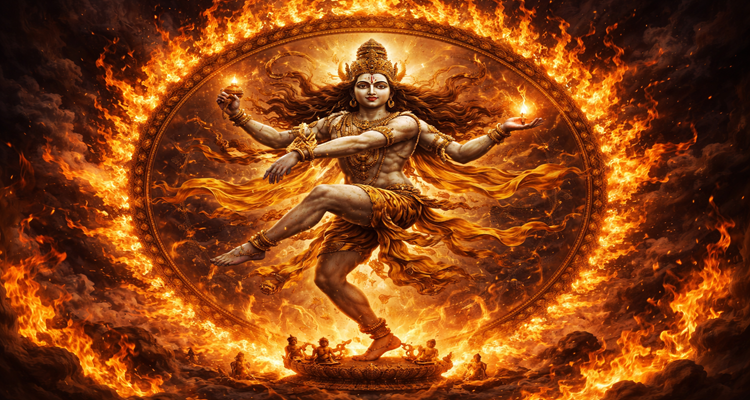

Why Lord Shiva Is Believed to Reside on Mount Kailash
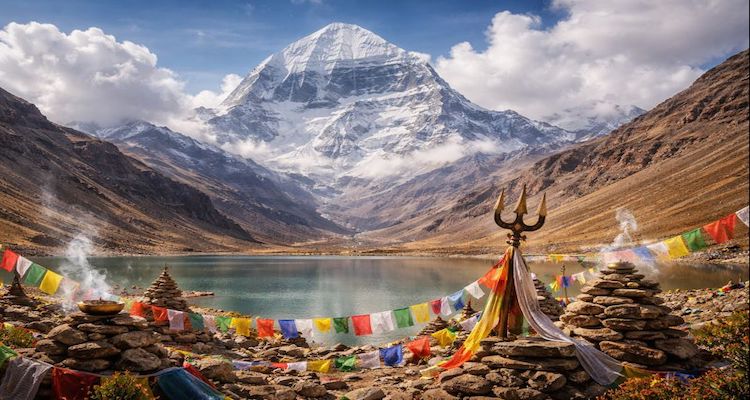
High in the remote reaches of the Himalayas stands Mount Kailash, a peak unlike any other on Earth. Revered for thousands of years, it is believed by millions of devotees that Lord Shiva, the Hindu god of destruction and transformation, resides here in eternal meditation.
This belief is not just a matter of faith it is deeply woven into religious texts, cultural traditions, and spiritual practices that continue to shape lives across Asia and beyond.
The Sacred Geography of Mount Kailash
Mount Kailash rises to about 22,028 feet in the Tibetan Autonomous Region of China. Unlike most Himalayan peaks, it remains unclimbed, protected by religious reverence rather than physical barriers.
For Hindus, Buddhists, Jains, and followers of Bon, Mount Kailash is not merely a mountain. It is considered the spiritual axis of the world, often described as the cosmic center connecting heaven and earth.
Ancient Hindu scriptures refer to Kailash as Shiva Loka the celestial abode of Lord Shiva and Goddess Parvati. This association has endured for millennia, making Kailash one of the most sacred locations in the spiritual geography of South Asia.
Lord Shiva and the Symbolism of Detachment
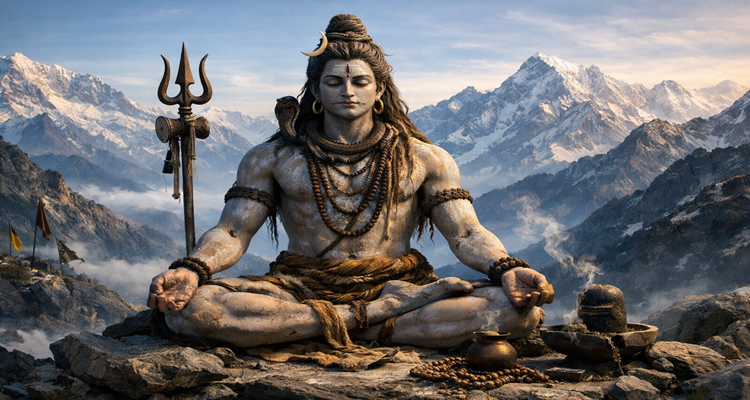
In Hindu philosophy, Lord Shiva represents renunciation, stillness, and transcendence. He is often depicted as an ascetic, seated in deep meditation, detached from worldly comforts.
Mount Kailash mirrors these qualities. The harsh climate, isolation, and untouched terrain symbolize the yogic ideal of withdrawal from material life. Scholars of Hindu theology often point out that Shiva’s residence on Kailash reflects his role as the ultimate yogi removed from society yet central to cosmic balance.
According to the Shiva Purana and other texts, Kailash is not chosen randomly. It embodies purity, permanence, and spiritual authority, qualities essential to Shiva’s cosmic function.
ALSO READ: Shiva’s Silence: The Cosmic Meaning Behind His Stillness
References in Ancient Texts and Epics
Hindu scriptures repeatedly reference Mount Kailash as Shiva’s eternal home. The Mahabharata describes sages undertaking arduous journeys to Kailash seeking divine wisdom.
The Skanda Purana elaborates on Kailash as a place beyond time, where Shiva resides in uninterrupted meditation. These texts emphasize that Kailash is not just a physical location but also a metaphysical realm a bridge between human consciousness and divine reality.
Such consistent references across centuries have reinforced the belief, embedding it deeply into collective religious memory.
A Shared Sacred Space Across Religions
Mount Kailash’s significance extends beyond Hinduism. Tibetan Buddhists identify it as the home of Demchok, a wrathful deity representing supreme bliss. Jains believe it is the site where their first Tirthankara, Rishabhadeva, attained liberation.
This multi-faith reverence strengthens Kailash’s global spiritual status. Rather than conflicting claims, these traditions coexist, each viewing the mountain as a symbol of ultimate truth and enlightenment.
Religious historians note that this shared sanctity is rare and underscores Kailash’s unmatched spiritual gravity.
ALSO READ: The Eternal Union: Shiva and Parvati’s Timeless Love Story
Pilgrimage and Living Faith
Every year, thousands of pilgrims undertake the Kailash Parikrama, a 32-mile circumambulation of the mountain. The journey is physically demanding, often performed at altitudes above 18,000 feet.
Devotees believe that completing the parikrama cleanses past sins and accelerates spiritual growth. For many, the pilgrimage is less about reaching a destination and more about inner transformation.
Anthropologists studying Himalayan pilgrimages describe Kailash as a “living sacred site,” where belief is continually renewed through human effort and devotion.
Scholarly and Expert Perspectives
Dr. Radhika Sharma, a professor of comparative religion at Delhi University, explains that Shiva’s association with Kailash is “a convergence of geography, symbolism, and spiritual psychology.”
“The mountain represents stillness in a chaotic universe,” she notes. “Shiva’s residence there reinforces the idea that true power comes from inner control, not external dominance.”
Cultural historians also point out that the absence of recorded climbs adds to Kailash’s mystique, preserving its sanctity in an age of conquest and exploration.
ALSO READ: Shiva’s Dance and Quantum Physics: Mystical Parallels of Creation
Cultural Impact and Modern Relevance
The belief that Lord Shiva resides in Mount Kailash continues to influence art, music, yoga, and meditation practices worldwide. Images of Shiva in meditation often place Kailash in the background, reinforcing the connection in popular consciousness.
In modern India and Nepal, Kailash remains a powerful symbol of spiritual aspiration. Even for those unable to travel, the mountain occupies a central place in prayers, festivals like Maha Shivaratri, and devotional literature.
The reverence has also sparked discussions about environmental protection, as religious respect has unintentionally preserved the region’s fragile ecosystem.
What Lies Ahead for Mount Kailash
As global interest in spiritual tourism grows, Mount Kailash faces increasing attention. Authorities have so far maintained strict regulations to balance access with preservation.
Religious leaders and environmentalists alike argue that Kailash’s sanctity must remain intact, emphasizing that its value lies not in physical conquest but spiritual meaning.
The belief in Shiva’s residence continues to guide these conversations, shaping how the mountain is treated in the modern world.
ALSO READ: Kailash Beyond Geography: Is the Mountain a Cosmic Library?
A Mountain Beyond Stone
Mount Kailash’s association with Lord Shiva endures because it speaks to universal human longing for peace, purpose, and transcendence. Whether viewed through scripture, symbolism, or lived devotion, Kailash stands as a reminder that the sacred often exists beyond physical proof.
For millions, Shiva’s presence on Kailash is not a question to be proven but a truth to be experienced through faith, reflection, and reverence.
ALSO READ: The Birth of Lord Shiva: Myths That Shaped Hindu Thought
This content is published for informational or entertainment purposes. Facts, opinions, or references may evolve over time, and readers are encouraged to verify details from reliable sources.