







Why Baby Giants Became Jurassic Predators’ Prey
A Jurassic Survival Story Hidden in Fossils
A fully grown Brachiosaurus was one of the largest animals to ever walk the Earth, an intimidating target for any predator. Yet new scientific research suggests meat-eating dinosaurs rarely went after these colossal adults. Instead, they focused on something far more vulnerable: sauropod babies.
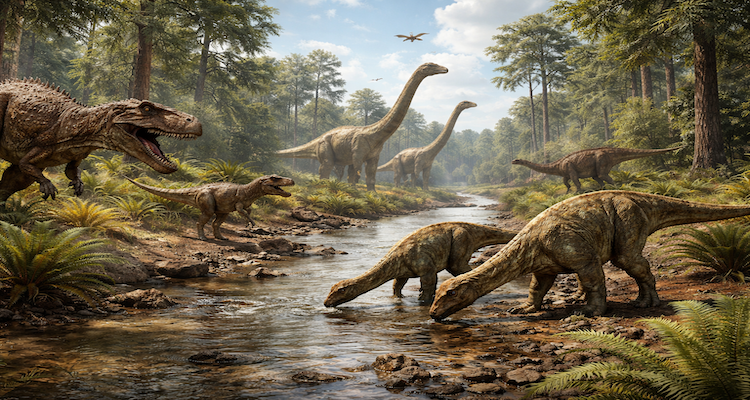
Drawing from one of North America’s richest dinosaur fossil sites, researchers have reconstructed a remarkably detailed Jurassic food web, revealing how survival often hinged on size, timing, and opportunity. The findings shed new light on predator behavior and ecosystem balance 150 million years ago.
A Fossil Site That Captured an Entire Ecosystem
The study centers on the Dry Mesa Dinosaur Quarry in southwestern Colorado, a fossil deposit formed during a severe prehistoric drought. This rare event preserved an unusually wide snapshot of life—from tiny reptiles to massive dinosaurs, within a single ecosystem.
According to the research, Dry Mesa was home to at least six species of sauropods and five major types of meat-eating dinosaurs. The area also supported other herbivorous dinosaurs, flying pterosaurs, early mammals, crocodilians, fish, insects, and small reptiles.
Because drought conditions concentrated animals around dwindling water sources, the site offers scientists a unique opportunity to reconstruct who lived together, and who fed on whom.
Giants at the Center of the Food Web
Sauropods dominated this Jurassic landscape. These long-necked, four-legged plant-eaters included some of the largest animals in Earth’s history, such as Brachiosaurus, Diplodocus, Apatosaurus, Supersaurus, Camarasaurus, and Haplocanthosaurus.
Adult sauropods relied on sheer size, long tails, and herd behavior for defense. A single tail swing from a healthy adult could seriously injure or kill a predator. As a result, hunting a fully grown sauropod would have been an extremely risky gamble, even for the largest carnivores.
But while adults were nearly untouchable, their offspring were another matter entirely.
Why Sauropod Babies Were Easy Targets
Despite their enormous adult size, sauropods began life surprisingly small. Hatchlings emerged from eggs roughly the size of a football and required many years to reach maturity. Fossil evidence suggests these young dinosaurs received little to no parental protection.
That vulnerability made them a reliable food source.
Researchers concluded that juvenile sauropods were abundant, slow-moving, and largely defenseless, ideal prey for predators at the top of the food chain. Their lack of armor, spikes, or protective plates set them apart from other herbivores like Stegosaurus, whose spiked tail could be lethal.
As a result, baby sauropods became the backbone of the carnivore diet in this ecosystem.
The Hunters of Dry Mesa
The Dry Mesa food web included an impressive lineup of predators. The largest were Torvosaurus, stretching roughly 30 feet, and Allosaurus, measuring about 26 feet. Other carnivores included Ceratosaurus, Marshosaurus, and the smaller Stokesosaurus.
Even these formidable hunters faced serious risks when targeting large prey. A misplaced step or defensive blow from an adult sauropod could prove fatal. Because of that danger, predators likely prioritized safer options, young individuals, sick or injured animals, those trapped in mud, or carcasses left behind by droughts or floods.
Whether large theropods hunted cooperatively remains debated, but researchers note that bringing down a healthy adult sauropod would have required extraordinary coordination and luck.
How Scientists Rebuilt a Jurassic Food Web
To reconstruct this ancient ecosystem, researchers combined multiple lines of evidence. Chemical signatures preserved in tooth enamel helped identify dietary patterns, while microscopic scratches on teeth revealed what types of food animals consumed.
Biomechanical models provided insight into hunting and feeding capabilities, and rare fossilized stomach contents offered direct clues about predator diets.
This multi-layered approach allowed scientists to map more than 12,000 unique food chains, highlighting a deeply interconnected system rather than a simple predator-prey hierarchy.
Expert Insight: Size Was Everything Eventually
Paleontologist Cassius Morrison of University College London, the study’s lead author, explained that juvenile sauropods occupied a critical ecological role precisely because they hadn’t yet reached their massive adult size.
Ecologist Steven Allain of Anglia Ruskin University, a co-author of the study, emphasized that adult sauropods depended on size and group behavior for protection, defenses that took years to develop. Until then, young individuals remained exposed to constant danger.
Together, the findings underscore how growth stages, not just species, shaped survival in prehistoric ecosystems.
A Landscape Built for Life and Loss
During the Jurassic Period, the Dry Mesa region was dominated by open woodlands filled with conifers, cycads, ferns, and horsetails. Rivers and shallow ponds supported dense plant growth but periodically dried out, creating harsh conditions that concentrated animals and increased competition.
These environmental pressures played a major role in shaping feeding behavior, making juvenile prey and scavenging essential survival strategies for large predators.
Why This Research Matters Today
Beyond dinosaurs, the study offers broader insights into how ecosystems function under stress. It shows how vulnerability at early life stages can influence entire food webs and how predators adapt their strategies to minimize risk.
Understanding these dynamics helps scientists better interpret fossil records and improves modern ecological models, particularly those involving large herbivores and apex predators.
Looking Back to Understand Ancient Balance
The Dry Mesa food web reveals a Jurassic world far more complex than once imagined, one where even the largest animals began life as prey, and survival depended on timing as much as strength.
By piecing together chemical traces, fossils, and biomechanics, researchers have brought clarity to a long-standing mystery: how predators thrived alongside giants they could never safely challenge.
(With inputs from a Reuters report.)
ALSO READ: Ancient Galaxy Cluster Challenges Timeline of the Universe
This content is published for informational or entertainment purposes. Facts, opinions, or references may evolve over time, and readers are encouraged to verify details from reliable sources.