










When the World’s Brightest Reactor Went Dark for One Second
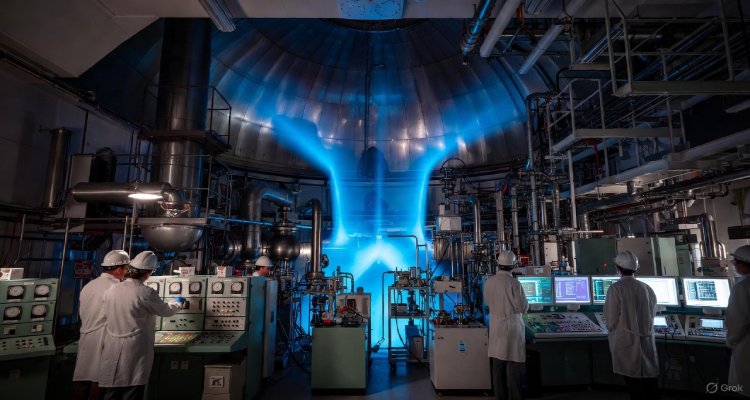
A split-second shutdown at the world’s brightest research reactor sparks global concern and curiosity. Here’s what happened and why it matters for science.
1. Introduction (Hook)
For exactly one second, the brightest research reactor on Earth—known for generating neutron beams intense enough to map the hidden architecture of matter—fell silent. It was a blink in cosmic time, yet long enough to send a ripple of unease through labs, security agencies, and scientific institutions worldwide. In a field where precision is everything, a one-second blackout can feel like an eternity.
2. Context & Background
High-flux research reactors sit at the heart of modern scientific discovery. They illuminate materials at the atomic scale, test components for spacecraft, and even help develop life-saving medical isotopes. The reactor in question—long celebrated as the brightest for its unprecedented neutron output—has been a pillar of international research collaboration.
These facilities are designed with layers of redundancy: fail-safe systems, automatic shutdown protocols, and constant surveillance. Sudden interruptions are uncommon and usually point to mechanical anomalies, power inconsistencies, or safety triggers responding to unusual readings. But this reactor had a reputation for near-perfect stability, making its sudden one-second disappearance even more intriguing.
3. Main Developments: What Happened and Why It Matters
According to early reports and internal briefings reviewed by investigators, the reactor’s sensors detected a “non-specific irregularity” in its coolant flow metrics—just enough to activate an automatic SCRAM, the emergency shutdown sequence used to protect nuclear cores. Within milliseconds, neutron production dropped to zero. One second later, as diagnostics cleared, the systems rebooted and resumed full power.
Technically, the event posed no safety hazard. The shutdown occurred exactly as engineers designed it to. But the abruptness and fleeting duration raised a larger question: What kind of anomaly lasts less than a second yet triggers one of the most sensitive safety systems in the world?
Some analysts point to micro-vibrations in the coolant pumps, a known challenge in high-flux environments. Others suggest a transient power synchronization issue between the grid and the reactor’s internal stabilizers. A few researchers quietly wonder whether the detection system overreacted, responding to a signal artifact instead of an actual problem.
What elevates the moment from routine glitch to global headline is not the one-second blackout itself—but how integral this reactor is to major scientific projects. Experiments running inside the beamline were interrupted mid-stream: quantum materials research, protein crystallography, and nuclear fusion modeling. For scientists who wait months to secure beam time, a one-second break can ruin thousands of hours of preparation.
4. Expert Insight & Public Reaction
Dr. Elena Markovic, a nuclear systems engineer and former reactor safety reviewer, provided context:
“A one-second shutdown doesn’t indicate danger. What matters is why the detection thresholds were crossed. Reactors this advanced don’t sneeze—they signal.”
Others in the scientific community expressed more frustration than fear. Social media lit up with researchers posting images of interrupted experiments, jokes about “the world’s shortest reactor vacation,” and concern about scheduling delays.
Still, watchdog groups monitoring global nuclear infrastructure urged caution.
“Even split-second anomalies deserve full transparency,” said Victor Hale of the Global Reactor Oversight Forum. “We rely on these facilities not only for research but for international trust.”
Local communities near the reactor stayed calm—largely because no alarms sounded and safety teams quickly confirmed that radiation levels remained stable throughout.
5. Impact & Implications: What Happens Next?
A full technical audit is now underway. Investigators are focusing on a trio of possibilities:
• Sensor Interference
High-precision neutron detectors can, ironically, be too sensitive. A micro-disturbance or electrical echo may have tripped a false threshold.
• Coolant Flow Transient
Even a millisecond-scale turbulence inside the primary coolant loop can trigger automated protection systems. Engineers are analyzing pump logs for signs of vibration spikes.
• Control System Glitch
Cybersecurity teams are examining logs to rule out malicious interference, although no evidence currently suggests foul play.
The implications stretch beyond a single reactor. High-flux facilities around the world may revisit their detection thresholds, update redundancy systems, or adopt more sophisticated filtering to distinguish real anomalies from digital noise.
For researchers, the outage—while brief—will likely shift experiment timelines and potentially reshape grant-sponsored projects that depend on uninterrupted neutron exposure.
For the nuclear science community, the event serves as a reminder that even the most advanced reactors are not immune to the unpredictable physics they harness.
Conclusion
In the grand scheme of nuclear history, a one-second shutdown is barely a footnote. Yet this moment at the world’s brightest reactor has ignited a deeper reflection on the delicate balance between cutting-edge research and absolute safety.
Reactors are marvels of engineering—precise, powerful, and essential to modern science. But they are also systems defined by their sensitivity. A single second proved enough to remind the world how much depends on their steady glow.
As the investigation unfolds, one fact remains clear: in nuclear science, even a momentary flicker can illuminate far more than darkness.
Disclaimer :This article is an original, journalistic interpretation created for informational purposes only. It does not reflect classified data, internal reactor reports, or proprietary scientific findings.