








Trump’s ‘Board of Peace’ Plan Divides U.S. Allies, U.N.
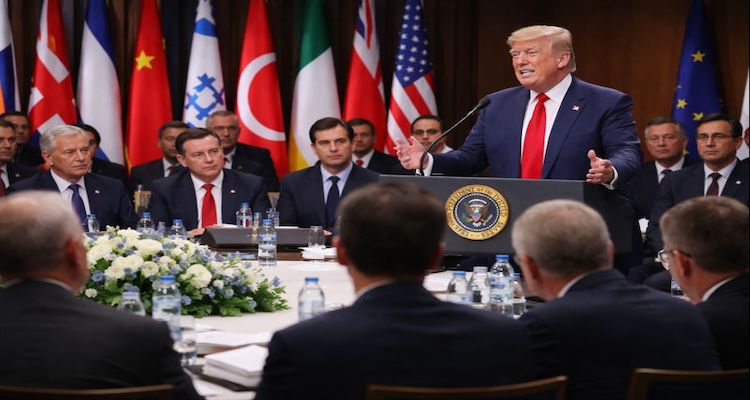
U.S. President Donald Trump is pitching a new global peace initiative that could reshape how conflicts are negotiated on the world stage. But while several countries have signed on, diplomats warn the plan may weaken the United Nations and deepen existing geopolitical fault lines.
According to a Reuters report, Trump’s proposed “Board of Peace” is already drawing sharp, uneven reactions especially among America’s closest allies.
What Trump’s “Board of Peace” Is Meant to Do
Trump first introduced the idea of a Board of Peace in September while outlining a plan to end the war in Gaza. He later clarified that the initiative would not be limited to Gaza.
Instead, the board would expand into a broader mechanism aimed at addressing conflicts across the globe.
A draft charter reviewed by Reuters describes the Board of Peace as a body tasked with promoting peace worldwide and helping resolve international disputes. Trump would serve as the first chairman.
A Charter That Raises Eyebrows
One of the most debated elements is how membership would work.
Under the draft charter, countries would typically be allowed to serve three-year terms. However, there is an exception that has sparked controversy: nations could secure permanent membership by paying $1 billion each to fund the board’s operations.
Diplomats cited by Reuters have expressed concern that such a structure could blur the line between diplomacy and pay-to-play influence.
Who Will Run It: The Executive Board Picks
The White House has already named a founding Executive Board, giving the initiative a recognizable power structure.
According to Reuters, those listed include:
-
U.S. Secretary of State Marco Rubio
-
Trump’s special envoy Steve Witkoff
-
Former UK Prime Minister Tony Blair
-
Jared Kushner, Trump’s son-in-law
The lineup signals that the project is being built around figures with deep experience in high-level negotiations, alongside political allies with strong access to Trump’s inner circle.
Which Countries Have Joined So Far?
Steve Witkoff said up to 25 countries have already accepted the invitation to join.
Those who have agreed include several U.S. partners in the Middle East:
-
Israel
-
United Arab Emirates
-
Bahrain
-
Egypt
Two NATO members Turkey and Hungary have also accepted. Reuters noted both countries are led by nationalist leaders who have cultivated strong personal relationships with Trump.
Armenia and Azerbaijan: A Rare Case of Shared Support
Two other notable sign-ons are Armenia and Azerbaijan, countries with a long history of tension.
Reuters reported that both accepted after reaching a U.S.-brokered peace agreement last August, following meetings with Trump at the White House.
Their participation is being watched closely because it offers the Board of Peace an early example of countries with deep disputes still choosing to engage under the new framework.
Belarus Joins, Adding a New Layer of Controversy
One of the most politically sensitive acceptances has come from Belarusian President Alexander Lukashenko.
Lukashenko has been widely shunned by Western governments due to Belarus’ human rights record and its backing of Russia’s war in Ukraine. Yet Reuters reported he has accepted Trump’s invitation.
That move comes as Washington and Minsk appear to be moving toward a broader thaw in relations an unexpected shift that could complicate how the board is viewed in Europe.
Russia and China Haven’t Signed On-Yet
Two of the most powerful global players are still undecided: Russia and China.
Reuters noted that Russia has not confirmed whether it will join, even as U.S.-Russia relations have warmed significantly under Trump’s outreach to President Vladimir Putin. Trump has also accused Kyiv of obstructing efforts to end the war.
China, meanwhile, has also not announced a decision. The country has frequently clashed with Trump in the past, though it recently reached a fragile trade truce with Washington.
Both Russia and China are historically strong supporters of the United Nations and hold veto power on the U.N. Security Council, making them likely to tread carefully around any initiative that appears to compete with the world body.
Trump’s U.N. Comments Add to the Debate
Trump has long criticized the United Nations as ineffective, which is one reason diplomats are questioning the Board of Peace’s real intent.
Still, Reuters reported that Trump downplayed fears that he wants the board to replace the U.N., saying:
He believes the U.N. should continue because “the potential is so great.”
That message appears aimed at calming international concerns, even as critics argue the board could create a parallel system of influence.
Who Has Refused-or Is Hesitating?
While some countries have joined quickly, several traditional U.S. allies have responded cautiously.
Reuters reported that:
-
Norway and Sweden have declined the invitation.
-
Italy’s Economy Minister Giancarlo Giorgetti said joining looked problematic.
-
Italian newspaper Il Corriere della Sera reported that joining a group led by a single foreign leader could violate Italy’s constitution.
France is also expected to say no. A source close to President Emmanuel Macron told Reuters that Paris intends to decline.
That refusal has already triggered friction. Trump reportedly threatened 200% tariffs on French wines and champagnes unless France joins the board an escalation that ties diplomacy directly to economic pressure.
Canada, Britain, Germany, Japan: Waiting for Clarity
Some U.S. partners have not shut the door, but they also aren’t fully committing.
Canada has agreed “in principle” to join, according to Reuters, but said the details still need to be finalized.
Other key allies including Britain, Germany, and Japan have not taken a clear public position so far.
A German government spokesperson said Chancellor Friedrich Merz would not attend a signing ceremony for the board at the World Economic Forum in Davos, signaling distance even without an outright rejection.
Ukraine’s Dilemma: Diplomacy Meets Reality
Ukraine has said its diplomats are reviewing the invitation, but President Volodymyr Zelenskiy has openly questioned the idea of sharing any forum with Russia.
After four years of war, Zelenskiy said it is difficult to imagine sitting on a board that includes Moscow.
The issue highlights a central challenge for Trump’s proposal: it may be easier to build a table than to persuade enemies especially active wartime rivals to sit at it together.
What Power Would the Board Actually Have?
One of the biggest unanswered questions is authority.
Reuters reported that it remains unclear what legal force the Board of Peace would carry, how it would enforce outcomes, or how it would coordinate with existing institutions like the United Nations.
The draft charter states the board would perform “peace-building functions” in line with international law.
However, it also gives Trump, as chairman, significant executive powers such as the ability to veto decisions and remove members, though with some limits.
For diplomats, this structure raises concerns about whether the board is designed as a multilateral forum or a centralized tool controlled by Washington.
A Second Body: The Gaza Executive Board
The White House has also announced a separate Gaza Executive Board, designed to support a transitional Palestinian administration in Gaza.
Reuters noted that it is not yet clear how the founding Executive Board and the Gaza Executive Board will operate in practice, particularly since some members overlap.
This dual-board setup adds complexity and could invite confusion about where decision-making power truly sits.
Expert and Diplomatic Reaction: U.N. Concerns Take Center Stage
Diplomats cited by Reuters have warned that Trump’s initiative could disrupt the work of the United Nations rather than complement it.
Their concern is not only political, but structural: the U.N. already has established frameworks for peacekeeping, mediation, and conflict resolution. A competing platform especially one shaped by membership payments and unilateral executive control could pull attention and legitimacy away from existing processes.
At the same time, the early participation of countries across the Middle East, parts of Europe, and the Caucasus shows the proposal is not being dismissed outright.
Impact Analysis: What This Could Change
If the Board of Peace continues gaining members, it could create a new diplomatic lane that runs alongside the U.N. system.
For Trump, it offers a way to frame U.S. influence as direct, results-driven conflict management particularly in regions where Washington already plays a major role.
But the risks are equally clear:
-
Allied unity could weaken, especially if European countries view the board as politically coercive.
-
U.N. legitimacy could be tested if negotiations shift into a competing structure.
-
Conflict diplomacy could become more personalized, driven by leadership relationships rather than institutions.
-
Funding-based membership rules could raise ethical and governance concerns.
The biggest question may be whether the board becomes a serious peace mechanism or a symbolic project that intensifies geopolitical divisions.
A Peace Pitch That’s Also a Power Test
Trump’s Board of Peace is being marketed as a bold alternative to stalled diplomacy. Yet its design, leadership structure, and uneven reception suggest it could become as controversial as the conflicts it aims to address.
With dozens of countries weighing participation and major powers still undecided the initiative is quickly turning into a test of global trust: not just in Trump’s approach, but in the future shape of international problem-solving itself.
(With inputs from Reuters.)
ALSO READ: Australia’s Gun Count Hits Record High After Bondi Attack
Disclaimer:
The information presented in this article is based on publicly available sources, reports, and factual material available at the time of publication. While efforts are made to ensure accuracy, details may change as new information emerges. The content is provided for general informational purposes only, and readers are advised to verify facts independently where necessary.