








The Startup Building Tools for a World That Doesn’t Exist Yet
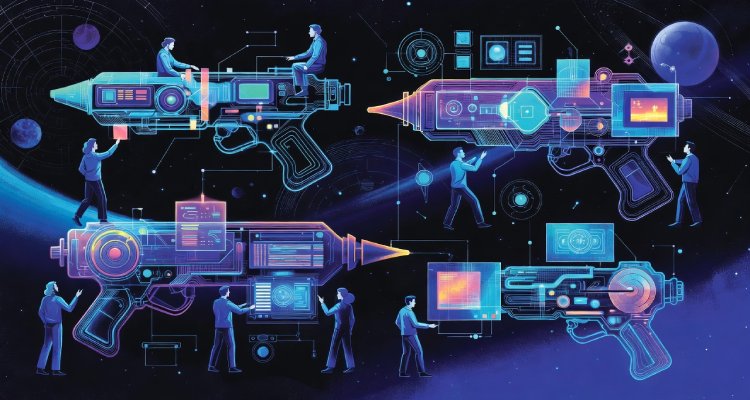
A new generation of startups is building tools for a future that hasn’t arrived yet—designed for adaptability, uncertainty, and long-term change.
Introduction: Designing for Tomorrow’s Unknowns
Most startups chase existing markets. A rare few chase futures that haven’t fully arrived. Somewhere between speculative science, practical engineering, and quiet optimism sits a new breed of startup—one building tools not for today’s problems, but for a world that does not yet exist.
These companies are not reacting to demand; they are anticipating it. They are designing platforms, systems, and frameworks for realities shaped by artificial intelligence, climate disruption, space expansion, decentralized economies, and digital identities still taking form. Their work raises a provocative question: Can you build for a future you cannot yet clearly see?
Context & Background: Why Future-First Startups Are Emerging Now
The rise of future-oriented startups is not accidental. It is a response to a world where technological change now outpaces social, legal, and institutional adaptation.
Over the past decade, innovations such as large-scale AI models, synthetic biology, immersive virtual environments, and quantum computing have evolved faster than the systems meant to govern or integrate them. Traditional software tools—built for stable assumptions—struggle to keep up.
At the same time, global uncertainty has become the norm. Climate volatility, geopolitical fragmentation, and rapid demographic shifts have made long-term planning harder, not easier. In this environment, some founders are choosing a counterintuitive strategy: build flexible tools meant to adapt to multiple futures rather than optimize for a single present.
These startups operate at the intersection of foresight and functionality, borrowing ideas from futurism, systems thinking, and speculative design while remaining grounded in real-world engineering.
Main Developments: What These Startups Are Building—and Why It Matters
The tools being built for a “world that doesn’t exist yet” are less about prediction and more about preparedness. Instead of betting on one future, these platforms aim to remain useful across many possible outcomes.
1. Infrastructure for Uncertain Systems
Some startups are developing modular digital infrastructure that can evolve as rules, markets, and technologies change. This includes adaptable data architectures, governance-agnostic platforms, and software that can operate across centralized and decentralized environments.
Rather than locking users into rigid workflows, these systems emphasize interoperability, resilience, and long-term adaptability.
2. Tools for Human–Machine Collaboration
As artificial intelligence becomes less of a tool and more of a collaborator, startups are designing interfaces that allow humans to work with intelligent systems rather than merely instruct them.
These platforms focus on explainability, shared decision-making, and ethical oversight—acknowledging that future workplaces may involve continuous negotiation between human judgment and machine reasoning.
3. Planning for Post-Industrial Challenges
Some ventures are tackling problems that barely register in today’s markets but loom large on the horizon—such as managing digital identity across virtual worlds, coordinating climate migration, or organizing labor in automated economies.
Their products often resemble toolkits rather than finished solutions, allowing future users to define rules and norms that do not yet exist.
Expert Insight: Building Without a Map
Technology analysts describe this approach as a shift from solution-driven innovation to capability-driven innovation.
“The most valuable tools of the next decade won’t solve one problem,” says a systems design researcher familiar with future-focused startups. “They’ll help societies respond to problems we can’t fully articulate yet.”
Investors, too, are beginning to recognize the strategic value of such companies—not necessarily for immediate returns, but for long-term optionality. While risky, these startups may become foundational layers once emerging realities solidify.
Public reaction, however, is mixed. Some see future-first startups as visionary. Others criticize them as abstract or disconnected from present needs. Yet history suggests that many of today’s essential technologies—from the internet to GPS—began as solutions in search of a world ready to use them.
Impact & Implications: Who Benefits—and What Comes Next
If successful, startups building tools for an unrealized future could influence how societies adapt to change itself.
For Businesses
Companies may gain tools that allow them to pivot faster as regulations, technologies, and markets evolve—reducing the cost of being wrong about the future.
For Governments and Institutions
Flexible platforms could help policymakers experiment safely, test scenarios, and respond to emerging crises without rewriting systems from scratch.
For Individuals
These tools may eventually shape how people work, learn, and define identity in environments that blur physical and digital boundaries.
The greatest risk lies in misalignment—building tools that anticipate futures that never arrive. Yet proponents argue that adaptability itself is the hedge.
Conclusion: Preparing for the Unknown, One Tool at a Time
Building for a world that doesn’t exist yet requires humility as much as ambition. These startups are not claiming to know the future. Instead, they are acknowledging uncertainty as a permanent condition—and designing accordingly.
In doing so, they challenge a fundamental assumption of modern innovation: that success depends on predicting what comes next. In an age of accelerating change, the startups that endure may be those that build not for certainty, but for possibility.
The future, after all, rarely arrives exactly as expected. The tools that matter most may be the ones flexible enough to meet it anyway.
The information presented in this article is based on publicly available sources, reports, and factual material available at the time of publication. While efforts are made to ensure accuracy, details may change as new information emerges. The content is provided for general informational purposes only, and readers are advised to verify facts independently where necessary.