










The Server Rooms Where Clocks Never Agree on Time
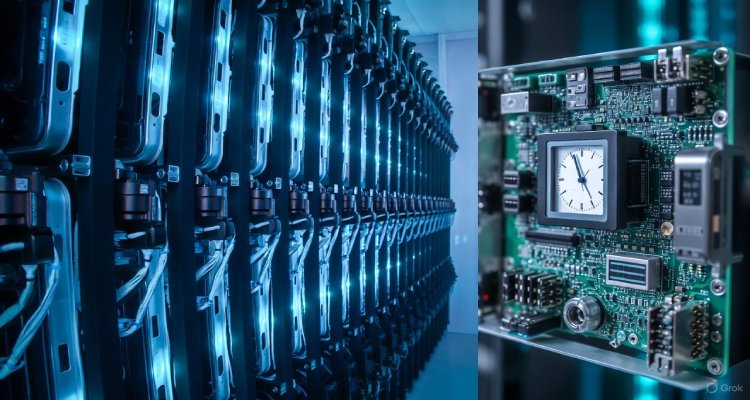
Inside data centers worldwide, a hidden crisis unfolds: server clocks drift out of sync, threatening financial systems, AI accuracy, and global digital stability.
The Server Rooms Where Clocks Never Agree on Time
1. Introduction (Hook)
In the chilled silence of a modern data center—where tens of thousands of machines hum in perfect mechanical rhythm—there is one thing that rarely aligns: time.
Despite blinking LEDs and redundant power systems built to avoid even a millisecond of downtime, server clocks inside these massive facilities drift, disagree, and sometimes fall entirely out of sync. And in a digital world where nanoseconds determine trades, transactions, and trust, the smallest disagreement becomes a hidden but growing risk.
Welcome to the server rooms where no two clocks truly match—an invisible problem with very real consequences.
2. Context & Background
Timekeeping inside computers might seem trivial, but it is one of the most fragile parts of global infrastructure.
Most servers rely on internal oscillators—tiny quartz components that gain or lose milliseconds every hour depending on temperature, age, and hardware stress.
While protocols like NTP (Network Time Protocol) and the more modern PTP (Precision Time Protocol) attempt to sync millions of machines, perfect alignment is almost impossible.
Reasons include:
- Network delays: A timestamp sent across the internet might arrive tens of milliseconds late.
- Hardware inconsistencies: Each server’s internal clock ages differently.
- Geographical spread: Cloud networks run across continents, under oceans, and through satellites.
- Security restrictions: Some critical systems don’t allow external time sources for fear of spoofing attacks.
As a result, every major tech company—from stock exchange servers to cloud giants—fights a constant, silent battle to keep their machines on the same second.
3. Main Developments: Why It Matters and Its Impact
Clock drift isn’t just a technical nuisance. Once timestamps fall out of sync, the consequences ripple across industries:
Financial Systems
A few milliseconds can reorder buy-and-sell transactions worth billions. When clocks disagree, trades can be misinterpreted or reversed—threatening market stability.
Cybersecurity
Security logs rely on precise timestamps. If server clocks drift:
- Intrusion timelines become inaccurate
- Authentication tokens expire too early or too late
- Attackers exploit timestamp gaps to mask malicious activity
Clock drift has even been linked to failed security audits and incorrect forensic reports during major breaches.
Cloud Computing & AI
Distributed AI systems depend on synchronized time to train models correctly.
Inconsistent timestamps can:
- Create duplicate or missing data entries
- Break event ordering in large-scale systems
- Affect time-sensitive simulations like weather forecasting
When billions of data points arrive even slightly out of order, machine learning models lose accuracy.
Consumer Impact
Most people never notice, but clock drift affects daily life:
- Video calls that lag or desync
- Incorrect timestamps on messages
- Backup systems that fail to trigger
- Location apps that rely on time signals to calculate movement
Digital life runs on time—and even small irregularities create friction.
4. Expert Insight or Public Reaction
“Perfect time doesn’t exist in computing. What exists is ‘close enough,’ and even that is getting harder,” says Priya Menon, a systems reliability engineer who manages multi-region cloud clusters.
Menon explains that today’s distributed infrastructure is too large for traditional synchronization methods. Even with atomic clocks, GPS signals, and advanced time servers, discrepancies emerge daily.
Meanwhile, cybersecurity analysts warn that clock drift is becoming a target for attackers.
“If you control time, you control the system,” says Alan Ruiz, a network security researcher.
Manipulating timestamps can let attackers bypass logs, confuse authentication, or mislead monitoring tools.
Across developer forums and data-center Reddit threads, engineers describe time drift as “the bug you can’t patch” and “the ghost in the server room.”
It’s a problem no one owns, yet everyone must manage.
5. Impact & Implications: What Happens Next?
The Push for Atomic-Clock-Level Precision
Tech companies are investing in ultra-precise time infrastructure:
- Data centers installing local atomic clocks
- GPS-independent time delivery networks
- AI-driven prediction systems that correct drift before it happens
A growing industry—“Time as a Service”—is emerging, offering microsecond-accurate timestamps for financial, scientific, and industrial use.
Regulatory Shifts
Governments are drafting rules that require exact time synchronization for:
- High-frequency trading
- Power grid operations
- Aircraft tracking
- Health and medical device data
In Europe, financial firms must log events in microseconds, or face penalties.
The Bigger Question
As systems grow more distributed—from cloud computing to autonomous vehicles—will synchronized time become the new foundation of global stability?
Because if machines can’t agree on the time, they can’t agree on anything else.
Conclusion
In the world’s most advanced server rooms, time has never been stable.
It drifts, slips, disagrees—and demands constant oversight.
As digital ecosystems grow more complex, perfect time synchronization becomes both critical and elusive.
The future may bring atomic-level accuracy or new protocols, but for now, every server room lives with the same reality:
even in the most controlled environments, the clocks refuse to agree.
Disclaimer :This article is for informational purposes only. It does not offer financial, technical, or cybersecurity advice. All analysis reflects general industry knowledge and publicly observable trends.